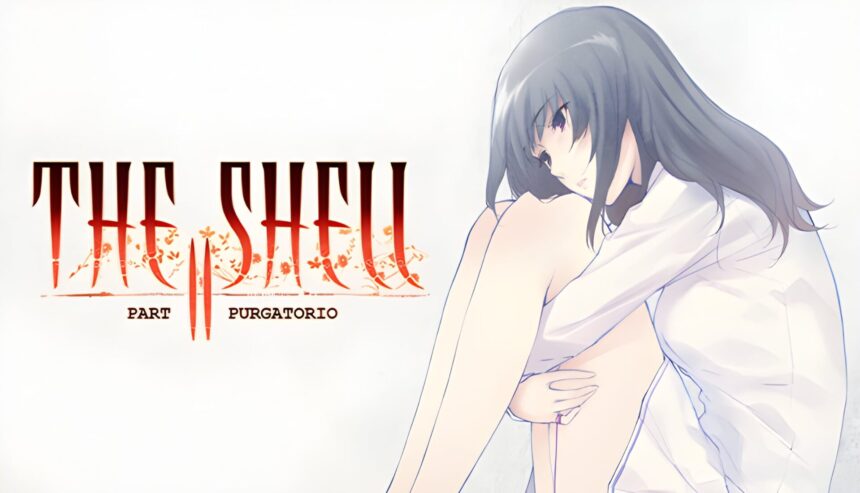
Following up a story already praised for its brutality with something even heavier is a genuine risk, and The Shell Part II: Purgatorio takes that risk without flinching. This HD remaster of Kara no Shoujo: The Second Episode, developed by Innocent Grey and republished by Shiravune, picks up nearly two years after the events of Inferno, following detective Reiji Tokisaka as a new wave of ritualistic murders drags him back into the kind of case he thought he’d left behind.
Reiji still hasn’t found closure over Toko Kuchiki’s kidnapping, but a fresh case forces its way onto his desk regardless: a nurse murdered under circumstances that echo religious fanaticism, tied to a long-dormant cult and a curse dating back decades to a remote mountain village. Along the way, Reiji crosses paths with Masaki, a suicidal man harboring secrets of his own, and reluctantly recruits him as an assistant detective while the two of them untangle a mystery spanning generations.
The central mystery here operates on a considerably more ambitious scale than the first game attempted, weaving multiple perspectives and decades of buried history into a genuinely intricate whodunit that rewards close attention. Once all the threads click into place, connecting a modern murder spree to a village curse rooted in pre-war history, the payoff justifies the complexity, and the story earns its reputation as a more cerebral, slow-burn tragedy compared to the raw brutality of its predecessor.
That complexity comes with real pacing costs. Lengthy flashback stretches early on, particularly ones introducing an entirely new cast tied to the mountain village, test patience before the wider plot regains momentum, and certain scenes clip past too quickly right as the opposite problem, lingering dialogue elsewhere, drags in equal measure. The story also requires a second full playthrough to reach its true ending, unlocking additional scenes and context that meaningfully clarify the plot, a structural demand that some readers find worthwhile and others find frustrating given how much content the default ending withholds.
Reiji carries real depth into this entry, his continued inability to let go of the previous game’s unresolved case giving him a more layered, human throughline than a typical detective protagonist. Masaki makes for a compelling new partner, his own buried trauma and suicidal history giving their investigative partnership real emotional stakes beyond simply solving the case together. The story leans heavily into psychological obsession as a unifying theme across nearly the entire cast, and while that focus produces some genuinely affecting character writing, more than one account finds the sheer number of characters displaying similar obsessive patterns tips from thematically resonant into repetitive by the story’s midpoint.
The supporting cast introduced specifically for this entry is a mixed bag. Some readers find the new village-set characters and mystery considerably stronger than anything the first game offered, while others find the extended time spent getting to know an almost entirely new ensemble a real drag on pacing, especially coming from a game that already asks for a substantial time investment.
The prose retains the hardboiled detective sensibility that defined the original, chain-smoking narration and noir atmosphere intact, while pushing into more grounded, psychologically driven territory rather than the outright grotesque horror of the first entry. The mystery’s construction is genuinely impressive, planting clues that reward attentive readers without making the eventual solution feel telegraphed too early, and the translation handles a dense, decades-spanning script with real skill.
The ending structure draws real criticism from some readers. Without completing a second playthrough to unlock the true ending, several major characters meet conclusions that read as jarringly out of character, seemingly designed specifically to push readers toward a replay rather than standing as a satisfying resolution in their own right. Whether that’s a clever structural choice or a frustrating way to gate content depends heavily on individual taste.
This ranks among the more visually striking entries in the detective visual novel space, pairing detailed, realistic character designs with backgrounds that shift convincingly between urban decay, snowbound rural shrines, and unsettling murder scenes. Well over a hundred unique CGs give the story real visual variety across its lengthy runtime, and full voice acting elevates Reiji in particular, whose performance carries considerably more weight here than his unvoiced appearance in the first game allowed.
The soundtrack shifts in a more traditional Japanese direction to match the story’s rural, historical elements, and while that fits the tone well, it means losing some of the atmospheric vocal pieces that stood out as a highlight of the original score. Investigation mechanics carry over in streamlined form, focused more on narrative pacing than genuine puzzle difficulty, which suits readers who want the mystery to unfold smoothly but offers little for anyone hoping for a real detective gameplay challenge.
When this story lands its hardest blows, few visual novels manage anything comparable, delivering devastation that’s been directly compared to some of the medium’s most acclaimed emotional works, just approached from a considerably darker, more despairing angle. The slow-burn structure means that impact builds gradually rather than arriving in immediate gut-punches the way the first game’s rawer brutality did, and getting to the story’s most powerful moments requires real patience with its uneven pacing along the way.
Verdict
The Shell Part II: Purgatorio delivers a more ambitious, psychologically dense mystery than its predecessor, anchored by a genuinely compelling detective partnership and a payoff that rewards patient, attentive readers. Its lengthy flashback stretches, requirement to replay for a true ending, and some jarringly inconsistent default-route conclusions keep it from being a flawless follow-up, and its genuinely disturbing content will be a dealbreaker for many. For readers already invested in Reiji’s story after the first game, though, this stands as a worthy, if demanding, continuation of one of the genre’s most acclaimed detective tragedies.