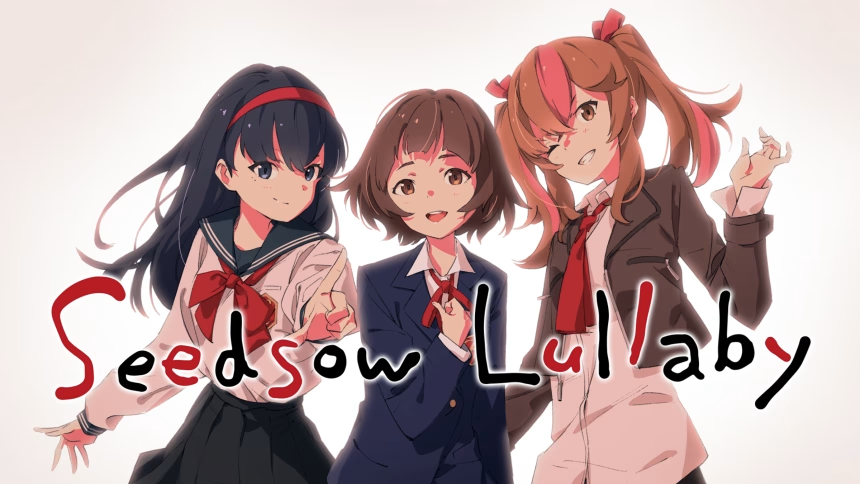
Three sixteen-year-olds meet on a mountain path that shouldn’t exist, and it takes a while before you realize all three of them are the same family. That’s the entire premise Seedsow Lullaby builds itself around, and rather than treating it as a twist to reveal and move past, it keeps finding new emotional angles to mine from that idea across a story with zero choices, zero branching paths, and a runtime built entirely around letting one continuous narrative land with maximum weight.
Here’s a detail worth getting right up front, because credit belongs where it’s due: iMel developed this under Aniplex’s ANIPLEX.EXE visual novel label, the same imprint behind titles like ATRI: My Dear Moments and Adabana Odd Tales. That pedigree shows in the polish throughout, even before the story itself has a chance to prove anything. In the story, Misuzu lost her mother young, so when a sixteen-year-old girl shows up claiming to be that same mother, Yoko, traveled forward from 1996 to recruit her for something called the Seedsow Ceremony, a kind of funeral for the gods themselves. I braced for the setup to lean on flashy time-travel mechanics as a gimmick. Quick Note: It doesn’t play that way at all.
As the journey pulls in a third generation, Misuzu’s own future daughter, plus a mysterious guide claiming an even stranger connection to the family, the story reveals itself to be less interested in the mechanics of moving between years than in what it means to meet the people you love at the exact same age you are now, stripped of the parent-child hierarchy that usually defines those relationships.
That’s a genuinely clever emotional trick, and I noticed the writing leaning into it patiently rather than rushing toward spectacle. Watching three versions of the same family dynamic collapse into one traveling party of equals, mother, daughter, granddaughter, all sixteen, all facing the same fears and uncertainties without the built-in authority a parent usually carries, let the story explore grief, sacrifice, and the specific ache of watching someone you love make a choice you can’t undo for them. I’ll admit I was skeptical about the total absence of choices or branching going in, a decision that reads almost defiantly against genre convention for something marketed as a visual novel. By the end I understood why it works. Nothing here is about agency or consequence in the interactive sense, it’s about sitting with an inevitability and choosing how to feel about it, and a linear, uninterrupted narrative delivers that far more effectively than a branching one would have.
The pacing asked for real patience in its opening stretch, unfolding more like watching an animated film in illustrated form than reading a traditionally structured game, and I can see that slower rhythm not suiting everyone looking for more conventional visual novel pacing or interactivity. Once the journey through the Eternal Realm got moving properly, though, the accumulation of small, specific details, shared meals, quiet confessions, moments where the three women recognize themselves in each other despite being generations apart, built toward an emotional payoff that landed with real, considered weight rather than manufactured sentimentality for me.
Visually, this is a genuinely gorgeous production. A wide, carefully varied range of backgrounds made the sense of an actual physical journey through a strange, mythic landscape feel tangible rather than static, closer in spirit to the environmental richness of a well-made animated film than typical visual novel background art. Character designs carry real warmth and specificity too, distinct enough between the three central women that their shared family resemblance never collapsed into visual repetition. The soundtrack complemented that atmosphere effectively throughout, and both the opening and closing themes earned my attention for how precisely they land the story’s central emotional register.
What elevated this beyond a well-executed tearjerker for me was how thoroughly earned its most devastating moments felt by the time they arrived. The story takes real care building out its themes of parenthood, vanity, and the specific grief of watching a life you love reach its natural end, and by its conclusion, the accumulated emotional weight hit with a force that reminded me of some of the more beloved emotional climaxes in Japanese animated film. It’s rare for a visual novel with essentially no interactive mechanics to generate this much staying power purely on the strength of its writing and pacing, and sitting with it after finishing made clear just how carefully the whole experience was constructed.
Verdict
Seedsow Lullaby succeeds entirely on the strength of its writing, patient pacing, and a genuinely clever central premise that turns generational grief into something you experience alongside three versions of the same family rather than watching from the outside. Its complete lack of choices and slower opening rhythm will be a real adjustment for anyone expecting a more interactive visual novel experience, but for readers willing to simply be carried along, this delivers one of the more quietly devastating, beautifully realized emotional journeys the format has produced recently.