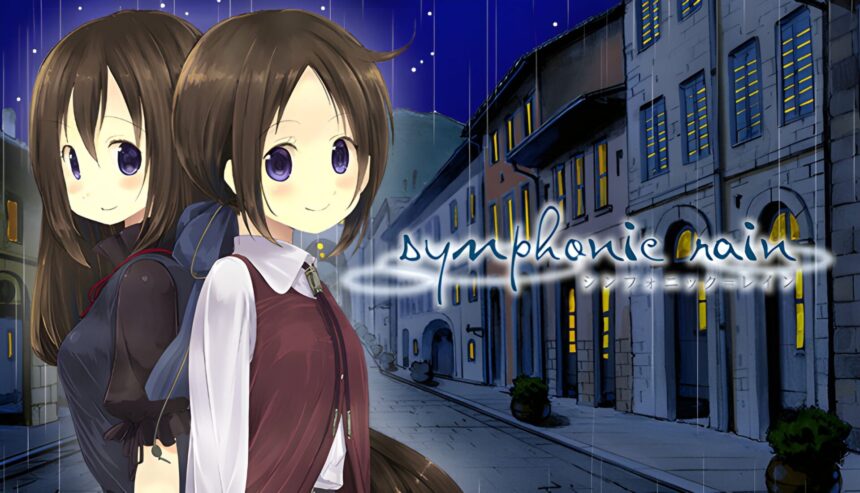
Rain that never actually stops falling is a strange thing to build an entire school around, and Symphonic Rain commits to that gimmick with more sincerity than I expected from a premise this simple and distinct. This unique game was developed by Kogado Studio and later given a HD remaster in 2017 with original character designer Shiro still overseeing the art. So basically, we can call this game a slice-of-life romance built around an inventive hook. The hook being a music school in a town where the rain literally never lets up, and a protagonist whose whole emotional life gets filtered through practice sessions on a fictional instrument called the Fortelle.
Chris is a student nearing graduation at the Piova Communal School of Music, quietly unmotivated, prone to staring out at the rain, and mostly confiding in a tiny, invisible fairy named Phorni who only he can see or hear. His final performance exam is looming, he has no vocal partner secured, and most of the early plot comes from watching him drift through daily routines, writing letters to his distant girlfriend Arietta, chatting with Phorni, making half-hearted attempts to find someone to perform with, rather than any immediate dramatic hook. That’s a deliberate choice, and it’s also the biggest gamble the story makes. For a long stretch, very little happens in the traditional sense, and I’ll be honest, there were hours in the middle where I found myself checking how much longer this comfortable, meditative pace would go on before something actually happened. Whether that reads as calming or just slow is going to come down entirely to how much patience you bring in.
The payoff, once it arrives, justified the wait for me completely. Each individual route builds toward a late reveal that recontextualizes everything I’d read up to that point, and the story’s true shape, less a gentle campus romance and more a quiet, unsettling meditation on obsession, deception, and how thoroughly people construct false realities for themselves, only comes into focus in the final stretch of each path. Rather than foreshadowing that darker turn early, the story commits fully to its comfortable surface for most of the runtime, and that patience is exactly why the eventual gut-punch landed with real surprise for me instead of a slowly telegraphed inevitability. The trade-off is real, though. Because so much narrative weight gets loaded into a comparatively brief climax, the quieter connective material in between feels noticeably thinner once I already knew where things were headed on a second route, and revisiting familiar beats from an earlier path started to wear on me by my third playthrough.
The signature rhythm segment, pressing keys in time as notes scroll across the screen to simulate playing the Fortelle alongside a vocal partner, is a clever way to make a story about musicians feel literally interactive rather than just thematically musical, and it ties directly into the plot since performing well enough can shift which ending you land on. I liked the concept a lot more than I liked actually playing it repeatedly. It’s well-integrated into the story rather than feeling bolted on, but the mechanical challenge itself grows repetitive fast, working better as an emotional delivery system for the music than as a test of skill in its own right, and I ended up leaning on the auto-play option more than once just to sit back and enjoy a song without fumbling the timing.
Character work benefits a lot from that slow-burn structure. Each of Chris’s potential partners, and Phorni herself, who carries as much narrative weight as any of the officially romanceable heroines, gets room to develop a specific, believable personality before the plot demands anything dramatic of them. The visual side is more of a mixed bag. Backgrounds render Piova’s constant rain effectively without being individually striking, and the remastered character art divides my own opinion scene to scene, with some designs benefiting from the sharper resolution and others reading better in the original’s softer lines. The cast also looks noticeably younger than their stated college age would suggest, and that gap between the art style and the story’s own details never fully stopped bothering me across multiple routes.
Musically, this is close to unimpeachable. Ritsuko Okazaki composed the score in what turned out to be her final project before her death in 2004, and the soundtrack blends melancholic, rain-soaked piano work with more upbeat vocal pieces, woven directly into pivotal narrative moments through the rhythm sections in a way a purely background score couldn’t replicate. It’s the clearest, most consistently strong part of the entire experience, skeptical stretches in the middle chapters included.
Verdict
Symphonic Rain succeeds by committing fully to a slow, comfortable atmosphere before pulling the rug out with genuinely surprising, thematically dark revelations that reward the patience its unhurried pacing demands. Its rhythm minigame is a clever idea tightly woven into the narrative that doesn’t hold up as compelling gameplay across repeat routes, and its quieter middle stretches will test anyone who doesn’t fall under its particular spell early. For readers willing to settle into its rhythm, this remains a well-regarded, emotionally rewarding visual novel carried by an exceptional soundtrack and a slow burn that genuinely pays off.