Twenty-one nanoseconds. That’s the entire window this story takes place in, the impossibly small sliver of time between the moon crashing into Earth and the actual end of everything, and somehow an indie team of three people turned that sliver into one of the most emotionally consistent visual novels I’ve played in years.
Developed by Japanese indie studio Acrobatic Chirimenjako and published by Shueisha Games, this debut effort built a considerable following well before release, racking up a huge number of Steam wishlists off the strength of a striking demo alone, and the finished game largely justifies that anticipation.
I want to start with the thing that could have sunk the whole premise: Schrödinger’s cat itself gets referenced fairly directly through Hamlet’s dialogue, and name-dropping a famous thought experiment in your title is exactly the kind of move that usually signals hollow philosophical dressing over something shallow. That’s not what happens here. The game weaves the underlying tension between certainty and possibility genuinely into both the individual spirits’ stories and Mary’s own fractured identity, trusting me to sit with the implications rather than spelling everything out.
Mary wakes up in a small room beside an old telephone, with no memory of who she is or how she got there. Guided by a mercurial, talking cat calling itself Hamlet, she learns her purpose: she is the World’s Last Confidant, tasked with answering calls from spirits trapped by unresolved regrets, unable to accept the end until someone helps them find peace. Each call she answers introduces a new spirit and a new personal tragedy, and the structure let the game explore an impressive range of human experience, grief, isolation, self-worth, unfinished relationships, without ever feeling repetitive in its emotional beats to me.
Being entirely linear, with a single definitive ending and no meaningful branching, felt like a deliberate structural choice that paid off well for a story this focused on emotional throughline rather than replayable variety. The pacing isn’t flawless, though. I hit certain flashback sequences that overstayed their welcome, slowing momentum during stretches that could have been tightened without losing anything essential to the story being told. Dialogue choices during Mary’s conversations with each spirit occasionally leaned toward the obvious too, with correct answers sometimes signaled clearly enough by her own internal monologue that the illusion of difficult choice felt thin. I came to read that as a deliberate accessibility decision for a game more interested in emotional immersion than genuine branching consequence, and I made peace with it fairly quickly.
Mary herself makes for a quietly compelling protagonist specifically because her own amnesia mirrors your uncertainty as a reader, and watching her piece together fragments of her own identity alongside every spirit’s story she helps resolve gave the whole experience a satisfying symmetry for me. Hamlet provided sharp, occasionally unsettling commentary throughout, functioning as both comic relief and thematic mouthpiece without ever tipping into heavy-handed exposition. The individual spirits Mary encounters carry real specificity despite limited screen time each, and the anthropomorphic character designs given to several of them add an unexpected layer of visual charm to material that could easily have read as unrelentingly grim without it.
I should flag one thing honestly: there’s a real minority opinion out there that the tone reads considerably more juvenile than the moody, unsettling box art suggests, a genuine mismatch between marketing and content that left some players disappointed. That’s a real outlier against overwhelming critical and player consensus, but expectations matter for a game this tonally specific, so it’s worth knowing going in.
The prose handles genuinely heavy material, grief, isolation, self-worth, with real sincerity and restraint, and keeping its philosophical framing woven into character-level stakes rather than delivered as standalone lecture kept the writing from ever feeling pretentious despite its ambitious central metaphor. Each caller’s story landed with enough distinct emotional weight for me that the cumulative effect by the game’s conclusion felt earned rather than repetitive, a real achievement given how many distinct tragedies the runtime has to work through in a relatively short overall length.
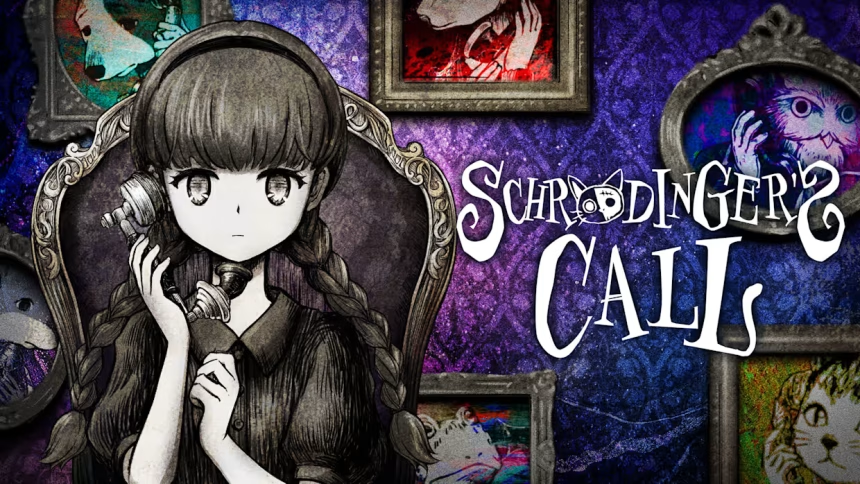
Visually, this ranks among the most striking indie visual novels I’ve seen in recent memory, blending anime influences with sketchbook linework, noir shadow, and gothic atmosphere into something that never settles into a single, predictable visual mode. The black-and-white palette punctuated by vibrant, targeted bursts of color gave the game a distinct identity, and dynamic effects, portraits fading in and out, spinning clocks and abstract shapes during climactic emotional confrontations, did real work selling urgency and psychological weight beyond what static visual novel art typically achieves. The signature “babble” voice acting, characters speaking in an invented, non-verbal language similar to how Animal Crossing or The Sims handle dialogue, added a genuinely haunting texture to conversations, effective enough that I found myself wondering more than once if it was real speech. The soundtrack matched that ambition throughout, unsettling even during the story’s gentler, more reflective moments, and doing significant work building tension during the game’s more surreal, boss-fight-like confrontations with each spirit’s underlying trauma.
Few recent visual novels land emotional beats with this much consistency, and I found myself needing to take breaks specifically because of how heavy and affecting the material became at points. The way Mary’s own mystery unfolds alongside every spirit’s resolution gave the ending real cumulative weight for me, tying personal identity and universal human regret together in a way that earned its emotional payoff rather than manufacturing it. For a debut effort running only eight to ten hours, the density and consistency of that emotional impact struck me as remarkable.
Verdict
Schrödinger’s Call announces Acrobatic Chirimenjako as a genuinely exciting new voice in visual novel storytelling, using a deceptively simple premise to explore grief, regret, and human connection with real sincerity and visual ambition. Its striking, genre-blending art direction and haunting “babble” voice work elevate the format well beyond typical still-image storytelling, even as some flashback pacing and occasionally obvious dialogue choices keep it from total perfection. If you’re willing to sit with genuinely heavy material and a linear, single-ending structure, this stands as one of the most affecting and artistically distinctive visual novels I’ve played in recent memory.