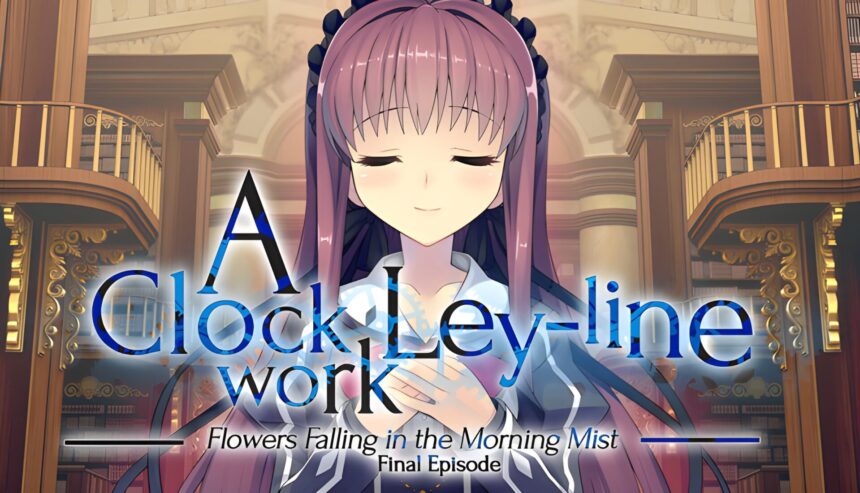
Wrapping up a trilogy is hard enough without doing it twice, and that’s essentially what Flowers Falling in the Morning Mist asks of itself. Rather than branching into multiple heroine routes the way the earlier two entries did, this finale locks its side stories, covering characters like Adelheid, Fuhito, Neko, and the paired Tsubaki and Kasumi, behind full completion of the main story first. Going in, I wasn’t sure how I’d feel about that structure, treating those routes as non-canon detours instead of competing endings, but by the time I finished the main story, I understood why they made that call. It let the central narrative stay tightly focused on Ushio and Mitsuyoshi’s relationship without spreading itself thin across a handful of simultaneous love interests.
That focus paid off for me once the plot picked up steam. Picking up after the destruction of the Realm of Night, the story sent Ushio and the rest of the cast searching for the missing Night Students and the truth behind a fire that happened two decades earlier. I found myself completely locked into that mystery, and it’s handled with the same patient, carefully seeded reveal structure that made me fall for this trilogy in the first place. More than once I hit a late revelation and immediately wanted to go back and reread earlier scenes with what I now knew, and that’s always the sign to me that a mystery was actually plotted with care instead of made up as it went along. I will say the finale leans on narrative convenience here and there, characters showing up at exactly the right place at exactly the right time more than pure chance would really allow, and while it never ruined anything for me, I noticed it enough times to bring it up.
Ushio stayed the clear centerpiece of the whole trilogy for me, and this entry treats her relationship with Mitsuyoshi as the emotional core worth protecting above everything else. That choice worked, honestly, given how much time the earlier games spent building that specific pairing. I went into the side heroine content after finishing the main story expecting more of the same intensity, and instead got something more like a pleasant bonus. Those routes read to me as fan service extras for people who wanted more time with the wider cast rather than anything essential to the actual story, and I was fine with that. As an optional epilogue, it worked. I wouldn’t have wanted the core story to lean on it for its payoff.
The pacing throughout stayed a lot tenser and more plot forward than the earlier two games. I noticed pretty quickly that the slice of life, day to day school stuff that filled some of the softer stretches in the first two entries was mostly gone, replaced by a story that kept moving with real urgency. That worked for me as a finale specifically. By this point the stakes had piled up enough weight that spending time on lighter material would have felt like stalling instead of earned breathing room. The romance itself satisfied me, but I noticed it moved at a pretty brisk pace in exactly the moments where I wanted it to slow down and land. It felt like the story’s priority by that point was resolving its mystery rather than lingering on romantic beats for their own sake, and I have mixed feelings about that trade off.
Presentation wise, I kept noticing how much work the ambient soundtrack and the settings were doing throughout, and the finale in particular reminded me of Ace Attorney in the way it hooked me into the mystery solving side of things, even though the actual gameplay stayed firmly in traditional visual novel territory the whole time. I also want to call out the English localization specifically, because it was genuinely excellent. I went through a script of considerable length and didn’t run into typos or awkward phrasing in any noticeable way, which stood out to me given how often visual novel localizations stumble on exactly that.
The choice structure followed a familiar branching then converging model. Most of the early decisions didn’t meaningfully change where the plot went, they felt more like comprehension checks than real forks in the road, while picking the wrong answer late in specific chapters sent me straight back to the title screen after a bad ending. There’s also a post completion grading system that tallies how many correct responses I gave, which added a light layer of replay incentive if I wanted to chase a perfect score. It’s a pretty minor system in the grand scheme of things, not something I’d call a defining feature, but it was a nice touch to have.
By the time I reached the credits, I felt like this trilogy had actually stuck the landing. The mystery paid off the patience I’d put into two prior games, and the ending gave Ushio and Mitsuyoshi’s relationship a conclusion that felt earned rather than rushed.
Verdict
Flowers Falling in the Morning Mist closes out this trilogy with real confidence. It delivers a tightly plotted mystery finale that rewards everything I’d invested across two prior games and gives its central couple a satisfying, well earned conclusion. A bit of narrative convenience here and there and a romance that moves a little too briskly in its key moments keep it from being perfect, and the side heroine content unlocked afterward is pleasant bonus material rather than essential storytelling. For anyone already invested in this trilogy, though, this is exactly the kind of confident, well built send off a mystery driven visual novel series should be aiming for.