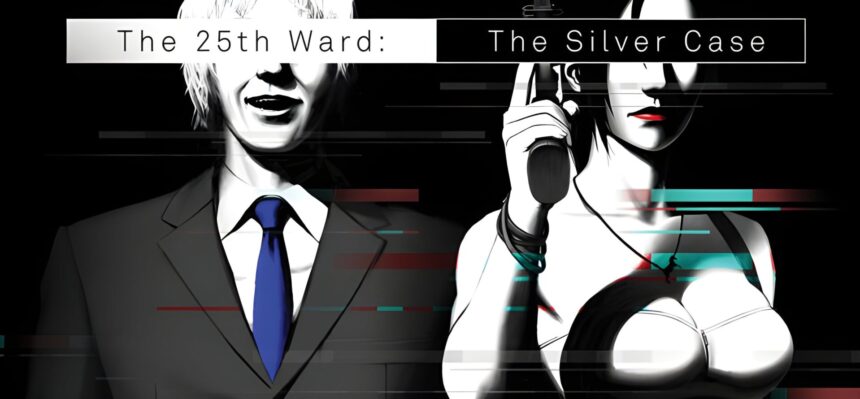
A dice-face menu made me put the controller down for the night more than once, and that single piece of interface design tells you almost everything about how The Silver Case 2425 treats its own audience. This Switch release bundles Grasshopper Manufacture’s 1999 debut title with its 2005 mobile sequel, The 25th Ward, both directed by Goichi Suda, better known as Suda51, years before No More Heroes and Killer7 made his name in the West. I came away from both games genuinely torn on whether I liked the experience, and I don’t think that’s a failure of patience on my part so much as an accurate reflection of how demanding and deliberately obtuse this pair of crime thrillers actually is.
The Silver Case follows a newly recruited member of the Heinous Crimes Unit investigating a wave of murders in the fictional 24 Wards, all seemingly connected to a legendary serial killer named Kamui Uehara who’s supposedly escaped confinement despite that being impossible. The 25th Ward picks up five years later, splitting its narrative across three separate perspectives, a police unit, a shadow government bureau, and a pair of private investigators, weaving standalone cases into a larger conspiracy that eventually connects back to the original game’s unresolved threads.
Both games commit fully to an atmosphere of dread and confusion that asked more patience from me than clarity ever did, burying a genuinely intriguing central mystery under a presentation that made following along a real chore for long stretches. The Silver Case in particular took real time to click into place for me, with its opening hours built almost entirely around confusion by design, dropping unexplained terminology, unreliable characters, and disorienting tangents well before the pieces of its larger conspiracy started connecting.
The 25th Ward carries that same structure forward with an even more fragmented approach, jumping between its three separate storylines Pulp Fiction-style, weaving standalone crime-of-the-week cases into a larger mystery that didn’t fully cohere for me until considerably later. That approach rewarded my patience eventually, since connecting scattered threads across dozens of hours delivered real satisfaction once I got there, but I’d be lying if I said the same fragmented structure didn’t feel scattershot and unnecessarily confusing plenty of times along the way, with entire sequences reading like filler unconnected to anything that actually mattered by the time I finished.
The dialogue here carries a naturalism and crudeness that sets it apart from typical visual novel writing, with characters who talk, argue, and react like real people rather than genre archetypes, heavy profanity included. Sticking with this specific cast paid off for me, since neither game leans on shallow, cute-for-cuteness’s-sake characterization, giving even secondary figures real personality and motivation buried under the deliberately confusing presentation. That said, getting to know these characters demands real patience given how much of both games’ early hours are built around obfuscation rather than clarity, and I found myself struggling to like almost the entire cast for a long stretch, which becomes a real problem in a story this dependent on caring about the people at its center.
When the prose lands, it lands hard, delivering some of the most distinctive crime fiction writing I’ve encountered in this medium, closer in spirit to hardboiled noir than typical Japanese visual novel conventions. The 25th Ward specifically read as an improvement in prose quality and translation over the original Silver Case for me, even as its structural fragmentation worked against it in other ways. The writing’s biggest liability isn’t plot structure but pacing at the sentence and scene level. Scenes stretched on far longer than their content justified or cut off abruptly without warning, dialogue frequently veered into tangents that only paid off much later if at all, and I hit entire passages that read as nonsensical or impenetrable on a first pass through them. Whether that reads as deliberate, rewarding difficulty or simply bad pacing depends heavily on how much patience you personally bring to Suda’s specific brand of obtuseness.
Visually, this remains one of the more genuinely distinctive-looking visual novels I’ve played, using a Film Window layout that frames the unfolding story within a dynamic, shifting background, with each chapter carrying its own unique color palette and comic-like cut-ins for dramatic emphasis. It’s a striking, purposeful aesthetic that held up remarkably well for me decades after the original’s PlayStation release, even if the archival FMV sequences look noticeably dated next to the remastered UI surrounding them. The interface, that dice-face menu included, is where this package drew my sharpest, most consistent frustration. Neither game includes auto-scrolling text or fast travel, both notable absences by modern visual novel standards, and navigation ranges from merely dated, climbing the same staircase repeatedly with no shortcut, to genuinely frustrating, exactly the kind of fiddly, unintuitive menu work I mentioned at the start. Neither game features voice acting, which places the full weight of characterization entirely on text that’s already working hard to be deliberately confusing.
For anyone willing to meet both games on their own terms, the payoff for pushing through that opening confusion is real. What’s here is a genuinely memorable, tonally unique crime drama that connects meaningfully across its full runtime and into Suda’s wider body of work. The emotional and thematic weight builds slowly and rewards patience specifically, rather than delivering more immediate hooks, and that made the experience deeply satisfying for me by the end even though I spent a fair amount of the middle stretch wondering whether it was worth the frustration.
Verdict
The Silver Case 2425 is a genuinely polarizing package, and I can see the case for both sides of that divide because I lived through both reactions myself over the course of playing it. For dedicated fans of Suda51’s distinctive style, this fills in essential missing pieces of his catalog with genuinely striking presentation, sharp crime fiction writing, and a mystery that rewards patient, attentive readers. For newcomers or anyone with limited tolerance for deliberately obtuse pacing, fiddly navigation, and a slow, confusing opening stretch, this is a legitimately difficult recommendation, one I respected more in hindsight than I enjoyed in the moment. Know which type of reader you are before committing to this one.