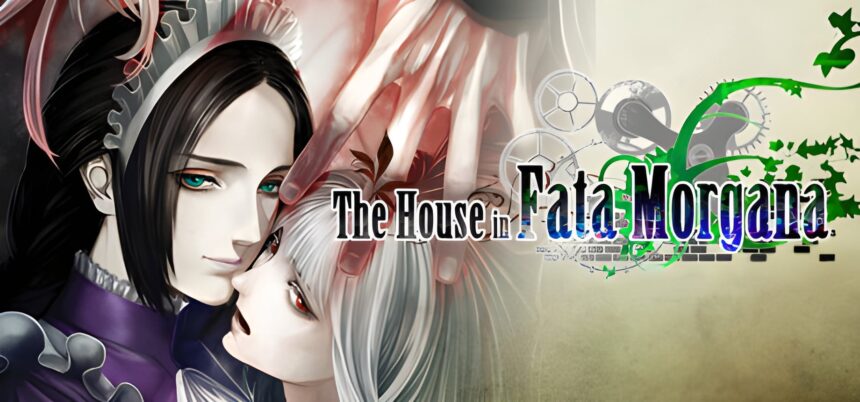
Forty hours is a long time to spend with anything, let alone a story that barely lets me make a single decision along the way. That’s roughly what The House in Fata Morgana asked of me on the original 2016 MangaGamer release, and by the time I reached the end I understood exactly why this gothic mystery has spent close to a decade sitting near the top of the genre’s essential titles. It earns that reputation almost entirely through patience, developed by Novectacle and translated for English audiences in a release that still holds up as one of the format’s most literary achievements.
I woke in a decrepit mansion with no memory of who I was. A woman with jade eyes stood before me, introducing herself as my Maid and informing me that I was the Master of the house. From there, she led me through a series of doors, each one opening onto a different tragedy from the mansion’s near-millennium-long history, spanning four distinct eras from 1099 through 1869, all of them circling around a mysterious White-Haired Girl who reappears again and again across the centuries in different lives, different names, and different kinds of ruin.
That structure is ambitious in a way I didn’t fully appreciate until I was several doors deep. Each one opens onto a self-contained period tragedy, distinct in setting and tone, before the game slowly stitches all of them into one larger, centuries-spanning mystery. I could see how this format might fall apart in lesser hands, disjointed eras that never quite connect, but the tissue binding each period together builds patiently enough that the final picture landed with real force for me once the pieces clicked into place.
Getting to that force takes a while, and the climb is deliberately slow. The early chapters crawl before the emotional weight kicks in, and I had a few twists figured out well before the game formally revealed them. Whether that reads as a flaw or a feature depends on how much patience you bring to a story willing to make you wait this long for a payoff. The pacing felt less like an oversight to me and more like a calculated decision to wear me down gradually so the back third could hit as hard as it does, and on that front, it worked exactly as intended.
The White-Haired Girl anchors every chapter in a different guise, and each version of her stood on her own for me while still accumulating meaning across the full runtime. Striking that balance across a cast that essentially reinvents its central figure several times over is a difficult trick, and the writing, penned by Keika Hanada, manages it with a level of consistency I rarely see attempted at this scale. The dialogue carries a naturalism that held up remarkably well in this English translation, a real achievement for a script built around period-specific voices spanning seven centuries.
A few smaller cracks showed up around the edges for me. Minor characters lacking their own sprites occasionally flattened scenes involving side figures who otherwise carried real emotional weight, and certain characters’ mindsets read as a touch more modern than their historical settings would suggest. Neither issue did much to dent what’s otherwise a remarkably cohesive ensemble by the time the full cast comes together.
Literary ambition runs through nearly every line of this script, and for the most part it earns that reach. This is a Gothic tragedy treated with real dignity rather than shock value, and the prose leans into a formal, occasionally poetic register, especially once the story moves into its later chapters. The quieter conversations between the central pairings did more devastating work for me than any of the louder, more dramatic scenes managed. That same literary reach is also where the writing overextends itself at points. The denser vocabulary in the later stretches slowed the pace further than it probably needed to, and certain scenes lingered on points the story had already made clear, circling back to emotional beats that didn’t need the extra repetition. It’s a minor drag on otherwise strong material rather than a structural flaw.
Headphones aren’t optional here. The soundtrack, built around haunting vocal pieces sung mostly in Portuguese, with one standout track performed in French, ranks among the best original scores I’ve heard in this medium, and it does as much narrative heavy lifting as the writing itself in the story’s most pivotal moments. The art matches that ambition. Character designs across each era feel genuinely distinct from typical visual novel art, ethereal without tipping into gratuitous territory, and the shifting visual language across time periods sold the story’s massive historical scope convincingly for me. The one real technical limitation is structural rather than visual: this is an almost entirely kinetic novel on this original release, with only a small handful of meaningful choices across dozens of hours, which makes it a poor fit for anyone looking for genuine branching interactivity rather than a guided read.
Few visual novels build dread and tenderness in equal measure the way this one does. Music and writing converged at exactly the right moments to land emotional blows that felt earned rather than manipulative, and the final stretch pulled together threads I’d forgotten were even planted, with a precision that made the whole experience feel inevitable in hindsight rather than contrived. The one real risk in a slow-burn structure like this is that the emotional connection has to build gradually, and it won’t land the same way for every reader at the same pace. For a story banking so heavily on a long, deliberate wind-up, that’s a genuine vulnerability, and it’s the clearest place where the game’s biggest strength and its biggest risk turn out to be exactly the same thing.
Verdict
The House in Fata Morgana is a gothic, centuries-spanning tragedy held together by an extraordinary score, richly layered characters, and prose willing to take its time earning every gut-punch it delivers. It demands an enormous commitment on this original release, somewhere in the neighborhood of thirty to forty-plus hours depending on reading speed, and it offers almost nothing in the way of player agency, which will be a real sticking point for anyone who wants their choices to shape the story. The slow build asks a lot before it gives much back, and the payoff, when it finally arrives, is substantial enough to justify the wait.