A studio famous for gut-punch tearjerkers set in sunlit high schools does not seem like the obvious source for a scavenged, post-apocalyptic wasteland stalked by towering war machines, and that mismatch is the first thing that struck me about Stella of The End. And trust me, if you know anything about them, i’m willing to bet it will struck you too. Because Key built its name on stories like Kanon and Clannad, and even its earlier kinetic novels, Planetarian and Harmonia, stayed relatively gentle by comparison. This one does not.
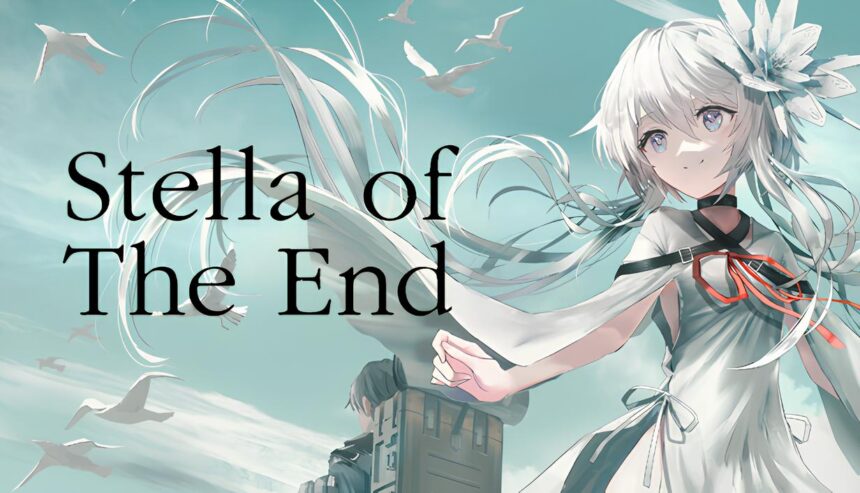
In this visual novel, Jude Gray, a Courier scraping by hauling salvaged pre-collapse tech across a broken continent, takes a job from a mysterious old client named Willem. The job seems straighthforward, retrieve an android and deliver her across hostile territory for more money than he has ever seen. The android accepts the name Philia, and what follows is a long, frequently brutal road trip about a hardened man slowly, reluctantly falling for the naive passenger he insists he does not care about.
That relationship carries the entire story on its back, and for a good stretch it earns the weight through patience rather than rushing toward sentiment. Philia starts the journey completely unprepared for the world outside her creation pod, refusing to defend herself even when it puts her life on the line, which is frustrating to watch play out in the early chapters but pays off once her arc matures into someone willing to make harder calls without losing the decency that defines her. Jude’s walls come down slower and more convincingly than I expected going in. His insistence that she is just cargo cracks bit by bit, and a heated argument well past the story’s midpoint finally forces him to admit what has actually grown between them. None of this is a new shape for a story, the hardened traveler who learns to love again is a familiar arc in any medium, but the execution carries real sincerity, especially once the plot lets itself sit in their companionship instead of constantly escalating the danger around them.
I went into this already having spent time with other stories about a jaded escort and a childlike android discovering humanity on a ravaged road, and that familiarity worked against the game more than I wanted it to. A fair chunk of the early and middle chapters plays out in beats I had already seen coming from a mile off, and there were stretches where I found myself waiting for a scene to arrive rather than being surprised by it. That is a real mark against the pacing, not a nitpick, and anyone who has spent real time with genre touchstones in this exact space should walk in with tempered expectations for the first half. What changed my mind was the back half. The story tightens considerably once it stops setting pieces on the board and starts paying them off, and the final stretch through the epilogue landed as some of the strongest material Key has put out under this kinetic novel banner, familiar setup or not.
Scenario writer Tanaka Romeo keeps the prose deliberately restrained rather than reaching for constant emotional peaks, trusting me to piece together the truth behind the android technology driving the plot well before the story states it outright. That is a harder trick to land than it sounds, planting enough context that an attentive reader arrives at the reveal on their own timeline instead of being told, and this script pulls it off with real confidence. Since Stella of The End is a linear kinetic novel with no branching choices, every scene stays locked into service of that patient reveal structure, and the whole thing runs a brisk eight to thirteen hours depending on reading speed. Even during the slower middle stretch, it never felt like padding for padding’s sake, just a story taking its time before the drop.
The presentation is close to flawless. SWAV’s art renders a scavenged, decaying world without losing clarity or warmth in the quieter character scenes, applying a muted green filter that gives the whole thing a distinctly cinematic look rather than the brighter palette Key is usually associated with. Composers Tsubasa Harihara and Ice do serious heavy lifting on the soundtrack, and the voice work sells scenes that a weaker cast would have let fall flat. A short epilogue centered on a newly introduced android character closes things out with a small, unexpectedly charming coda, one that leaves the door open for more time in this setting even though nothing further has been announced since release.
I will not describe how the story resolves for Jude and Philia specifically, since the impact of that ending depends entirely on not seeing it coming, but I will say it earned an emotional reaction from me that the familiar setup in the opening hours did not lead me to expect. Whether that lands the same way for you depends heavily on how much patience you have for a slow, quiet buildup toward a payoff you cannot rush.
If post-apocalyptic, character-driven visual novels are your thing, this one is worth placing next to the rest of Key’s catalog on our Key visual novels ranked page, and readers curious about kinetic novels specifically should check our best kinetic novels list for more in the same no-choice format.
Verdict
Stella of The End takes Key’s established emotional playbook and reroutes it through darker, more violent territory than the studio’s reputation suggests, built around a patient, well-crafted central relationship between Jude and Philia that earns its strongest moments through restraint rather than manufactured spectacle. The premise leans on familiar road-trip and android-discovering-humanity beats, and if you have already spent time with similar stories elsewhere, the first half will likely feel more predictable than surprising the way it did for me. The back half and epilogue make up for it, delivering some of Key’s most affecting material to date. Backed by excellent art, music, and voice work, this is a worthwhile, if imperfect, read for anyone drawn to quiet, character-driven post-apocalyptic fiction.