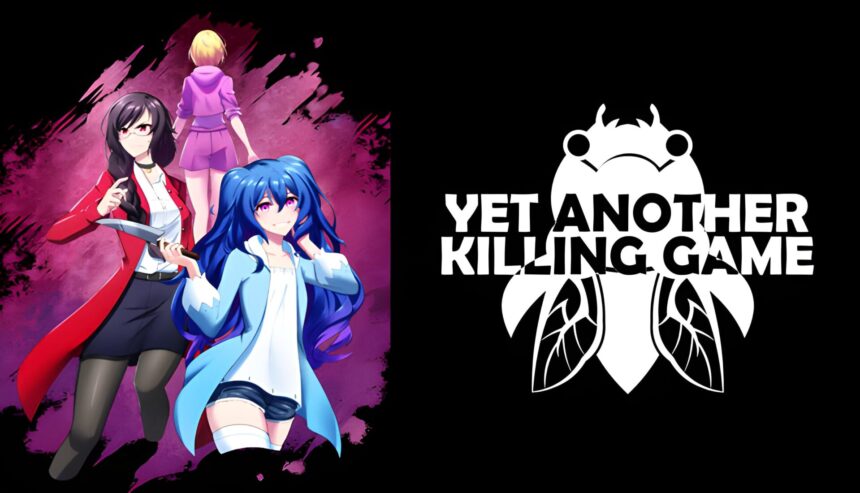
Danganronpa’s whole formula usually hinges on a large, extensive cast of trapped students picking each other off one by one over a drawn-out timeline. This visual novel strips that entire formula down to its barest possible components, starting with just three participants forced into an impossible bargain, one must die so the other two can live. It’s a bold, deliberate structural choice for a genre usually built around scale, and the game uses that reduced cast size to make every single relationship and decision carry disproportionate weight from the very first scene onward.
Jun Kakeru, a Canadian narrative designer who also serves as director at Soulseer Studios, leads the small team behind this release, Team YAKG. That team grew from just three people, Jun Kakeru, one friend, and a single commissioned artist, into a full ten-person team over the course of the finished game’s much longer development cycle. The project began life as a Day 1 Demo released January 6, 2023, after roughly half a year of early work. A fuller Part 1 demo followed in December 2024, and the completed game released January 30, 2025, available on both itch.io and Steam by deliberate choice, accommodating anyone who avoids Steam’s DRM specifically alongside those who prefer buying there directly instead.
You wake up as an amnesiac protagonist trapped inside a locked house the game calls the Black Magic Mansion, alongside Cecilia, an occult enthusiast, and Oriana, considerably more straitlaced by comparison. A message waits at the entrance stating plainly that the door won’t open until one of you dies. A twenty-hour countdown hangs over the whole situation, ticking down whether or not anyone actually acts on the ultimatum waiting behind that locked door. Your own character’s real name eventually comes to light as Carol-Maria. As the three of you grow comfortable enough with each other to start using nicknames, Cece, Ria, and Karma respectively, the game’s interface actually updates to reflect that shift. It’s a small but thoughtful touch that reinforces how much these relationships evolve under pressure rather than staying frozen at their initial, guarded starting point. Investigation plays out through familiar genre conventions, point-and-click exploration across different rooms, choosing who to talk to and what to say, all clearly drawing on Ace Attorney, Danganronpa, and Zero Escape as stated influences the developer has openly acknowledged. I found the mystery held together remarkably well once everything clicked into place, and I ended up replaying certain stretches afterward just to catch details that only made sense in hindsight. Specific lines of dialogue that had read as throwaway banter the first time through turned out to be quietly seeding the eventual reveal well in advance of the actual payoff. That’s a real, difficult trick for any mystery this size to pull off convincingly, and one that requires the earlier hours to have laid real groundwork carefully enough that nothing in the reveal feels arbitrary. Small details I’d brushed past on my first pass through the mansion’s rooms turned out to matter far more than I’d originally given them credit for at the time.
What elevates the story beyond a clever structural gimmick is its willingness to let its resolution carry real, bitter irony rather than settling for a straightforward victory once the mystery gets solved. Once the full truth about a shadowy mastermind figure, referred to as the Professor, comes to light, revealing his murders were all committed in service of his own escape, one surviving character is left quietly grappling with a hard fact. Stopping him and redeeming his path back to Hell effectively renders every death that came before completely meaningless. That’s a real, dark note to land on for a project with such a self-aware, jokey title. It speaks to real thematic ambition beyond just replicating genre trappings for their own sake. The title itself reads like a shrug, yet the writing underneath it takes its own consequences far more seriously than that shrug lets on.
Presentation punches well above what a small indie team usually manages, especially considering its origins as a project built by essentially three people working with commissioned art rather than an in-house illustrator from the very start of production. The original demo alone packed over 2,500 dialogue lines, more than 20,000 words, into roughly an hour for a first playthrough and up to four hours for full completion. The finished release then expanded quite meaningfully on that same foundation once the full ten-person team came aboard. A version 1.2 update introduced 60 separate achievements tied to specific events, choices, and optional conversations, rewarding exactly the kind of thorough exploration the mystery structure encourages rather than just tracking simple playtime milestones. The game has also managed to find its way into at least one notable crossover partnership, with a Valentine’s Day collaboration announced alongside Kumitantei: Old-School Slaughter. That’s a similarly Danganronpa and Ace Attorney inspired mystery ADV from developer Mango Factory, one that sets itself apart specifically through card-battler mechanics paired with a deliberately retro anime aesthetic. The collaboration came complete with a dedicated crossover illustration pairing characters from both games together in a single shared piece of artwork.
Verdict
Yet Another Killing Game succeeds by taking Danganronpa’s core premise and deliberately shrinking its scale to make every choice and relationship carry real weight, using a reduced three-person cast to build a mystery that held together convincingly for me and rewarded going back to catch details I’d missed the first time through. Its willingness to let the resolution land on real, bitter irony rather than a tidy triumphant ending gives the story more thematic teeth than its self-deprecating title initially suggests, and small interface touches like the nickname system show real care in how the game tracks its characters’ evolving relationships. For a genre-savvy project built entirely from the ground up by a tiny team that grew alongside its own ambitions, this delivers a real, compelling mystery worth the asking price. It clearly understands exactly which genre conventions to lean fully into and which ones to quietly subvert instead.