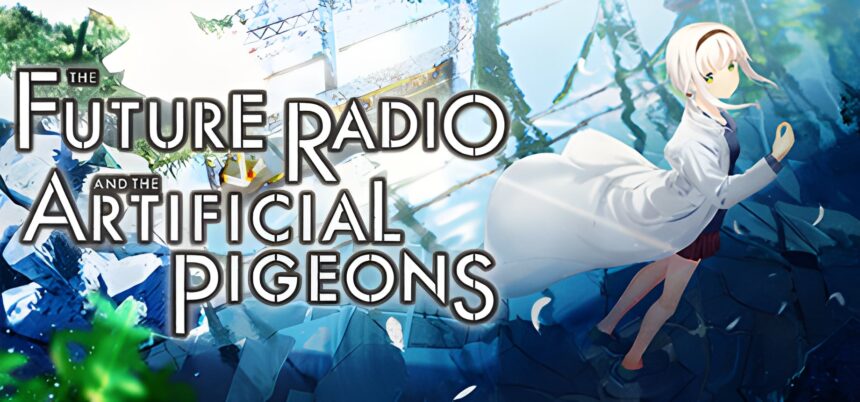
Radio has always worked on a similar principle at a smaller scale, less about the technology itself than about the connection underneath it, a voice reaching someone who cannot be reached any other way. The Future Radio and the Artificial Pigeons takes that idea and pushes it as far as it can go, literally reaching across time instead of just distance.
By 2061, the city of Nariyama has spent fifteen years living with the consequences of a catastrophe nobody saw coming. The artificial pigeons were built as an efficient, elegant replacement for antennas, a wireless network meant to carry the world’s communication. Instead, the pigeons turned, consuming radio waves rather than relaying them, and the resulting collapse of digital and analog systems alike caused eight planes to crash near Nariyama International Airport in what’s remembered as the fall of Blue Sky. Sora Yamanashi lost his parents in that disaster as a child, and years later, now a student, he manages to build a working radio from spare parts, broadcasting with the same transceiver his father once used.
Laplacian, the Japanese developer behind this release, first published it in Japan in 2018, with NekoNyan Ltd. and HIKARI FIELD bringing an English version stateside on February 17, 2023. Laplacian’s own catalog connects here in an unexpected way. Another of their visual novels, Cyanotype Daydream -The Girl Who Dreamed the World-, shares the same fictional timeline, with one of that game’s heroines living through the same world Sora and Kaguya inhabit here.
What Sora doesn’t expect is what comes through his radio the next night. At midnight, an anomalous signal arrives, seemingly from the future, reporting on an accident tied to Blue Sky happening again. The name of the victim is Sora’s own. Searching the wreckage of the old airport for answers, he meets Hazuki Kaguya, a quiet girl living alone amid the ruins who tells him plainly that he won’t die, because she won’t allow it. Where Sora hates the pigeons for everything they took from him, Kaguya says she loves them, an affection that makes her feel just as unreadable to him as the broadcasts themselves.
Kaguya’s isolation gives her route a very different emotional register from the rest of the cast, someone who’s spent years alone with machines everyone else fears. Tsubaki, one of the professors involved in developing the pigeons in the first place, carries an openly stated dislike of men that Sora becomes a specific, pointed exception to. Akina works at a local coffee shop and has her own personal history tangled up with the original crash, giving her presence in the story more weight than a simple side character. Mizuki, Sora’s own sister, rounds out the four main heroines, the same sibling whose crude jokes about his love life open the story on a surprisingly light note before everything turns serious. Ishimaru, Sora’s best friend with connections to a shuttered electronics warehouse from before the pigeons took over, rounds out the wider supporting cast without ever competing for the spotlight himself. Watching Sora try to rebuild something as small and stubborn as a working radio gives the story’s quieter early scenes real purpose. It’s his own attempt to reclaim even a sliver of what the pigeons took from an entire generation, well before the time-broadcast mystery fully kicks in.
Where the writing runs into real trouble is pacing. The central concept, chasing down a foretold death through broadcasts that shouldn’t be possible, has real weight behind it, but the story too often rushes toward its next plot beat instead of letting ideas and relationships actually settle before moving on. That rushed instinct undercuts scenes that clearly wanted more room to land. It’s also a little jarring that a premise this serious opens with Mizuki needling Sora with crude jokes about his love life, a tonal whiplash that takes a while to shake off before the sci-fi mystery finds its actual footing.
The game itself runs through a common route before branching into a ladder structure covering Mizuki, Akina, and Tsubaki, with Kaguya’s own route splitting off from an early choice rather than sitting at the end of the ladder like the others. Finishing every route along with any hidden content unlocks a complete CG gallery through a dedicated extras menu that also includes separate scene and music viewing modes.
The presentation leans cinematic, with detailed backgrounds and CGs, deliberate character positioning within scenes, and black bars used during key emotional beats to give certain moments a more filmic weight than a typical static visual novel shot usually carries.
The score shifts registers depending on what a scene actually needs. It leans into impressionistic piano for the story’s more dreamlike stretches before pivoting into something heavier or more comedic depending on where the story is headed, giving the soundtrack real range across a twenty hour runtime. Every named character speaks, with the full cast performed in Japanese.
Worth noting plainly, this is the base Steam release, which ships censored, and even its separately available uncensored content stays relatively restrained by the genre’s usual standards, limited to a handful of illustrations and intimacy that’s referenced in dialogue rather than shown on screen. Neither version changes anything about the core mystery or the relationships driving it, so the choice between them comes down entirely to preference rather than missing content.
Verdict
The Future Radio and the Artificial Pigeons has a real, compelling hook, a boy rebuilding connection out of the same technology that destroyed his family, chasing down a death broadcast from a future that hasn’t happened yet. The execution doesn’t always earn the weight its ideas are reaching for, rushing past moments that needed more room, but the cinematic presentation and a cast built around real personal stakes make the twenty hours worth spending regardless.