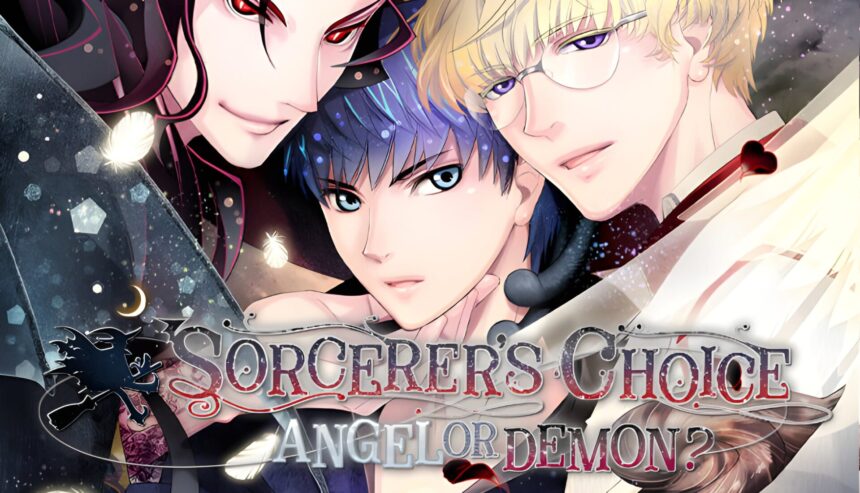
Being burned and left half-conscious by an angry mob is a rough way to start any story, and Lucil doesn’t even get a moment to recover before two supernatural beings show up arguing over who gets to help him. This BL fantasy visual novel builds its entire premise around that single fork in the road. An angel named Flow offers aid that costs him something of his own standing in Heaven, while a demon named Lobelia offers healing with far murkier motivations attached from the very start. Which hand Lucil actually takes determines which of two very differently shaped stories unfolds from that point forward.
Varenyett developed this as their first and, so far, only release, putting it out in Japan back in 2018 under the original title Mahoutsukai to Tenshi to Akuma. An English release followed from JAST BLUE on April 21, 2023, available through Steam and the JAST Store directly. That release marked something of a departure for the publisher specifically, one that carried real stakes for how JAST BLUE positioned itself going forward as a label rather than simply a Nitro+Chiral distribution channel by another name. JAST BLUE has built its identity primarily around its ongoing partnership with Nitro+Chiral, and this was the label’s first release from an outside developer, even though JAST’s own broader catalog had previously included other non-Nitro+Chiral titles like Enzai and Absolute Obedience under different circumstances. Illustrator Tor Nishio served as the project’s original planner and lead writer, working alongside co-writers Chitose Rima, Sakamata Shigeru, and Yukie Yuta. It’s an unusually hands-on role for an illustrator to take across a project this size, shaping both how the game reads and how it looks from the same creative hand. Nishio’s other illustration credits include Akazukin to Mayoi no Mori and the otome title Torikago no Marriage for developer Kalmia8, work that had already built her a following among BL readers before this project even released.
What elevates this beyond a simple pick-your-supernatural-partner premise is how seriously the writing engages with real psychological damage. Lucil arrives already bitter and closed off after the townsfolk’s betrayal, and both routes use that wound differently. Flow’s path leans into whether real care can coexist with real personal cost and sacrifice, since helping Lucil at all risks his own real standing in Heaven’s grace directly. Lobelia’s path leans into something murkier and more transactional from the start, offering to heal Lucil’s burns in exchange for his body while keeping his actual motivations deliberately unclear for much of the story. That ambiguity gives Lobelia’s route real tension precisely because you cannot easily tell how much of his interest in Lucil is real affection and how much is something closer to manipulation dressed up as care, a distinction the writing never rushes to resolve for you. I found myself second-guessing Lobelia’s intentions well past the point where I expected the story to clarify them, and that sustained uncertainty carries real weight rather than reading as a cheap narrative trick. It’s a harder balance to strike than it sounds, keeping a love interest’s motives properly unclear without the writing losing its own grip on where his arc is actually headed.
Both of these leads get real, specific characterization rather than existing as interchangeable archetypes wearing different wings or horns, a trap plenty of angel-versus-demon premises fall into without much resistance. Flow’s eccentricity comes wrapped around a real willingness to sacrifice his own comfort for people who have no idea what that costs him, while Lobelia’s seductive confidence hides someone considerably harder to read than his surface behavior suggests. Watching Lucil grow more open with each of them, understanding himself better than he did at the story’s start regardless of which route you follow, gives both paths real emotional payoff even though they arrive there through very different means. It’s rare for a two-route structure like this to make both endpoints feel equally earned rather than treating one path as the obvious intended default.
The fantasy setting itself is where the game shows its clearest limitation. The concepts of angels and demons stay fairly generic throughout, offering only a general overview of familiar religious framing rather than anything more developed. The magic system gets kept deliberately minimal too, present only where the plot strictly needs it rather than built out as its own point of interest worth exploring further. That thinness in the wider worldbuilding is a real, noticeable shortcoming, one that becomes more apparent the longer you actually sit with the story. It does let the character writing carry most of the emotional weight, though, without ever competing for attention against a more elaborate setting around it.
Presentation carries real strength throughout. Tor Nishio’s illustrations give each character a distinct visual presence. Coloring work makes every design feel like it’s carrying its own internal glow rather than sitting flat against the backgrounds around it, a quality that shows up especially clearly across the CGs tied to each route’s more pivotal emotional scenes. Every scene across both routes gets full Japanese voice work, Aoba Nanami as Lucil, Kyousai Nanoka as Flow, and Sawa Manaka as Lobelia, the same actor known for playing Clear in Dramatical Murder. That same range shows clearly in how differently Lobelia’s warmth and his more guarded moments come across in performance alone, a versatility that helps sell the character’s ambiguity even in scenes where the writing itself stays deliberately withholding.
Verdict
Sorcerer’s Choice: Angel or Demon? succeeds as a real entry point into BL fantasy romance with real psychological weight behind its central choice, using its angel-versus-demon premise to explore real personal cost and ambiguous motivation rather than settling for surface-level supernatural romance. Gorgeous illustration work from Tor Nishio and a well-matched voice cast elevate both routes considerably, even as the fantasy setting around them stays fairly thin and generic at the edges. As a character study wrapped in a heaven-and-hell premise, it holds up as a strong debut from a first-time developer, and as JAST BLUE’s first real step outside its usual creative partnership.