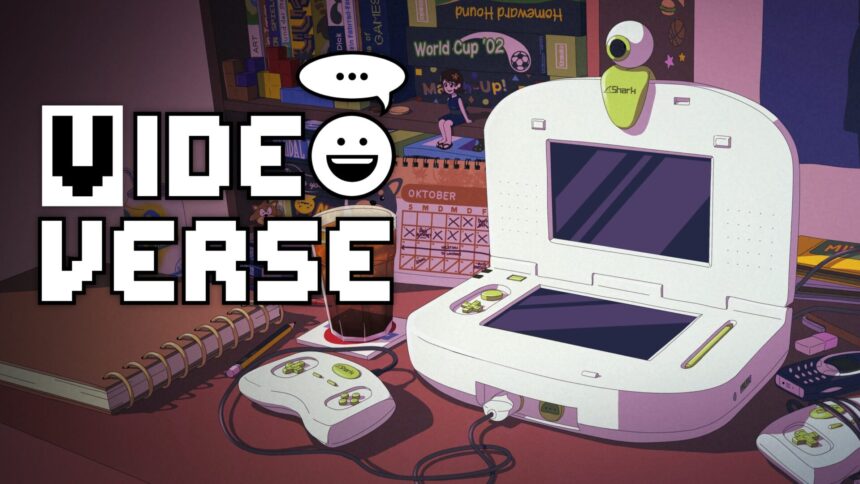
Nostalgia games about dead platforms tend to lean on one of two tricks, either wallowing in aesthetic recreation for its own sake or using that dead space as a backdrop for a story that could have happened anywhere. The stronger ones understand that the platform itself has to be doing narrative work, not just visual work, for any of it to land. VIDEOVERSE builds its whole story around a specific, low-key heartbreak nobody warns you about in the moment, the online space holding your entire social life together quietly dying underneath you. It dropped me into 2003 as Emmett Palmer, a fifteen-year-old gamer glued to his handheld console’s built-in social network, right as that network starts showing the first cracks that will eventually take it offline for good.
Kinmoku, the solo studio run by Lucy Blundell, built this as a follow-up to her earlier visual novel One Night Stand from 2016, and the two games share a small, knowing joke. An in-universe version of One Night Stand exists as a game for Emmett’s own console, deliberately anachronistic since it features technology, modern smartphones among it, that wouldn’t actually exist yet in this 2003 setting. Kinmoku released VIDEOVERSE for PC on August 7, 2023, with Switch, PlayStation 4, PlayStation 5, and Xbox Series X/S ports following in November 2025.
Videoverse the in-fiction platform functions almost like a character all its own. It’s a lovingly recreated blend of MSN Messenger cadence and early Miiverse-style forum culture, complete with clunky private messaging, grainy webcam calls, and a steady stream of fan art posted by strangers who slowly stop being strangers. Emmett spends his time there mostly orbiting Feudal Fantasy, his favorite JRPG, whose own in-fiction hero Hanzo faces off against a villain named Nobunaga. It’s through that shared fandom that he reconnects with an old friend and meets Violet Williams, better known online as Vivi, a fellow artist whose work catches his eye before anything else about her does. Watching an entire in-fiction fandom form around a game that doesn’t actually exist, complete with its own theory-crafting and tip-sharing, sells the whole platform’s authenticity in a way I didn’t expect a side detail like that to manage. Their relationship, allowed to shift toward friendship, rivalry, or romance depending entirely on how I choose to respond in chat, becomes the emotional spine of the whole game, and it earns that weight by refusing to rush. Watching two teenagers fumble toward intimacy through typed messages, deleted drafts, and awkward video calls feels uncomfortably, wonderfully specific to anyone who actually lived through this particular flavor of early internet romance.
What elevates VIDEOVERSE well past pure nostalgia bait is how squarely it’s willing to look at harder material without losing its warmth. Over the course of the story, Emmett, a comfortably privileged kid who starts out mostly unaware of it, gets pulled into conversations touching on disability, family strain, mental health, and the particular cruelty online spaces make so easy to inflict anonymously. None of it plays as lecture. The dialogue stays natural and lived-in throughout, letting characters reveal themselves through small, human exchanges rather than big dramatic reveals. The choice to let Emmett’s own traits shift based on how he treats people, sometimes locking certain relationships off entirely depending on earlier behavior, gives every interaction real weight rather than treating dialogue options as cosmetic flavor.
The backdrop of Videoverse’s slow institutional decline, declining moderation, rising trolling, a looming platform shutdown in favor of a shinier new console, adds a real melancholy undercurrent that deepens rather than distracts from the central relationship drama. It’s a shrewd bit of structural design, using the death of a digital space to mirror the more personal losses and growth Emmett experiences individually. I did find myself wishing the story spent more time in the wider forum community it builds so richly, given how narrowly the back half narrows in on just Emmett and Vivi specifically. The ending doesn’t stick its landing quite as cleanly as the build-up promises, either. Neither issue undoes how consistently well observed the writing is scene to scene, though.
Presentation carries real charm throughout, with colorful, expressive 1-bit-inspired pixel art that never feels visually cluttered even as multiple forum windows and chat panels stack up on screen. Voice acting covers key story beats too, with Mark Takeshi Ota voicing Emmett and Leader Looi voicing Vivi. That gives their exchanges an extra layer of warmth beyond what text alone carries, particularly in the video call scenes where hearing an actual voice crack or hesitate lands differently than reading it on a screen. Clark Aboud, also known for scoring Slay the Spire and Kind Words, composed the soundtrack, all warm, low-key MIDI-adjacent tones spread across fourteen tracks on the standalone release, with additional bonus startup sounds for the game’s fictional consoles contributed by Alexandre Carvalho. Aboud’s work does a remarkable amount of emotional work without ever reaching for anything more elaborate than it needs, complementing the game’s quiet, contemplative mood scene after scene. A real, thoughtful accessibility suite rounds things out, closed captions, colorblind-friendly themes, adjustable font clarity, and content warnings you can check before diving into heavier material, alongside separate volume sliders for sound effects, music, and voice work individually.
Verdict
VIDEOVERSE succeeds by treating early-2000s internet nostalgia as a vehicle for something considerably more emotionally substantial than pure retro comfort. It uses Emmett and Vivi’s halting, believable digital romance to anchor a story that takes privilege, loss, and the particular vulnerability of growing up online seriously rather than as backdrop. The slow, melancholy decline of the Videoverse platform itself mirrors the personal growth happening throughout, and the writing stays remarkably natural and unpreachy even while tackling real difficult material. Its focus narrows more than the game’s rich supporting cast seems to promise, and the ending doesn’t fully match the deftness of everything leading up to it. Still, as a specific, lovingly crafted time capsule of a very particular kind of teenage internet life, it’s hard to think of anything else quite like it.