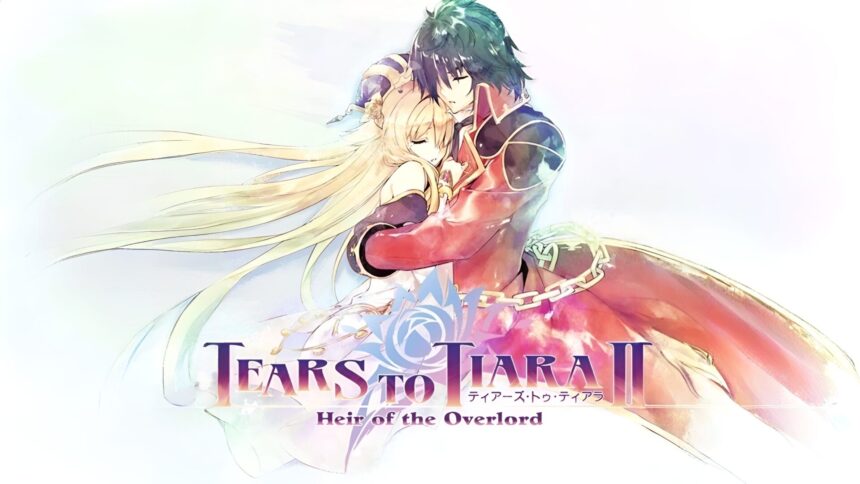
Tears to Tiara II: Heir of the Overlord tells its story of divine war and colonial oppression across a runtime that stretches past eighty hours. Depending on which half of the experience you came for, that length either justifies itself completely or wears out its welcome hours before the credits roll. This tactical RPG follows Hamilcar Barca, a disgraced prince living under the brutal occupation of the Divine Empire seven years after his father’s assassination. His fortunes shift entirely when a mysterious girl named Tarte appears claiming to be the long-lost goddess his people once worshipped, setting off a rebellion that pulls in Phoenician mythology, Roman-inspired imperial politics, and a large ensemble cast across the fictional land of Hispania.
Aquaplus co-developed this with Sting Entertainment, exclusively for PlayStation 3, under directors Shigeki Hayashi and Kazuo Ninomae. Aquaplus published the original Japanese release on October 31, 2013, with Atlus USA bringing it to North America on October 14, 2014, and NIS America handling the European release that November, priced at $39.99. Despite the numeral in the title, none of this requires familiarity with the original Tears to Tiara. That first game started life very differently, as a 2005 Windows eroge developed by Leaf rather than Aquaplus, before Aquaplus itself later produced an all-ages PlayStation 3 and PSP remake called Garland of the Earth. The original story also became a 26-episode anime in 2009, directed by Tomoki Kobayashi with a script by Tōko Machida and music by Takayuki Hattori, animated at White Fox and licensed in North America by Sentai Filmworks. Heir of the Overlord tells a fully separate story from all of that, connected only by shared mythology and setting rather than any direct plot continuity.
What got me hooked is how thoroughly this game blurs the line between visual novel and strategy RPG, to the point where calling it either one alone actually misrepresents the experience. Story sequences, delivered through dense, dialogue-heavy scenes with detailed character portraits and gorgeous individual CG illustrations, make up an enormous portion of total playtime, with some individual conversations stretching well past an hour without a single battle breaking things up. That imbalance is either the game’s greatest strength or its most exhausting flaw depending entirely on what you actually wanted from it. The writing itself handles serious subject matter, religious persecution, colonial exploitation, personal betrayal, with real emotional weight rather than surface-level drama. The sheer amount of time spent with this cast lets even secondary characters grow into people worth caring about rather than staying locked into single archetypes. That depth comes at a real cost in pacing, though. The story regularly circles back through backstory and political maneuvering that doesn’t always advance anything meaningfully, and I found entire hours passing between story battles more than once, testing my patience even as someone who really did enjoy the writing carrying me there.
The tactical combat underneath all that narrative weight deserves real, specific credit in its own right, and it’s a shame how little screen time it actually gets relative to the story surrounding it. A signature rewind mechanic lets you undo any turn back to its starting point and try again, removing the sting of one bad decision wiping out careful planning without turning into pure save-scumming, since identical actions replayed the same way always produce identical results. A positioning system that restricts how far enemies can move past units standing near each other adds a real, thoughtful tactical layer that rewards careful formation planning over simple stat-checking. The sheer size of the playable roster also gives real variety to how individual battles can be approached. Three difficulty settings accommodate both players who came purely for the story and want an easy path through combat, and those looking for a real, demanding tactical challenge, a smart, flexible design choice for a game this explicitly split between two different audiences.
Presentation is where this shows its clearest, most consistent weakness, and it’s worth being direct about how dated it looks even relative to when it originally released. Battle sequences render characters as chibi-proportioned models with limited animation, and environments during combat look flat and underdetailed compared to the far more polished character portraits and CG stills carrying the story sequences. That gap between the two halves of the game’s visual identity is jarring, a game that clearly poured its resources into the visual novel half at real cost to how its strategy half actually looks in motion. Every line of dialogue gets full Japanese voice work, adding real texture to the lengthy conversations. The decision not to include an English dub, likely a practical one given the sheer volume of text involved, means anyone hoping for a fully localized experience will be reading subtitles for the entire runtime. The soundtrack fares considerably better, and the game’s vocal victory themes in particular elevate key emotional moments well past what the middling visuals manage on their own.
A frustrating practical limitation worth flagging directly. Saving is only available at the end of scenes rather than at any point during them, which becomes a real problem given how long individual dialogue sequences can run. Getting pulled away mid-conversation with no way to save your place is an avoidable annoyance in a game this dependent on marathon reading sessions. Pre-orders and early launch copies came bundled with a 31-page Visual Works booklet collecting sketches, concept art, character designs, and background visuals, a nice physical extra for anyone who picked the game up close to release.
Verdict
Tears to Tiara II: Heir of the Overlord pulls off a real, ambitious hybrid. It delivers both a richly written, emotionally serious fantasy epic and a tactically satisfying strategy RPG, even though trying to be both at once means neither half gets quite the attention it deserves on its own. The story’s pacing drags across hours-long stretches of dialogue between battles, and the combat’s dated, underdetailed presentation stands in real contrast to the far more polished visual novel sequences surrounding it.