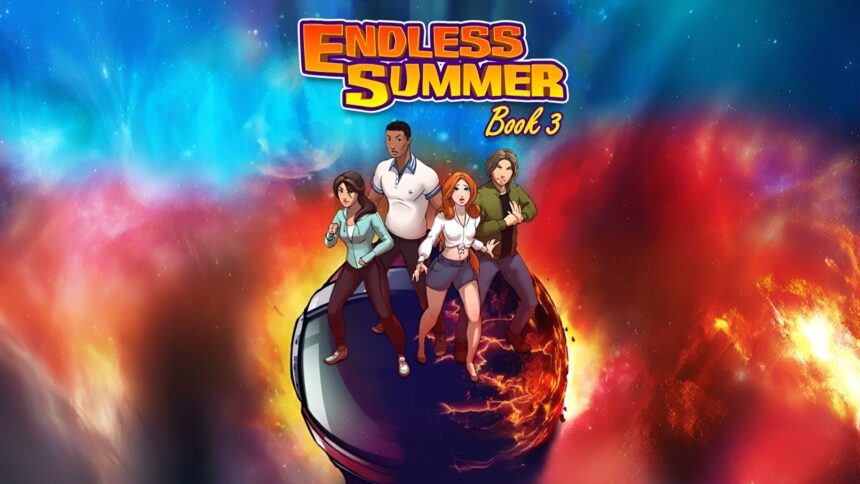
Closing out a trilogy built around time, identity, and the specific terror of growing up is a tall order for any interactive story. Endless Summer, Book 3 wraps its saga with a finale that its own writing team has described as an experiment in giving the whole thing real emotional stakes rather than a simple mystery box resolution. This final entry pulls its returning cast into confronting the full truth behind the island. Sean, Jake, Quinn, Estela, Diego, Grace, Raj, Michelle, Zahra, Craig, and the rest of La Huerta’s stranded classmates all have to face the mysterious being called the Endless, the shadowy figure Rourke, and the reality-warping entity Vaanu at the heart of everything.
Pixelberry Studios developed this as the concluding chapter to the story begun in Book 1’s tropical island vacation gone wrong, released within the wider Choices: Stories You Play mobile platform. Writer Taage, part of the team behind this final entry, has spoken about the challenge of wrapping up two prior books’ worth of startling revelations without the ending feeling rushed or unearned. Book 1 ran from December 2016 through April 2017, Book 2 followed that June through October, and the studio’s own announcement placed Book 3 arriving that December, closing the trilogy out within roughly a year of its original debut. As with the rest of the Choices platform, reading through the story is free. An optional diamond currency covers premium choices and cosmetic outfits along the way, though nothing behind that currency is required to see any of the three possible endings through to completion.
The sheer ambition of the structural choice underpinning the whole finale is what actually resolves this trilogy-spanning mystery for me. Rather than a single fixed conclusion, the story builds toward three distinct endings, each representing a different emotional and thematic stance on the story’s core question about clinging to the past versus accepting loss and moving forward. One path resets a significant amount of relationship progress built across the entire trilogy in exchange for restoring something closer to a normal life, a real, painful trade-off that lands exactly the way it was clearly designed to. A second path keeps the found-family bond between the whole cast intact, though it costs something real in the wider world beyond the island, ending on a quieter, more contained note. A third path closes the story on a considerably more somber, selfless note, weighing what the rest of the cast gets to keep against what the player character personally has to give up to make that possible. I won’t get into which specific consequences follow which choice, since sitting with that uncertainty is part of what makes the decision land as hard as it does. A mid-story conversation with a figure the story calls the clockmaker even lets you signal which of these three philosophies you personally lean toward, without locking you into that path outright. It’s a small but thoughtful touch that primes you for the actual decision well before it arrives.
That willingness to let the finale’s central choice carry real, permanent, occasionally heartbreaking weight, rather than funneling every path back toward a safely happy default, is the thing I respected most about how this trilogy chose to end. The story’s handling of that decision benefits considerably from a well-executed narrative device too. A mid-story time loop forces you to relive events with a growing understanding you didn’t have the first time through, giving the eventual choice between endings real accumulated context rather than presenting three cold, abstract options at the last possible moment. A separate character, IRIS, an artificial entity created from a fragment of Vaanu combined with the group’s own collective imagination, adds an additional wrinkle to how the story frames identity and creation that I wasn’t expecting going in.
The finale’s character work delivers on relationships built across the full trilogy’s runtime, and I felt real investment paying off by the story’s conclusion in a way that read as earned rather than manufactured for a season finale’s sake. The core cast still splits along the same contrasting personality lines it always has. Sean’s steady kindness and Quinn’s bubbly warmth play against Jake’s cynical edge and Estela’s more guarded, abrasive front, and Book 3 leans on those established contrasts rather than reinventing anyone at the last minute. That said, the finale’s comparatively short length, the shortest of the three books, means I walked away wanting more room for that emotional payoff to breathe, particularly given how much narrative and character weight the ending needed to carry in such a compressed space.
Where the book runs into real, fair criticism is pacing consistency in service of that emotional goal. The compressed chapter count means certain plot and character threads get resolved somewhat abruptly relative to how much setup they received across the earlier two books. The reality-bending, flashback-and-flashforward structure, borrowed loosely from shows like Lost, asks for real, sustained attention to keep track of which version of events, and which potential future, is currently playing out at any given moment. For anyone who stuck with the mystery-solving instincts this series has always rewarded, that density pays off considerably. For anyone hoping for a more straightforward, easily digestible conclusion, the finale’s structural ambition may test patience.
Presentation carries the trilogy’s established visual identity through to its conclusion with real consistency, and the accompanying soundtrack does real, effective work reinforcing the finale’s shifting emotional registers across its three possible conclusions.
Verdict
Endless Summer, Book 3 closes out its trilogy with real ambition, delivering three meaningfully distinct endings that let years of accumulated relationship-building and mystery-solving actually matter rather than funneling every choice toward a single safe conclusion. Its compressed chapter count occasionally rushes plot and character resolution that deserved more room to land, and its flashback-heavy structure demands real, sustained attention to fully track. For anyone who followed this cast through the full trilogy, though, this delivers a satisfying, emotionally weighty send-off that earns the affection this series clearly built across its full run.