Every character at Saint Angraecum Academy carries a flower’s name and its full symbolic weight, and this yuri visual novel clearly wants that motif read as more than pretty theming. Rikka Hanabishi’s own name ties to the lily, dignity and purity and splendor bound up in a single flower, and that kind of deliberate pairing runs through the entire cast rather than existing as a one-off flourish limited to just one or two characters. Suoh Shirahane arrives at this secluded, walled-off all-girls school already carrying real damage. Raised by a distant grandfather after her mother’s death and a stepmother whose harsh piano lessons left her unable to touch a keyboard without flinching, she now faces the academy’s own bonding system, called Amitié, which forces her into exactly the kind of social contact her anxiety has spent years teaching her to avoid.
Innocent Grey handled both development and publishing for the Japanese release on April 18, 2014. JAST USA brought the English localization west that August, following a planned March release that got pushed back specifically to allow for heavier editing and quality assurance after translation issues surfaced in an earlier demo. This marks the first of four planned entries, one for each season, with Flowers -Le Volume sur Été- following the next year to center on a different character entirely. The whole series draws its primary inspiration from Class S yuri storytelling and Maria-sama ga Miteru specifically, a genre lineage that shows clearly in the school’s insular, tradition-bound social structure. It also marks a deliberate departure from Innocent Grey’s other work. Unlike the studio’s earlier visual novels, which lean on adult content and frequently build around character deaths, Flowers avoids both, focusing instead on everyday school life and the mysteries the cast works through together.
What sets Flowers apart from a lot of gentler yuri visual novels is how seriously and specifically it treats Suoh’s anxiety rather than using it as a quirky character trait to be overcome in a single triumphant scene. Suoh’s internal monologue captures the exact, exhausting loop of a socially anxious teenager convinced everyone around her is operating from total confidence while she alone is failing at basic interaction, and that portrayal lands as painfully relatable rather than performed for sympathy. Rikka, composed and quick to take a protective interest in Suoh after their first awkward encounter, and Mayuri Kohsaka, blunter and less polished than the academy’s usual refinement, anchor Suoh’s two main romantic paths as her assigned Amitié partners. Both relationships take real time working through the layered anxieties, about identity, about whether these feelings are even allowed, that the story refuses to rush past for the sake of a quicker payoff. The wider cast, Yuzuriha Yatsushiro, Ringo Sasaki, Nerine Komikado, and Erika Yaegaki among them, fills out Saint Angraecum with enough distinct personalities that the school feels like a real place rather than built solely to support Suoh’s own arc. Erika in particular ended up going on to headline the following seasonal entry, a sign of how much groundwork this first game does for the wider series beyond just its own central romance.
That patience is also the game’s clearest weakness. I found the pacing dragged more than once across the roughly twenty hours it takes to see everything, and this holds up as the least immediately satisfying of the four seasonal entries even as a starting point for the wider saga. The deduction sequences scattered throughout, where failing to correctly puzzle out a mystery leads straight to one of the seven available bad endings, felt more frustrating than clever to me given how sparse the clues sometimes are. I came away liking this cast a great deal while still finding the central mystery plot itself notably thinner than the character work surrounding it. Editing and grammar mistakes crop up with some frequency too, minor individually but noticeable across a read this long. That’s an odd residue given how specifically JAST USA delayed the release to address exactly that kind of issue beforehand, pushing the original March target back several months after translation problems turned up in an earlier public demo.
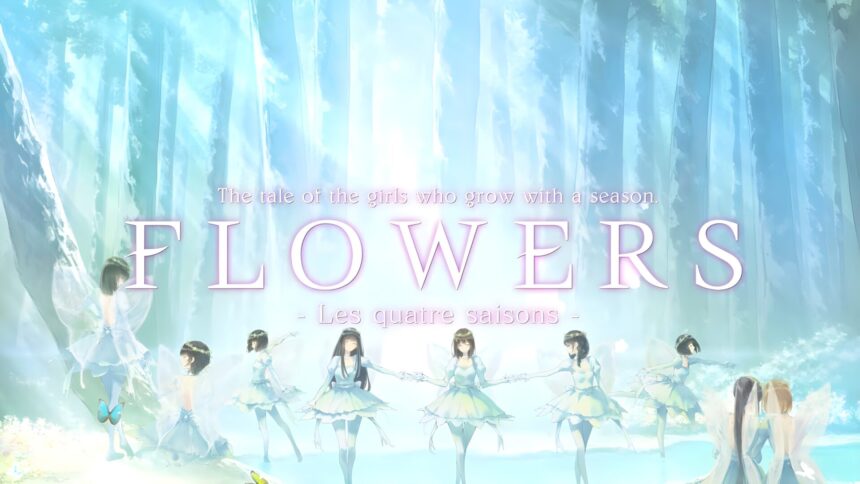
Presentation is where this earns its reputation without any argument needed. Miki Sugina’s character art is consistently gorgeous, every named-after-a-flower cast member visually distinct and striking, and the sheer number of CG illustrations rewards lingering on scenes rather than clicking past them. The Victorian-inflected backgrounds give Saint Angraecum real atmosphere, elegant and slightly otherworldly in a way that suits a story so preoccupied with fleeting, precious moments. Full Japanese voice acting covers the entire main cast, Yuka Nishiguchi as Suoh, Kei Mizusawa as Rikka, Ayane Sakura as Mayuri, Juri Nagatsuma as Yuzuriha, Rie Okamoto as Nerine, and Mitsu Takashiro as Erika, and performances range from solid to remarkably striking across the board. The piano-centered soundtrack ties directly back into Suoh’s own trauma in a way that gives even quiet scenes real emotional undertone, though the default audio mix has a real, noticeable problem with music drowning out dialogue that’s worth adjusting in settings before diving in. Two tie-in drama CDs, Girls’ Day Off and Nighttime Ghost Stories, both featuring Suoh, Mayuri, and Rikka, give that same trio of voices somewhere to live outside the main story itself, worth seeking out once the base game is done. An official fanbook released around the same time collects art and character material from the game itself.
Verdict
Flowers -Le volume sur printemps- succeeds most as a thoughtful portrait of social anxiety and early queer identity, giving Suoh’s slow, hard-won growth real psychological weight rather than treating her anxiety as a simple obstacle to clear. Its deliberately slow pacing and occasionally frustrating deduction sequences keep it from being the strongest entry in its own series, and its mystery elements never quite reach the same quality as its character work. Still, the gorgeous art, strong voice performances, and Suoh’s own affecting arc make it easy to understand why this remains a beloved starting point for anyone willing to meet its unhurried rhythm on its own terms.