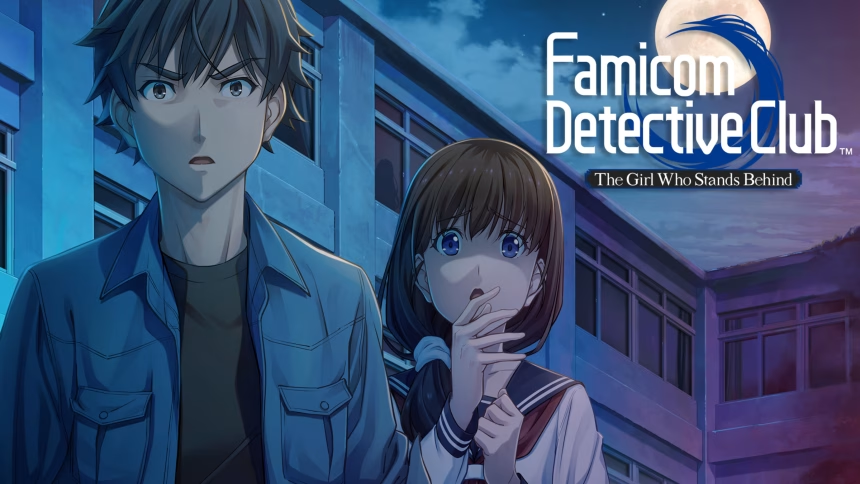
A body pulled from a river dressed up to look like suicide is a classic mystery hook, and it’s a real surprise that this particular version of that hook first appeared on the Famicom back in 1989, decades before it ever reached western audiences. This is actually already the second time Nintendo has remade the original 1989 game. A Super Famicom version came first in 1998, directed by Tomoyoshi Yamane with music once again composed by Kenji Yamamoto, before this fuller overhaul finally brought the whole story west for the first time in its history. Having played the earlier Missing Heir first, I can say this particular entry earns its reputation as the stronger of the two without much real argument.
Mages. developed this Switch remake under director Yasuhiko Nomura, working from a scenario Nagihiro Asama wrote based on a concept by Yoshio Sakamoto, whose original work on this series marked his very first writing credit before he went on to far greater recognition with Metroid. This second Famicom Detective Club game specifically owed its existence to how well the first one, The Missing Heir, actually performed, prompting Nintendo to commission a direct sequel using that same graphic-adventure gameplay rather than letting the whole format end after just one single release. Toru Osawa served as scenario supervisor on the original two games, with Daisuke Beppu and Chiaki Okubo handling scripting duties on this specific remake, and Yukihiro Matsuo taking the lead art credit. Composer Takeshi Abo built an entirely new arrangement of Kenji Yamamoto’s original score specifically for this occasion. Nintendo released this alongside a simultaneous remake of The Missing Heir on May 14, 2021, worldwide, after both games slipped from an originally planned 2020 release, marking the first time either title had ever officially reached players outside Japan. The wider Famicom Detective Club duology drew its own inspiration from Enix’s The Portopia Serial Murder Case, Dario Argento’s horror filmography, and Seishi Yokomizo’s detective fiction. Its fingerprints show up clearly in later Japanese adventure games like Ace Attorney and Hotel Dusk, both released decades after these two original games had already faded from most western memory entirely.
The protagonist, having run away from home, gets taken in by detective Utsugi and drafted into his agency, and his very first solo case involves a high school girl named Yoko found strangled and left in the river to look like a drowning. Working alongside Yoko’s two closest friends, Ayumi Tachibana and Hitomi Kawai, the investigation quickly widens well past a straightforward murder. It tangles with a school-wide urban legend about a bloodied ghost girl called the titular Girl Who Stands Behind, a story every character treats with real dread rather than campfire spookiness. That willingness to let the mystery breathe into something eerie, rather than just procedural, gives this entry a darker, more atmospheric tone than its sunnier, will-dispute-driven predecessor. That shift is a big part of why this prequel outshines the game that technically came first in release order.
Ayumi herself gets real, meaningful development here that she never actually received in her limited role in The Missing Heir. Watching her push through real grief to help solve her friend’s murder gives her a presence worth rooting for in a way the first game’s cast rarely managed. That improved characterization extends to the mystery’s structure too, weaving Yoko’s murder together with the school’s ghost legend in ways that reward patient, attentive investigation rather than treating the supernatural angle as a cheap distraction from the real underlying plot. It’s worth noting that some of the dialogue involving Ayumi and Yoko underwent noticeable localization changes for the English release, changes that don’t track precisely with the original Japanese script. That distinction matters if you ever swap impressions with someone who played the original Japanese version instead of this one.
Where this entry inherits its clearest weakness directly from its predecessor is progression logic. For most of the game, following clues and knowing exactly where to go next stays logical if I’m paying attention. As the story heads toward its conclusion, though, progression frequently demands clicking on unlabeled parts of objects or navigating confusing event sequencing that no amount of careful reading would reasonably anticipate. It’s a real, persistent flaw that forces trial and error at exactly the moments the mystery’s tension should be at its very highest.
Presentation carries the whole package well past what a game this old actually has any right to look and sound like today. Crisp, modern character art gives every figure real visual presence. A full voice cast brings real performance to dialogue that originally had none, Megumi Ogata as the protagonist, Yûko Minaguchi as Ayumi, Riki Kagami as Utsugi, Rikiya Koyama as Hitomi, and Michitaka Kobayashi as Tetsuji Komada, all under voice director Kazuhiro Ichikawa. Three selectable soundtracks, Abo’s newly arranged score, the original Famicom chiptunes, and the Super Famicom remake’s own music, let you tailor the atmosphere to your own personal taste, without any single option ever feeling out of place sitting next to the other two. A Japan-only collector’s edition packaged both remade games on a single cartridge alongside an artbook and soundtrack CDs, and the pair was also sold as a discounted bundle digitally too, for anyone picking up both at once rather than choosing between them individually.
Verdict
Famicom Detective Club: The Girl Who Stands Behind earns its reputation as the stronger of Nintendo’s two Famicom Detective Club remakes, using a creepy urban legend and a meaningfully developed Ayumi to build a darker, more atmospheric mystery than its predecessor managed. The remake’s presentation, crisp modern visuals, full voice acting, and a choice of three distinct soundtracks, brings a genre-founding piece of Nintendo history to western audiences with real care and polish. Frustrating, arbitrary progression blocks late in the story are a real and persistent flaw inherited from the original 1989 design, but for anyone willing to push through occasional trial-and-error frustration, this remains an engaging, historically significant piece of mystery gaming worth experiencing.