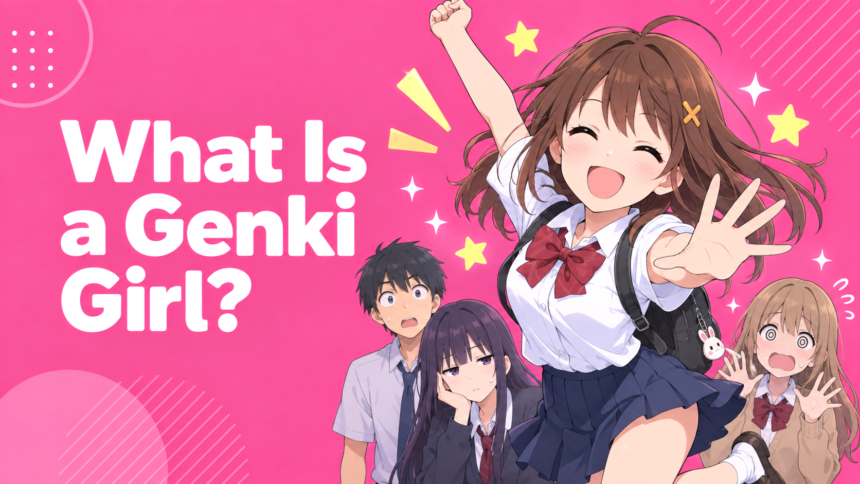
A genki girl is a character archetype from Japanese anime, manga, and visual novels describing a female character defined by seemingly inexhaustible energy, enthusiasm, and a proactive, cheerful approach to everything she does. She runs rather than walks, speaks quickly and loudly, dives into every situation headfirst, and radiates a vitality that affects everyone around her, sometimes charmingly, sometimes exhaustingly, and often both at once.
The term comes directly from the Japanese word genki, written as 元気, which carries meanings of energy, good health, high spirits, and vigour. TV Tropes defines the genki girl as a character possessed of an over-abundance of energy, such that she runs everywhere, speaks quickly and sometimes unintelligibly, and always does everything fast, fast, fast. That description captures the archetype at its most straightforward: a character who lives her life at full speed and whose energy is the defining quality through which everything else about her is expressed.
The Meaning of Genki
The word genki is worth understanding on its own terms before examining the character archetype that takes its name from it. In modern Japanese, genki functions both as an adjective describing someone as energetic or healthy and as a greeting, with the question genki desu ka meaning something close to are you doing well or are you full of energy today. Its kanji, 元気, carry the meaning of original spirit or vital energy, a concept borrowed from ancient Chinese philosophy referring to the primal energy that underlies all things.
As the calendar-canada.ca etymology note explains, the kanji for genki mean original spirit or good health and high vigor, and the term was used in ancient China to refer to a primal energy that makes up all things. In contemporary Japanese, the word has narrowed to a more everyday meaning, but the vitality and life-force dimension of its original meaning remains relevant when understanding why it was chosen to name this particular character archetype.
A genki girl is therefore, in the most literal sense, a girl who embodies original spirit. Her energy is not performed or calculated. It simply is, and it expresses itself in everything she does.
The Core Traits of a Genki Girl
The Backstage analysis of the genki girl archetype identifies the core defining quality as sheer energy, noting that genki girls are lively, talk a lot, and play an active role in their own lives. Beyond that foundation, the archetype clusters around a recognisable set of consistent traits.
Physical expressiveness is one of the most immediately visible qualities. Genki girls run rather than walk, gesture broadly, and inhabit space with a physical confidence and restlessness that marks them visually even before they speak. The TV Tropes documentation describes her as running everywhere, often with her arms outstretched or waving, and doing everything at speed.
Vocal expressiveness comes alongside it. The genki girl talks quickly, talks loudly, and talks a lot. She rarely filters her enthusiasms before expressing them. She is the character most likely to shout across a crowded room, narrate her own reactions in real time, and generate noise that others find difficult to keep pace with. Voice actors working with genki characters in anime are noted for the endurance the role demands, since sustaining the energy across extended recording sessions is physically demanding in ways that quieter character types are not.
Optimism and confidence are consistent regardless of whether the genki girl is actually competent. The TV Tropes entry on the archetype notes that she is filled with confidence and determination regardless of whether she is competent or not. This is one of the most distinctive qualities of the type: her enthusiasm is not contingent on success. She charges forward regardless of the odds, fails without losing momentum, and bounces back without visible damage to her self-belief. This is also what distinguishes her from characters who are confident because they are skilled, which is a very different type.
Social involvement is almost universal. Genki girls are rarely loners and rarely quiet observers. They insert themselves into situations, pull other characters into activities they had not planned on joining, and create social energy wherever they go. The CBR analysis of the archetype notes that genki girls love to live it up, enthusiastically moving from one experience to another, having loud conversations, going to the arcade or amusement park, playing sports, or pulling good-natured pranks. The specific activities vary but the pattern of active, outward-directed social engagement is consistent.
The Genki Girl as a Foil
One of the most common structural roles the genki girl plays in fiction is that of a foil to a quieter, more reserved protagonist or co-character. The Backstage analysis of the archetype notes that she is often a foil to a more straight-man protagonist, serving to both exhaust and frustrate while never intending either effect. This dynamic appears in visual novels, anime, and manga with sufficient regularity that it is essentially a structural convention of the archetype rather than an incidental use of it.
The contrast between the genki girl’s expansive energy and a quieter character’s restraint does a specific kind of narrative work. It creates comedic friction, generates situations, and draws the quieter character out of patterns they would otherwise remain in. The genki girl’s cheerful refusal to take no for an answer, combined with her genuine warmth toward the people she pulls into her orbit, makes her a catalyst for stories involving social connection and characters who struggle with it.
This foil function also explains why the genki girl is so commonly used in romance-focused visual novels and anime. Pairing an energetic, socially proactive genki girl with a quiet or introverted protagonist creates a dynamic where the relationship does not depend on the protagonist initiating, which removes a structural barrier that otherwise requires considerable narrative work to overcome.
The Genki Girl in Visual Novels
The genki girl is one of the common romantic interests or heroines in romance and harem anime as well as visual novels and dating simulations, as the Anime Clichés analysis notes. In the context of multi-route visual novels, she typically appears as one character in a cast where the routes represent different types of relationship dynamics, and her route provides the warmest and most immediately accessible contrast to the more reserved or complicated routes built around other characters.
Minori Kushieda from Toradora is cited by J-List as a defining example, described as a favourite genki girl precisely for the combination of relentless energy and the genuine complexity that occasionally surfaces beneath it. The anime cliché analysis notes that approximately a third of genki girl characters have dark or sad backstories that explain their outward energy, a reveal that is common enough to be considered its own recognisable subcliche. A genki girl who is discovered to be maintaining her cheerfulness over something difficult produces a specific emotional effect, because the energy the reader or viewer has been responding to throughout is suddenly recontextualised as something the character has chosen and worked to sustain rather than something that comes naturally without effort.
This backstory dimension is particularly effective in visual novel routes, where the format’s ability to spend dozens of hours with a character before the reveal creates a much deeper investment than an anime episode can build. By the time a genki girl’s route in a visual novel reaches its moment of vulnerability, the reader has spent enough time with her cheerfulness to feel the full weight of what it has been concealing.
For visual novels featuring vibrant ensemble casts where this archetype frequently appears alongside dandere, tsundere, and kuudere characters, our top 10 romance visual novels and top 10 slice of life visual novels cover the best available titles. The contrast between character types in multi-route games is one of the medium’s most distinctive pleasures, and understanding what each archetype brings to a cast helps explain why the combinations work. Our Clannad walkthrough and Clannad review cover one of the medium’s most celebrated ensembles, while the Summer Pockets review and Summer Pockets walkthrough cover a more recent Key title with similarly varied character types.
The Genki Girl vs the Deredere
The genki girl and the deredere archetype share significant surface overlap and are sometimes conflated in community discussions. Both are outwardly warm, enthusiastic, and openly affectionate. The distinction is one of emphasis and mechanism.
The deredere is defined specifically by being lovestruck and openly affectionate toward a romantic interest. The affection is the defining quality, and the warmth is directed toward the person they love. The genki girl is defined by energy that is directed outward toward everything and everyone, not specifically toward a love interest. Her enthusiasm applies equally to a sports game, a new food, a conversation with a stranger, and a moment with the protagonist. The deredere’s warmth is specifically romantic. The genki girl’s energy is simply who she is, applied uniformly to all of life.
A genki girl can also be a deredere in romantic contexts, and many are. The archetypes are not mutually exclusive. But genki describes a quality of energy and engagement with the world, while deredere describes a pattern of romantic expression. A character can have one without the other.
The Genki Girl as a Positive Presence
One of the most consistent notes across community discussions of the genki girl is the warmth with which the archetype tends to be received. She is rarely a villain and rarely a source of genuine conflict. The All The Tropes documentation of the archetype notes she is rarely a villain, she is often a foil to a more straight-man protagonist, and while she may be draining to others, this is never her intention, just a product of who she is.
This innocence in intent is part of what makes the archetype likeable rather than irritating to most audiences. Her energy is not directed at anyone. She is not trying to overwhelm, frustrate, or compete. She is simply living at full speed and bringing everyone around her along involuntarily. The friction she creates is incidental to her nature, not a goal or a strategy.
The genki girl also tends to represent the kind of life-affirming quality that stories use to pull quieter or more withdrawn characters out of their shells. In that structural role, she is as much a force of narrative momentum as a character in her own right, providing the energy that makes stories move.
Where to Find the Archetype in Visual Novels
The genki girl appears across virtually every visual novel genre that includes romance or ensemble casts. She is particularly common in school-setting visual novels, slice-of-life titles, and harem-format games where varied cast dynamics are a central feature.
For readers new to visual novels who want to understand how the genki girl archetype fits within the broader landscape of character types they will encounter, our guide on how to get into visual novels covers the format’s conventions and where to start. Our articles on what a tsundere is, what a dandere is, and what a kuudere is cover the dere types the genki girl most commonly appears alongside in multi-route visual novels. For readers exploring the school visual novel subgenre specifically, our top 10 school visual novels covers the titles where these character dynamics are most fully developed.
The visual novels glossary defines genki alongside the full range of character archetypes and visual novel terminology that comes up in community discussions of the medium.