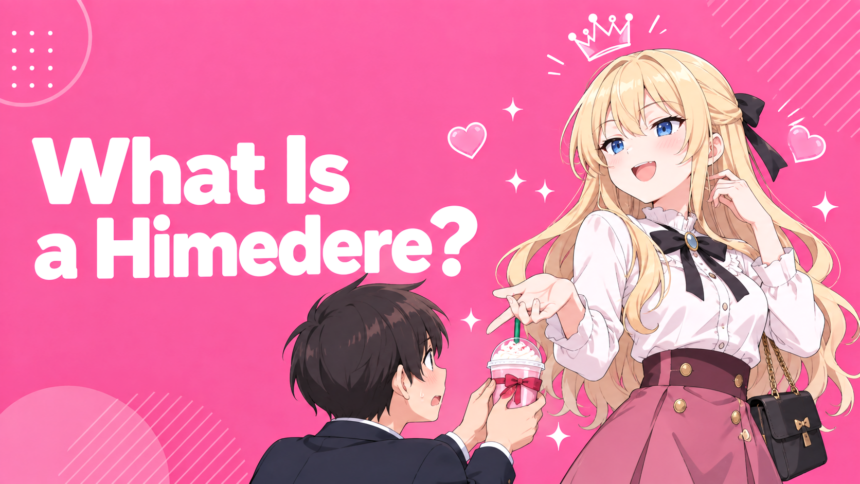
A himedere is a character archetype from Japanese anime, manga, and visual novels describing a female character who presents herself with the pride, elegance, and demanding attitude of royalty — often expecting to be treated as a princess by those around her — but who conceals genuine warmth and vulnerability underneath that regal exterior. The haughtiness is real. The desire for admiration is real. What the archetype complicates is the assumption that this is all there is to the character, because the journey from demanding princess to someone capable of genuine affection is where the himedere’s story actually lives.
The Dere Types Wiki defines the himedere as a term for a female character of nobility who starts out wanting their love interest to constantly give them lots of attention and affection, but who adopts a different, softer demeanor as the relationship develops. That definition captures the essential arc: demanding first, softer eventually, with the gap between the two being the emotional territory the archetype explores.
Where the Word Comes From
Himedere is a portmanteau of two Japanese words. The first is hime, written as 姫, meaning princess or noble lady. The second is dere, from deredere, meaning lovestruck or openly affectionate. Combined into himedere, the word describes a character who is a princess on the surface and lovestruck underneath, in a way that the surface initially makes very difficult to see.
The HubPages analysis of the archetype frames it clearly: much like the term tsundere refers to someone who masks their lovestruck feelings with a rude or feisty attitude, the himedere masks those feelings with the hauteur of a princess or noble. The mechanism of concealment is different from other dere types but the underlying structure is the same. There is genuine feeling underneath a surface that makes it hard to reach.
The term appears to have first circulated in Japanese internet communities around 2008, with the Dere Types Wiki tracing early documented usage to that period. Its popularisation followed the same trajectory as other dere type labels: fan communities needed precise vocabulary for a pattern they kept encountering in media, coined a term to describe it, and the term spread through anime and visual novel discussion communities until it became standard vocabulary.
The Core Traits of a Himedere
The Dere Types Wiki describes the himedere as very prim, proper, and ladylike due to their status as a noble lady, which makes them feel they deserve to always be the centre of their love interest’s attention. This sense of entitlement to attention and admiration is the most visible surface quality of the archetype and the one that distinguishes it most clearly from related types.
A himedere character typically presents with physical elegance. Her manner is refined, her speech is formal or elevated, and she carries herself with the posture and bearing of someone who has always expected to be the most important person in any room. She may use archaic or formal speech patterns in Japanese, a device that signals social elevation and is recognisable to Japanese audiences as a marker of aristocratic self-presentation.
She is demanding. She expects attention, service, and admiration from those around her, and she expresses displeasure when these are not forthcoming. Unlike the tsundere, whose hostility toward the love interest is the surface of concealed affection, the himedere’s demands are rooted in an expectation of status rather than in suppressed emotion. The mytour.vn archetype analysis describes her as proud, regal, and craving attention, yet hiding a more vulnerable and tender personality beneath.
The vulnerable dimension is essential to the archetype. The himedere is not simply an arrogant character who happens to have a love interest. She is a character whose pride and demanding behaviour conceal genuine emotional need. The HubPages analysis notes that the haughty attitude of many himedere characters is revealed over time to be the result of strict, overbearing parents or circumstances that demanded she maintain a particular image. The pride is often a performance of what she was raised to be rather than a genuine reflection of how she regards others.
The Himedere’s Arc
The emotional arc of a himedere character typically involves the gradual erosion of the princess facade through genuine relationship with a specific person who refuses to simply comply with her demands. The love interest who treats her as an equal rather than as royalty creates the conditions in which the himedere’s actual personality can emerge.
The Mytour archetype analysis describes the himedere as often undergoing a journey of personal growth, embracing their emotional side. That journey is the dramatic engine of the archetype. The reader or viewer watches someone who presents as supremely self-sufficient and demanding gradually reveal that the demands are compensation for a more fragile inner experience: the need to be genuinely valued by a specific person rather than simply deferred to by everyone.
This arc has real narrative satisfaction because it inverts the expectations established by the character’s opening presentation. A character who appears to have all the power in any social situation is revealed to be seeking something specific that her status cannot provide. Genuine affection cannot be commanded. The himedere’s arc is built around the discovery of this limitation and what it costs her to acknowledge it.
How the Himedere Differs From Related Types
The himedere shares some surface qualities with other archetypes while being fundamentally distinct from all of them, and understanding those distinctions helps clarify what the archetype specifically is.
The tsundere, as our article on what a tsundere is covers, conceals warmth behind active hostility directed specifically at the love interest. The tsundere’s hostile behaviour is itself evidence of the feelings underneath. The himedere’s pride and demands are not directed specifically at the love interest in the same way. They are a general presentation of status that the love interest must penetrate rather than a displaced expression of emotion toward them.
The kuudere, as our article on what a kuudere is explains, is reserved and emotionally controlled rather than demanding and status-conscious. The kuudere’s quietness comes from emotional restraint. The himedere is not quiet at all. She is expressive, demanding, and highly visible. The surface quality is entirely different even though both conceal genuine warmth.
The kamidere is the archetype most closely related to the himedere and the one most commonly confused with it. Where the himedere sees herself as a princess and wants to be treated as royalty, the kamidere sees herself as a deity and wants to be worshipped. The Mytour analysis of the himedere notes that kamidere characters are even more commanding than himedere, lacking the refined, ladylike behaviour typical of himedere, and demanding reverence rather than merely attention. The himedere has elegance as a core quality. The kamidere does not require it.
The Note About Nobility
The himedere archetype is specifically associated with nobility or at least the presentation of noble status, but the Dere Types Wiki and community discussions clarify that the character does not need to be a literal princess to qualify. She needs to present herself as one and to expect to be treated as one. Characters from wealthy families who have cultivated an aristocratic self-image, characters who were raised in environments that demanded formal behaviour, and characters who have adopted a princess persona as a protective identity all qualify as himedere regardless of their actual lineage.
The HubPages analysis makes this explicit, noting that the himedere may not be a literal princess, as many examples are the rich girl type. The character who maintains an elaborate facade of wealth and superiority even after her family has lost its fortune qualifies precisely because the archetype is about the performance of princess status rather than the reality of it.
This distinction matters for how himedere characters function dramatically. The gap between the princess persona and the reality underneath is often the source of the character’s most interesting moments, whether that gap is between inherited status and emotional vulnerability, between maintained appearances and changed circumstances, or between a demanding exterior and a sincere and simple desire to be genuinely liked.
Himedere Characters in Anime and Visual Novels
The himedere appears across anime, manga, and visual novels wherever wealthy, aristocratic, or status-conscious female characters are part of the cast. She is particularly common in school settings, where the gap between social hierarchy and genuine connection creates natural dramatic territory for the archetype to operate in.
Erina Nakiri from Food Wars: Shokugeki no Soma is one of the most cited himedere examples, described by the Ikigai-Box dere type guide as displaying a snobbish attitude and high standards while concealing emotional depth beneath. Her God Tongue ability and her position as the top culinary authority in the school creates a status dynamic that her character arc then systematically complicates.
Satsuki Kiryuin from Kill La Kill is another frequently cited example, with the HubPages analysis noting that her haughty attitude is revealed to be the result of strict, overbearing parents, which is one of the most common backstory structures used to contextualise himedere behaviour.
In visual novels, the himedere appears regularly as one of the cast members in multi-route romance titles, typically positioned as the most initially formidable and most apparently inaccessible potential love interest. Her route is often the one that requires the most patience to access and the most sustained engagement to unlock the genuine warmth underneath the demanding surface. For titles featuring exactly this kind of character dynamic, our top 10 otome visual novels covers games where aristocratic and status-conscious love interests of this type appear at their best. Our Collar x Malice review and Code: Realize review both cover titles with characters whose proud, demanding exteriors conceal genuine depth, which is the himedere dynamic at its most narratively satisfying.
The Olympia Soiree walkthrough and Olympia Soiree review cover a title with a particularly well-developed cast of aristocratic characters navigating status and genuine feeling, which represents the kind of setting where himedere dynamics appear most naturally.
The Himedere’s Appeal
The himedere’s appeal to audiences reflects something consistent about how status and vulnerability interact in compelling fiction. A character who appears to have everything, including elegance, status, and the compliance of those around her, is made dramatically interesting by revealing what that apparent completeness cannot provide.
The specific pleasure of the himedere arc is the discovery that her demands are not expressions of arrogance but expressions of need. The person who sees through the princess performance to the genuine person underneath, and who offers that person something the performance was designed to attract but could never actually earn, is doing something genuinely meaningful within the story’s terms. The himedere’s arc is about the difference between being deferred to and being genuinely valued, and that distinction is one that resonates beyond the fictional context.
For readers exploring the full range of character types that appear in visual novel and anime communities, our visual novels glossary defines himedere alongside tsundere, yandere, kuudere, dandere, kamidere, and the other terms used regularly in discussion. Our what is a visual novel page covers the medium’s basics for readers new to the format, and our top 10 visual novels for beginners covers the best titles to start with before exploring the character archetypes in depth.