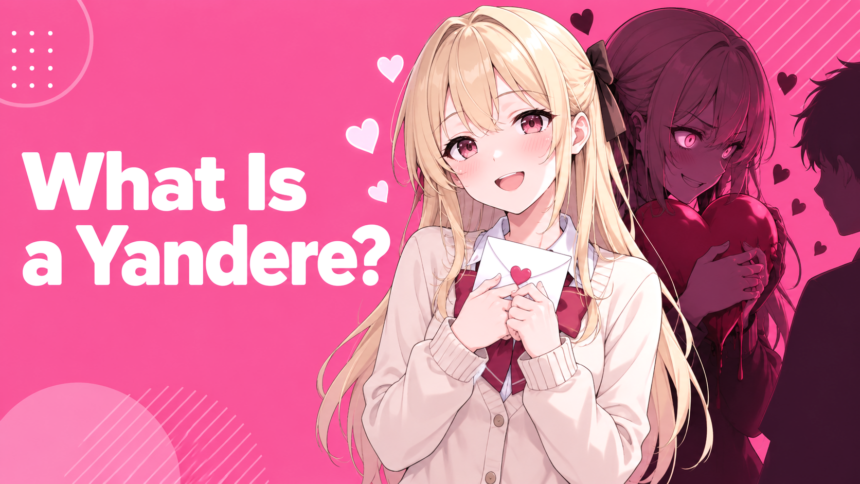
A yandere is a character archetype from Japanese anime, manga, and visual novels describing someone who initially presents as deeply loving and affectionate but whose feelings gradually reveal themselves to be obsessive, possessive, and often dangerous. The sweetness is real. The love is real. What makes the archetype distinctive is that those genuine feelings have crossed a threshold into something that cannot accommodate the autonomy, wellbeing, or sometimes the continued existence of anyone who threatens the bond the yandere has formed with the object of their devotion.
The term is one of the most widely recognised character archetypes in anime and visual novel culture, and it has expanded well beyond those communities into general online usage.
Where the Word Comes From
Yandere is a portmanteau of two Japanese words. The first is yanderu, written as 病んでる, meaning to be sick, mentally unwell, or emotionally troubled. The second is dere, from deredere, meaning lovestruck or openly affectionate. Combined into yandere, the word describes someone who is, in the most literal sense, sick with love.
The concept of obsessive and dangerous love is far older than the word. It appears in Greek mythology, in Japanese folklore’s tradition of jealous spirits and vengeful ghosts, and across centuries of storytelling in every culture. What the word yandere did was give a specific name to a specific pattern that anime and visual novel audiences had been encountering for years and needed precise language to discuss.
The term emerged from Japanese internet culture, particularly on the bulletin board site 2channel, around the early 2000s. The Dere Types Wiki notes that the concept gained wider cultural acceptance around 2005, when the violent behaviour of specific characters in visual novels and anime provided memorable reference points that anchored the word to recognisable examples. By the late 2000s the term had entered Western anime fandom through the same channels that spread other Japanese fandom vocabulary, and it has been in consistent use across English-language communities since.
What Makes a Yandere
The defining qualities of the yandere archetype are not simply violence or instability. The Dere Types Fandom Wiki is explicit about this: because it is common for people to share only the endings of yandere media, which are often shocking and violent, a false impression has formed that the entire archetype is only about grotesque scenes and bloodshed, when this is actually one of the least important aspects of what makes a yandere character.
The core of the archetype is the combination of genuine love and the inability to maintain boundaries around that love. A yandere character typically begins in a presentation that is warm, caring, and visibly devoted. Their affection for the object of their feelings is sincere and often portrayed as total, the kind of complete investment in another person that most love stories present as an ideal. The problem is not the love itself. The problem is that the love has no boundaries, no recognition of the other person’s independent existence, and no tolerance for anything that might diminish or threaten it.
This produces the specific pattern that characterises the archetype: a character who is sweet and devoted in one mode and becomes dangerous in another, triggered by real or perceived threats to the relationship. Those threats can be other potential romantic interests, situations that demand the beloved’s attention, expressions of independence from the person they love, or sometimes simply the discovery that the person they love is not fully and exclusively theirs.
The Four Common Types
The StoryNight analysis of yandere characters identifies four common subtypes that describe different expressions of the archetype’s core dynamic.
The possessive yandere controls their love interest through monitoring, restriction, and the elimination of outside relationships. The goal is ensuring that the beloved cannot be with or influenced by anyone else. The obsessive yandere engages in surveillance, stalking, and constant attention to every detail of the beloved’s life, driven by the need to maintain a complete and unbroken connection. The eliminative yandere removes rivals through manipulation, intimidation, or in more extreme fictional portrayals, violence, treating anyone who represents a threat to the relationship as a problem to be solved. The self-sacrificing yandere harms themselves, threatens self-destruction, or uses their own suffering as a mechanism to bind the beloved to them through guilt and obligation.
These are not mutually exclusive. A single yandere character may exhibit several of these patterns simultaneously, and many of the most celebrated examples of the archetype are complex enough that no single type fully captures them.
How the Archetype Works in Visual Novels
Visual novels are one of the formats most closely associated with the yandere archetype, both because the term crystallised partly within visual novel culture and because the format’s specific properties make yandere storytelling particularly effective.
The Dere Types analysis and the SCAD academic discussion of yandere in visual novels both note that the interactive element of visual novels contributed significantly to the archetype’s growth. In visual novels, players navigate complex relationship dynamics where seemingly innocent choices can reveal a character’s darker side. This discovery mechanism, where the reader’s own decisions expose the yandere’s true nature, creates a specific kind of horror and emotional weight that passive storytelling cannot replicate in the same way. The reader is implicated in what they find.
Visual novels also allow the story to build trust before breaking it. The warm and loving presentation of a yandere character can be maintained for hours of reading before the first cracks appear, and the investment the reader has built in the character during that period gives the revelation of their true nature its force. A reader who has spent twenty hours finding a character charming and caring experiences something specific when that character’s obsession becomes fully visible. A viewer who watches a twenty-minute anime episode build to the same reveal has less emotional architecture behind it.
Doki Doki Literature Club is the most widely discussed visual novel use of yandere elements in the Western market, though the archetype in that title is doing something more complex than conventional yandere storytelling. School Days, which began as a visual novel and received a widely discussed anime adaptation, is the title most directly credited with popularising the concept around 2005. You and Me and Her: A Love Story by Nitroplus is considered by the community to be one of the deepest and most thoughtful engagements with the archetype in any visual novel.
For readers interested in exploring yandere visual novels specifically, our top 10 yandere visual novels covers the best available titles with content warnings and honest descriptions of what each one does with the archetype.
Yandere vs Tsundere and Other Dere Types
The yandere is part of a family of character archetypes in Japanese popular culture that describe different patterns of expressing or concealing romantic affection, known collectively as dere types.
As our article on what a tsundere is explains, the tsundere archetype describes a character who is cold and prickly on the outside but warm underneath, and whose emotional arc moves from hostility toward affection. The surface behaviour is harsh but the underlying feeling is positive. The yandere in some ways inverts this: the surface behaviour is warm and loving, and what lies beneath it is something more complicated and more dangerous.
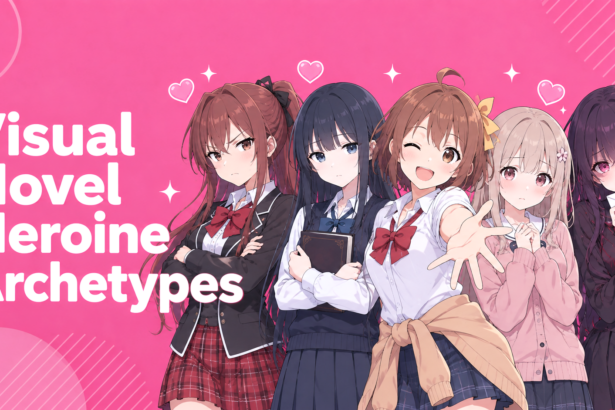
The kuudere is emotionally cool and reserved, expressing affection through understated action rather than open warmth. The dandere is shy and quiet, struggling to express feelings that are genuine and present. The deredere is openly and consistently affectionate without complicating layers. Each of these archetypes sits at the lighter end of the emotional spectrum relative to the yandere, whose defining quality is excess rather than restraint or concealment.
The yandere is the most extreme of the dere types because the emotional intensity crosses into harmful territory in ways the others do not. This is also what makes it the most dramatically interesting and the most morally complex to engage with.
Why the Archetype Endures
The yandere’s endurance as a cultural phenomenon reflects something genuine about what the archetype engages with emotionally.
The archetype externalises and dramatises the darker aspects of attachment that ordinary love stories prefer not to examine directly. Every person who has loved someone has experienced, at some level, the tension between wanting complete connection with another person and recognising that the other person is their own independent being with their own needs and autonomy. The yandere is what happens when that tension is resolved entirely in one direction, when the desire for connection obliterates any recognition of the beloved’s separateness.
Audiences find this compelling partly because it is recognisable at a safe remove. The seed of what a yandere feels is not foreign. The degree to which they act on it is what fiction allows to be explored without real-world consequences.
There is also a specific kind of appeal in the absolute certainty of devotion that a yandere represents. As our article on what a yandere game is discusses in more depth, the fantasy of being someone’s entire world, of being loved completely and without reservation, is one the archetype offers at a price that only fiction can safely charge.
An Important Distinction
The yandere is a fictional character archetype. The patterns it describes, obsessive love, possessiveness, the elimination of perceived rivals, and the inability to respect another person’s autonomy, describe genuinely harmful and dangerous behaviour when they occur in real relationships.
Using the term to describe a real person’s real behaviour, or applying it approvingly to actual situations involving control and possessiveness, misuses a fictional framework in ways that normalise behaviour that causes genuine harm. The yandere works in fiction because fiction provides distance and consequence-free exploration. Those conditions do not exist in real relationships.
For readers who want to explore the full vocabulary of character types that appears in visual novel and anime community discussions, our visual novels glossary defines yandere alongside tsundere, kuudere, dandere, and the other terms used regularly in the community.