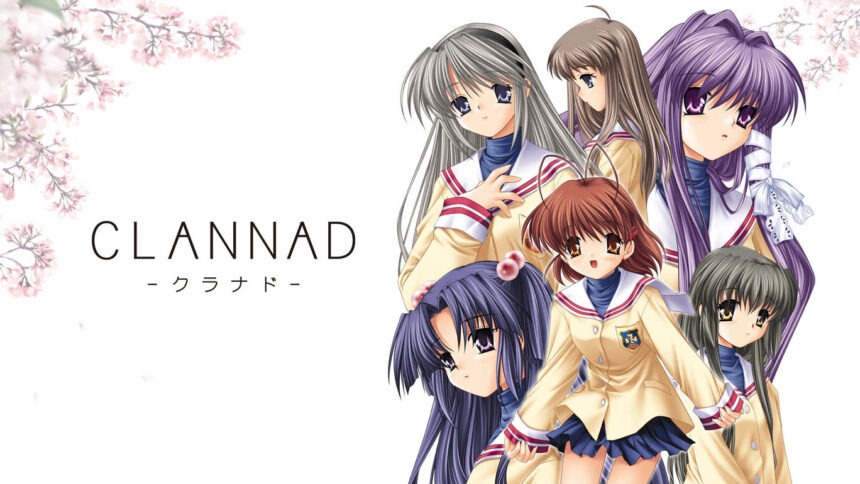
Few visual novels ask you to sit through this much cheerful high school comedy before hitting you with some of the most devastating storytelling I’ve experienced in the medium. CLANNAD spends its early hours looking like a pretty standard slice-of-life romance, and I’ll admit I wasn’t expecting much beyond that going in. Then it gradually reveals itself to be something far bigger, a story about family, loss, and the quiet work of rebuilding a life after everything falls apart. I came away thinking its reputation as a genre landmark is almost entirely earned, even though getting to the parts that earn it took real patience on my end.
I played as Tomoya Okazaki, drifting through his final year of high school, distant from his father and checked out from his own future, until a chance encounter with a strange, easily distracted girl named Nagisa on a hillside near school pulled me into her orbit. From there I got pulled into the lives of the rest of the school’s cast too. What started as a loosely connected set of individual heroine romances gradually built into something much heavier once the story shifted into its After Story arc.
Getting to that shift takes real time. Most of the individual heroine routes have to be worked through first, and that structural choice is both CLANNAD’s biggest strength and its most common complaint, mine included. Each route on its own offers a sweet, self-contained little arc. The problem is the ratio of meaningful content to comedic filler skews pretty heavily toward filler in a handful of the earlier paths, and getting through them before reaching the story I actually came for asked for a commitment measured in dozens of hours.
That patience paid off in a big way once After Story actually began. The shift from lighthearted school comedy into a story about marriage, parenthood, grief, and quiet perseverance caught me completely off guard, and the writing earns every bit of the weight it’s clearly building toward. There’s a recurring surreal subplot involving a strange, separate world running alongside the main narrative, and I’ll be honest, it never tied together as cleanly for me as the rest of the story did. It felt more disconnected from the emotional core than anything else here. It never derailed the bigger arc for me, though, just sat a little apart from it.
Nagisa is what anchors the whole thing. Her quiet warmth is exactly why the emotional stakes of After Story hit as hard as they do, and watching her relationship with Tomoya evolve from an awkward high school romance into something far more mature gave the back half of the story its entire foundation. The wider cast across the earlier routes ranges from genuinely well-built to fairly standard archetypal stuff, though even the characters who read as anime shorthand at first tend to grow real depth by the time their individual arcs wrap up.
The supporting characters introduced or expanded during After Story added real texture to the back half specifically. Adult figures who were mostly background presences earlier suddenly carry real weight once the story turns its focus toward family and responsibility. I noticed the character writing overall favors slow, patient development over quick emotional payoffs, and while that tested my patience at points, it suits what this story is actually trying to do.
The prose handles its tonal range well. Comedy in the early routes feels light and playful, genuinely funny in spots, while the writing in After Story shifts into something far more restrained and heavy without ever tipping into melodrama. Dialogue captures small, specific details of everyday life, a shared joke, a quiet moment between a parent and child, in ways that made the eventual emotional payoffs feel earned rather than forced on me.
The choice structure caused me real headaches throughout. Branching decisions aren’t always intuitive, and it’s entirely possible to sink hours into a route only to land on an unsatisfying ending because an earlier choice didn’t signal its consequences clearly. That’s a common enough frustration with visual novels from this era, but the sheer length of CLANNAD’s individual routes makes a wrong turn here way more costly than in most other games I’ve played.
The character art hasn’t aged as gracefully as the story surrounding it. Unusually large eyes and a fairly low CG count relative to how long this game runs stand out as clear products of its 2004 origins, and I noticed that dated look more in the earlier, lighter routes than anywhere else. Backgrounds held up considerably better for me, rendered with a level of detail that still looks solid next to more modern visual novels.
The soundtrack is where the presentation genuinely shines. Several of the recurring musical themes have earned an iconic reputation in visual novel circles for good reason, and hearing them deployed at exactly the right moments carried as much emotional weight for me during After Story’s hardest scenes as the writing itself did.
Few stories in any medium manage a tonal transformation this complete, and living through the shift from cheerful high school comedy to some of the quietest, most devastating material I’ve read in this format left a real mark on me. After Story’s reputation for reducing people to tears isn’t exaggerated in the slightest from where I sat. Its hardest emotional beats build off small, human details rather than manufactured tragedy, and that’s exactly why they hit as hard as they do. The patience required to reach that point is real, but for me, the payoff justified almost all of it.
Verdict
CLANNAD earns its status as a genre-defining visual novel almost entirely on the strength of its After Story arc, a quiet, devastating look at family and loss built on top of a foundation of heroine routes that range from charming to genuinely tedious depending on the path. The dated character art and a choice structure that doesn’t always signal its consequences clearly are real, era-appropriate flaws, and the sheer length required before the story’s most powerful material even opens up will test anyone’s patience. I stuck with it, and by the time the credits rolled, few visual novels I’ve read have delivered an emotional payoff this substantial.