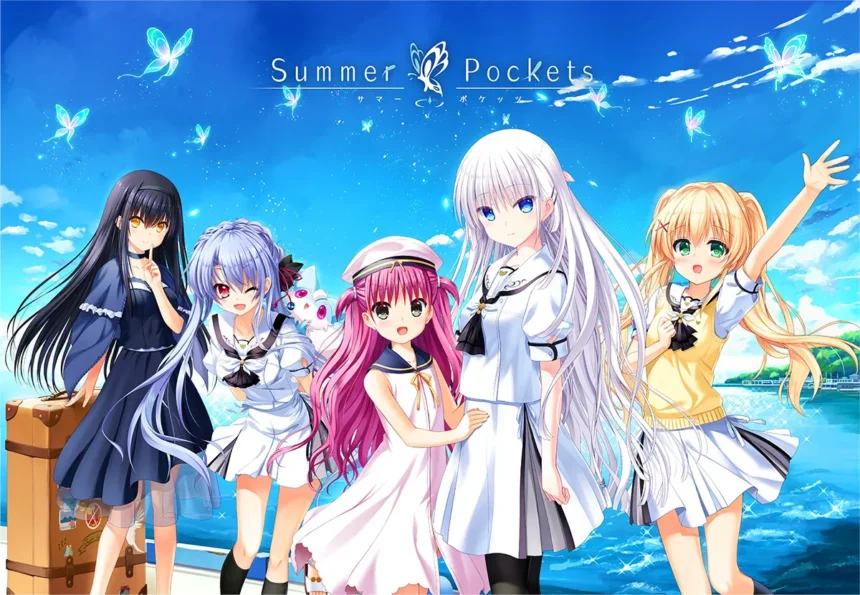
Torishirojima is the kind of island that does a lot of quiet work before a single heroine route even starts. Key has built an entire career on the promise that a peaceful summer somewhere small can still break your heart by the end of it, and Summer Pockets, specifically the expanded Reflection Blue edition I spent my summer with, follows that formula closely enough that longtime fans will recognize the shape of nearly every beat before it lands. Protagonist Hairi Takahara arrives on the island at the start of the game. And he didn’t just arrive normally, he actually came under the pretense of settling his late grandmother’s estate, though it becomes clear early on that he’s really running from a life back home that fell apart in ways the story takes its time revealing.
Once he settles in, a rotating cast of heroines starts pulling him into their own quiet mysteries and unresolved grief, and the whole thing unfolds across a single summer as Hairi untangles what’s actually going on with each of them while adjusting to island life himself. The mystery threads tying the island and its residents together give the plot a real hook beyond simple slice-of-life comfort reading, and the strongest routes deliver genuine payoffs once their individual foreboding builds toward a resolution. I noticed the rhythm repeating itself route after route, though: warm relationship-building, a looming complication, then a resolution built on companionship. Once I clocked that pattern, a lot of the game’s turns stopped surprising me well before they arrived, and with Reflection Blue folding in four additional heroines and a true route on top of the original four, several of those routes end up rushing through material that a tighter cast could have given real room to breathe.
Familiarity with Key’s back catalog followed me through a lot of this too. Several routes echo beats and structures I recognized straight from Air, Clannad, and Little Busters, closely enough in places that specific scenes played like a gentler retread rather than something new. That familiarity made the game’s freshest ideas stand out more by contrast, and Shiroha’s route in particular, the one most tied to the island’s central time-loop mystery involving Hairi’s daughter Umi, is the strongest thing here precisely because it commits to material the rest of the cast doesn’t touch.
Hairi anchors the story competently no matter which heroine a given playthrough centers on. His arc, growing from someone actively avoiding his problems into someone capable of facing them, gives the game a consistent emotional throughline even across such a scattered cast. The heroines themselves are a mixed bag by comparison. Several come across as flatter on their own terms, with their development concentrated more in how Hairi comes to see them than in any real internal growth of their own, and Tsumugi’s route in particular felt thinner than it should have, squeezed for space against seven other characters competing for the same summer.
Dialogue captures a warm, nostalgic atmosphere effectively, leaning on gentle humor and easy banter that makes island life feel lived-in even during the quieter stretches. When the writing commits fully to a heroine’s specific arc, and Shiroha’s route again stands as the clearest example, the payoff lands with real sincerity, balancing comfort against melancholy in a way that’s become something of a signature move for this studio. Spreading itself across eight-plus heroines is where the writing runs into its clearest trouble, though, and maintaining consistent quality across every single route turns out to be a genuinely difficult task that Reflection Blue doesn’t always clear.
Visuals and music are the clearest, most consistently strong part of the whole package, and honestly some of the best I’ve seen from Key. Torishirojima comes through vividly in both, giving the island a real sense of place that elevates even the more predictable story beats playing out against it. Voice acting supports the cast well throughout, including Hairi himself, who gets a full voiced performance in this edition after going unvoiced in the original 2018 release, and that single change alone makes the quieter conversational scenes land with more weight than they did before.
The strongest routes here build on Key’s established strength in slow, patient buildup toward bittersweet resolution, and the island’s unhurried summer atmosphere gives even lower-key emotional beats real staying power. That impact was not consistent for me across the whole cast, though. The compressed, thinner heroine arcs simply didn’t carry the same weight as the standout paths, and I came away from this play-through with a clear sense of which routes I’d point a new reader toward first and which ones I’d tell them to treat as optional.
Verdict
Summer Pockets Reflection Blue delivers a comfortable, visually and musically excellent slice-of-life mystery that will feel deeply familiar to anyone who’s already spent time with Key’s earlier work, for better and for worse. Its strongest individual routes, Shiroha’s above all, capture real emotional sincerity, and the island setting itself is a genuine highlight throughout. Spreading the story across such a large cast, expanded further by this edition’s four extra heroines and true route, leaves several routes feeling thin and predictable, and the heavy reliance on structures recycled from the studio’s own back catalog will read as comforting to some and derivative to others. For fans of Key’s established style, this remains an easy, if unsurprising, recommendation, and the newly voiced protagonist and added content make Reflection Blue the version worth picking over the original release.