Somewhere between waking up and walking out the door, most of us never stop to ask whose voice is actually running the commentary in our own head. This game hands you the microphone and dares you to use it responsibly.
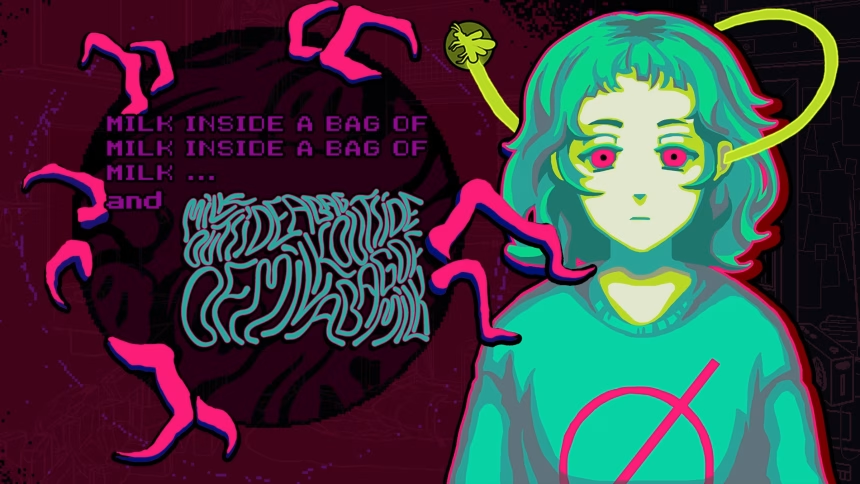
That microphone belongs to an unnamed girl sent out by her own mother to buy a bag of milk, a task so small it barely counts as a plot on paper at first glance. Nikita Kryukov built the whole thing around a sharper idea than the premise initially lets on though, since you never actually control the girl herself directly. Instead you’re the voice inside her own head, capable of steering her through a walk to the store or quietly making things worse for her the entire way there. Milk inside a bag of milk inside a bag of milk turns that single choice, helper or saboteur, into the whole engine of the experience.
Kryukov, a Russian solo developer and musician, released this specific title on Steam through publisher Missing Calm on August 26, 2020, handling every part of production personally, writing, pixel art, sound design, and score alike. This was his second released game overall, following an earlier, similarly experimental title called how it all ended. A Nintendo Switch port arrived November 11, 2022, published by Forever Entertainment and bundled together with the direct sequel. That sequel, Milk outside a bag of milk outside a bag of milk, had released the previous December and continues the exact same story from the moment this one ends.
Everything on screen stays deliberately crude, blocky pixel art rendered in a font that looks pulled straight from an old arcade cabinet. Tagged by its own creator as horror alongside its more clinical mental health themes, I expected that visual minimalism to feel like a limitation more than a deliberate creative choice. It doesn’t. The starkness of it works against me instead, stripping away anywhere comfortable to look while the girl’s perception of her own surroundings starts warping in ways the sparse visuals somehow make more claustrophobic rather than less. Ordinary background figures start reading as something closer to monsters the further into the walk you get, and the game never once bothers explaining whether that’s really happening or simply how she’s currently seeing things.
Choices along the way can actually end things early, contributing to the two distinct endings the base game actually offers, each one tied to its own separate achievement out of three total the game tracks across a full playthrough. Lines of dialogue I would’ve otherwise clicked through without a second thought in almost any other game started giving me real pause here. Once the milk actually gets bought and paid for, the girl turns and starts talking straight past the fourth wall. Her medication, the illness shaping how she sees the world, a father she lost to suicide, all of it gets handled in a few blunt sentences rather than any kind of extended scene. I won’t pretend that conversation didn’t sit with me longer than the ten or so minutes it took to finish the whole thing, short as that runtime technically is on paper.
Kryukov also composed the score himself, seven tracks that stay as sparse as everything else in the game, never swelling into anything that would tip the emotional register before the writing gets there first. A separate expanded soundtrack release followed on April 16, 2021, priced at just under a dollar, adding five bonus tracks along with a full ninety-minute ambient remix. The base game’s own seven tracks already do exactly what they need to on their own, though, without needing that extra padding to land. Nothing here gets spoken aloud. Every word arrives as text, and given how carefully that text is doled out, sentence by deliberate sentence, I never once missed hearing it spoken aloud. Digging through the game’s own files afterward turned up a small hidden touch too. A developer comment reading get out of my head in both English and Russian sits tucked into several script files, a quiet joke aimed squarely at whoever’s controlling the girl from inside her own skull. It’s the kind of detail you’d only ever stumble onto by going looking specifically, which somehow makes it land harder once you actually find it there.
Nothing here resolves cleanly by the time the credits roll, and that’s clearly on purpose rather than an oversight. The sequel picks up immediately where this one leaves off, running considerably longer than this first entry and building out branching conversations, alter-ego manifestations of the girl’s own psyche, and multiple distinct endings of its own. Knowing that continuation exists going in didn’t make the abrupt stop here land any softer, and I don’t think it’s supposed to.
Built in Ren’Py, the same engine Kryukov has used across most of his later work since, and available on Windows, macOS, and Linux ever since that original 2020 release, the game’s English script carries an odd little honesty to it too. Kryukov has described that translation himself, in his own words, as just my attempt to edit a machine translated script by someone else, nothing more to it. Once I knew that, some of the stranger phrasing throughout read less like clumsiness and more like part of the game’s own unsettled voice, an accident of process that ended up suiting the material anyway.
Verdict
Milk inside a bag of milk inside a bag of milk turns an errand nobody would bother writing a story about into something real, hard to shake, mostly by making you complicit in every small cruelty or kindness along the way rather than letting you watch it happen from a safe distance. Its crude pixel art and sparse score do more heavy lifting than their simplicity suggests, and the blunt honesty of its closing conversation earns weight it never once has to reach for. A short, uncomfortable walk to the store that stays with you well past its ten to fifteen minute total runtime.