Every otome fan eventually runs into the game everyone else seems to have strong feelings about, and for a solid stretch of years, that was Collar x Malice for me. Coming back to it now, after hearing it compared to Clannad or Steins;Gate as a gateway title for the whole genre, I found something more ambitious than most of its peers, and also something whose reputation turned out to be a lot more complicated than “essential otome” status suggests once I actually sat with the whole thing.
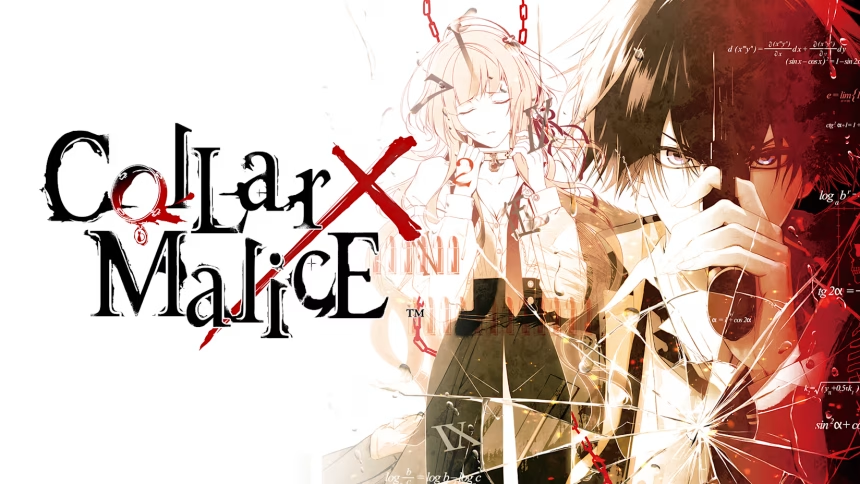
Ichika Hoshino is a rookie police officer stationed in a Shinjuku placed under mass quarantine after a string of violent crimes committed by a shadowy group called Adonis. One night on patrol, she gets abducted and fitted with a poison-dispensing collar by a mysterious figure calling himself Zero, who tells her that solving the X-Day Incidents and uncovering what Adonis is actually planning is the only way to save herself and the city. From there, five men end up pulled into her orbit, some cops, some ex-cops, one a former hacker turned fugitive, each carrying their own history tangled up in the case, and each giving a different lens on the story’s central question: what does justice actually mean when the people enforcing it and the people breaking the law both genuinely believe they’re right.
That question is where I got the most out of this game. Instead of setting Adonis up as simple villains and the police as simple heroes, the writing gave real weight to the organization’s stated motivations, and by the time the true route pulled every thread together, I didn’t walk away thinking any single faction, not the police, not Adonis, not even Ichika herself, was unambiguously correct. That’s a mature approach for a genre that often defaults to good-versus-evil framing, and it’s the throughline that kept me invested even through the parts of the game that frustrated me. Ichika herself benefits from an unusually grounded backstory too. Rather than the typical blank-slate otome heroine, she comes from a home where her parents openly favored her more talented younger brother and gave her essentially no attention, a specific, unglamorous kind of neglect that shaped her drive to prove her own worth as a cop in a way I found more textured than most genre leads get.
Where things get complicated is exactly how much romance actually shows up, and how believable it is when it does. Because the game compresses most of its events into a single month leading up to X-Day, the individual romantic arcs move fast, sometimes implausibly fast, and I’ll be honest about the endgame relationship in the mandatory true route specifically. That chemistry felt underwhelming to me, some of the weakest romantic pacing I’ve sat through in the genre. That’s a real problem for a story that gates its most important romantic payoff behind clearing every other character’s route first. It’s not just me either, from what I gathered, plenty of readers who love the mystery and world-building single out that final route as a step down, tying up plot threads efficiently while shortchanging the emotional beats supposed to make it feel like the culmination of everything before it.
Individual character routes varied a lot too, in both romantic and narrative quality. One route offered an easy, spoiler-light introduction with a genuinely endearing, if initially standoffish, love interest, though the romantic beats themselves stayed fairly thin. Another route started slow enough to test my patience before rewarding that patience considerably in its back half. Other routes drew more mixed reactions from me depending on how much I valued the mystery over the romance in that particular stretch, and one early route built around a detective with an unnecessarily convoluted personal backstory strained my belief badly enough to color how I felt about the rest of my playthrough.
The structural choices around all this branching gave me real headaches too. With thirty-two distinct endings scattered across the game, not having any in-game bad-ending tracker became a genuine frustration trying to see everything without pulling up an outside guide. The lack of a jump-to-choice feature for revisiting specific decision points, something plenty of otome releases already had even by the time this one launched, made replaying to catch missed content more tedious than it needed to be. Sprite work stays entirely static throughout too, without even basic blinking animation, which stood out as a small but noticeable gap given how polished everything else looks.
That polish is real, though, and it’s not something I’d argue with. Hanamura Mai’s character art gave the cast real visual charm, distinct enough that I recognized her style immediately from her work on the Amnesia series, and the muted, moody color palette used throughout did genuine work reinforcing the tense, quarantine-city atmosphere. The soundtrack mostly won me over too, anchored by a Plastic Tree opening theme that’s become something of a genre highlight in its own right, though I found large stretches of the background music fairly forgettable rather than distinctive. The English localization was broadly serviceable, but it carried real, noticeable rough patches. Scattered typos and at least one instance where a character’s name was simply wrong in a line of dialogue stood out, minor on their own but numerous enough across a script this size to notice.
The Unlimited fandisc rounded out the experience with genuinely well-built after-story content for the main cast, side material for a wider set of characters including figures from Adonis itself, and an alternate branch exploring one of the base game’s darker outcomes. I came away thinking it’s a satisfying, generous expansion for anyone who finished the main story wanting more time with this cast, even if its Vita-first release made it harder for some fans to get to originally.
Verdict
Collar x Malice earned its reputation as one of the more ambitious, thoughtfully written otome titles available in English largely on the strength of its moral complexity and Ichika’s unusually grounded backstory, treating its central conflict with a seriousness the genre doesn’t always attempt. It’s a worse fit, though, for anyone coming in expecting a strong, consistently satisfying romance to carry the experience, since multiple routes, including the mandatory true ending, gave me real, credible reasons to complain about underbaked chemistry and rushed pacing. Missing quality-of-life features around its enormous branching structure and a rough patch of localization errors kept it from feeling fully polished. This remains a worthwhile, well-regarded entry point into story-driven otome, just one whose reputation as an unimpeachable genre classic didn’t hold up quite as cleanly for me as its popularity might suggest.