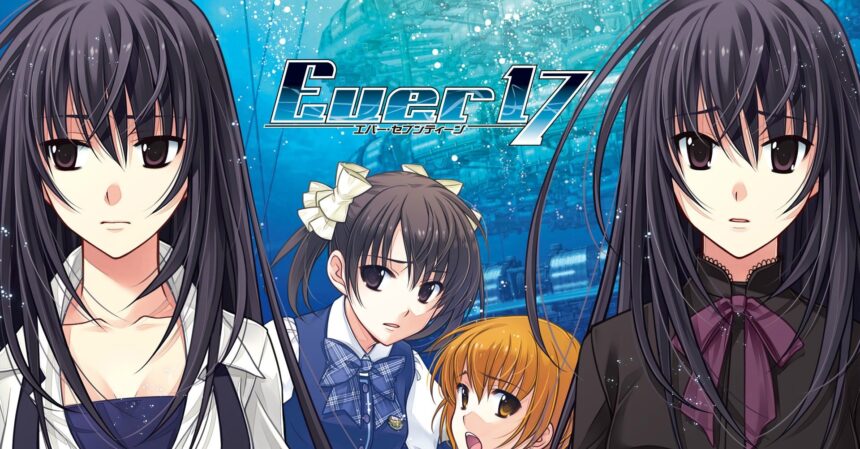
Getting trapped in a sinking underwater theme park is a strange premise for one of the most acclaimed sci-fi mysteries the visual novel medium has produced, and Ever17 has held that reputation since its original 2002 release under developer KID. This particular version complicates that legacy somewhat before a single line of dialogue gets read. Rather than remastering the original script, it’s built on a 2011 remake that replaced 2D character art with 3D models and introduced new scenario material, and that choice made this specific release a real point of contention for me before I even started.
Seven people find themselves trapped in LeMU, an underwater theme park slowly flooding with no clear way out, and the countdown to catastrophe frames a story I experienced from two alternating perspectives: college student Takeshi Kuranari, or a nameless boy suffering from amnesia. What starts as a fairly straightforward survival drama built around a rotating cast of potential romantic interests gradually revealed itself to be something considerably stranger once the story’s true structure came into focus across its five routes.
The reputation this game carries as one of the best-constructed mysteries in the genre is well earned, at least based on what I experienced. The first four routes each deliver a seemingly complete resolution to the immediate survival crisis, while quietly planting strange inconsistencies and unexplained details that only click into place once the fifth and final route pulls every thread together. That structure rewarded my patience with a genuinely satisfying, meticulously foreshadowed payoff, and the sheer craft behind stringing five interconnected perspectives into one coherent whole still impressed me over two decades after the original release.
Getting there demanded real patience on my end, though. The story moves at a deliberately slow pace, particularly in its earlier stretches, and I ran into repeated scenes across multiple routes, conversations and events I’d already watched play out from a different character’s perspective, that felt like a genuine drag rather than purposeful reinforcement. The climactic twist tying everything together split my own feelings too. Part of me found it a satisfying, audacious reveal that redefines everything that came before it, while another part of me thought it read as overcomplicated, struggling to decide whether it’s a real new character, a theoretical scientific concept, or a stand-in mechanism for the plot to resolve itself.
The rotating cast across both protagonists’ perspectives carried real emotional weight for me, and the amnesiac boy’s storyline in particular benefits from a mystery about his own identity that dovetails naturally into the larger plot. Takeshi’s route, by contrast, offered a more grounded, straightforward entry point that still managed real chemistry with the surrounding cast despite following more familiar visual novel romance beats.
Getting invested in these characters paid real dividends by the time the true route arrived, since so much of that route’s emotional impact depends on how much the earlier, more conventional routes made me care about people whose fates take on entirely new meaning once the full picture comes into view.
The writing handles an unusually complex, multi-layered plot with real clarity. Dense sci-fi concepts and foreshadowing stayed followable for me even as the story’s scope expanded dramatically by its conclusion. That said, this specific release carries real, distracting issues. I ran into inconsistent translation choices, including a character referred to by two different English names depending on the scene, and lingering errors like a food item translated inconsistently between different parts of the script. A fan-made patch exists specifically to address some of these issues and restore functionality, like skipping previously read text, that this official release oddly lacks.
The bigger, more contentious issue for me was structural rather than technical. This release is built on the 2011 remake’s script rather than the original, and series creator Kotaro Uchikoshi’s involvement in that remake was minimal to nonexistent. Whether that matters comes down to how much value you place on the specific text a particular script represents. The underlying story beats, character arcs, and plot twists remain essentially unchanged regardless of which version you’re reading, but if you’re specifically hunting for the original 2002 script, you won’t find it here.
The soundtrack stood out as a real highlight for me throughout, building tense, atmospheric tracks that elevated the underwater setting’s claustrophobic dread at every turn. This remaster restores 2D character art and expressions in place of the 2011 remake’s 3D models, while keeping the new scenario content that version introduced, which makes it something of a hybrid edition combining elements from multiple prior releases. Voice performances carried real weight for me too, particularly during the story’s most pivotal emotional and plot-critical scenes.
The payoff for sitting through Ever17’s slow, patient buildup is real. By the time the true route revealed how everything actually connects, I felt both an emotional and intellectual gut-punch that stuck with me well after I finished. Specific dialogue exchanges, character arcs, and twists are still vivid in my memory, and that lasting impact felt directly tied to how much patience I brought to the earlier, more repetitive stretches building toward it.
Verdict
Ever 17: The Out of Infinity delivers one of the visual novel medium’s most meticulously constructed mysteries, and the core story here remains genuinely worth experiencing regardless of which specific script version you’re reading. This release’s decision to base itself on the less-preferred 2011 remake script, combined with real translation inconsistencies and missing quality-of-life features other versions have addressed, made it a legitimately imperfect way for me to encounter a genre classic. If you don’t have prior attachment to the original release, though, what’s here is a slow-burning, ultimately rewarding sci-fi mystery that earns its status as an essential entry in the genre, even in this somewhat compromised form.