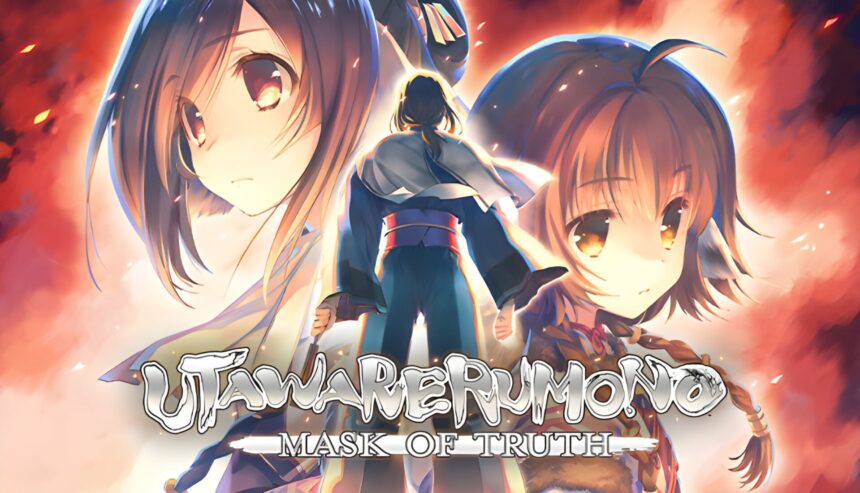
Don’t start here. If you haven’t finished Mask of Deception, Utawarerumono: Mask of Truth will not wait for you to catch up, and I mean that as a genuine warning rather than a stylistic statement. Developed by Aquaplus and localized by Atlus, this is the concluding chapter of the modern two-part retelling that sits within a franchise first launched in Japan back in 2002, and it commits fully to giving every character, every political thread, and every lingering question from the earlier games the space to actually resolve. That commitment comes at a real cost in runtime, but it rarely came at the cost of the story’s quality for me.
Picking up immediately where its predecessor left off, Mask of Truth finds Haku forced into impersonating the fallen General Oshtor while war closes in around the empire. Kuon, separated from her friends and dealing with selective amnesia of her own, works to track down the people she traveled with while the larger conflict between Yamato and its neighbors barrels toward a breaking point. The story assumes total familiarity with everything that came before and offers only a brief recap before diving straight back into the deep end, which confirmed for me that skipping straight to this one really isn’t an option.
Political intrigue and personal stakes intertwine here with a level of care I rarely see sustained across a runtime this long. Every conversation felt purposeful to me, threading larger wartime consequences through character-level drama in a way that kept a genuinely massive cast feeling relevant rather than sidelined. The scope widens considerably compared to the previous entry, pulling in new regions, new factions, and new complications tied to Haku’s deception, and the story earned its scale by paying off nearly every thread it introduced along the way.
That thoroughness runs both ways, though. A story built around refusing to sacrifice detail inevitably includes stretches that feel like padding, and the opening hours in particular lean heavily on rebuilding Kuon’s daily life before the plot regains momentum. It’s a deliberate choice rather than a mistake, one that rewarded my patience once the larger conflict kicked back into gear, but it’s a real ask this early in an already enormous game.
Haku carries the weight of an impossible role with real conviction, and watching him navigate the gap between who he’s pretending to be and who he actually is gave the story its emotional backbone for me. Kuon’s arc runs in close parallel, her selective amnesia forcing her to rebuild relationships from something close to scratch, and the way both characters’ journeys eventually converge paid off everything the trilogy had been building toward. The wider cast benefits enormously from a structure that treats the entire ensemble as worth developing rather than orbiting a single protagonist. Characters who could easily have been reduced to anime archetypes get genuine arcs here, their personal ordeals reshaping them into far more layered people than their first impressions suggested to me. A few side characters land less consistently, feeling underdeveloped relative to how much screen time they’re given, but the core cast carried the emotional weight of the story’s climax about as well as any ensemble I’ve read in this genre.
Dialogue moves naturally from scene to scene, balancing political maneuvering, humor, and genuine tragedy without the tonal whiplash that sinks lesser stories attempting the same range. The prose earns its reputation as the game’s single strongest asset, building toward a finale where nearly every scene landed with real emotional force for me. Munechika’s trial sequences in particular stand out as a highlight, delivering political intrigue that stayed engaging rather than becoming a slog of exposition. The localization holds up well across an enormous script, though I noticed a handful of small errors slip through here and there. The larger issue for me was pacing rather than prose quality: certain stretches revisit points the story has already made, and the sheer density of detail occasionally slowed momentum in ways a tighter edit could have smoothed out.
The traditional 2D visual novel art carries real polish throughout, with detailed, thoughtfully composed backgrounds and character art that held up across the entire runtime for me. Voice acting matches that quality across the board, with several performances delivering affecting work during the story’s heaviest emotional beats. The soundtrack ranks among the best I’ve heard in the genre, memorable enough that entire live concert recordings built around it exist as their own release. The strategy RPG battle sequences are the clear weak point by comparison. Chibi-style 3D models clash visually with the detailed 2D character portraits used everywhere else, generic enemy designs undercut some of the tension these fights are meant to carry, and occasional frame-rate hitches and rough animations make the combat feel like an afterthought next to the visual novel sequences surrounding it. Worth a brief, neutral note for anyone weighing whether this fits an all-ages read: the game includes some comedic fanservice moments that occasionally feel tonally mismatched with the wartime stakes around them, though it never becomes the focus of the story.
Few visual novel trilogies manage to stick their landing this well. The accumulated weight of two prior entries paid off for me in a finale that treats its characters’ sacrifices, reconciliations, and losses with real gravity, and the sheer amount of narrative closure delivered by the end justified a runtime that might otherwise feel indulgent. Watching the full cast’s arcs resolve after this much time invested produced a payoff that’s hard to replicate in shorter stories, and the finale earned the bittersweet farewell it was clearly going for.
Verdict
Utawarerumono: Mask of Truth closes out its trilogy by refusing to rush a single thread, delivering a conclusion that rewards patient investment with genuine emotional payoff and some of the strongest character writing in the visual novel genre. Its scope demands total familiarity with the two games preceding it and asks for an enormous time commitment even by the standards of a series already known for its length, and the strategy RPG battles remain the least polished part of the package throughout. For anyone who’s already fallen for this world and these characters, though, it delivers the ending they’ve been waiting for.