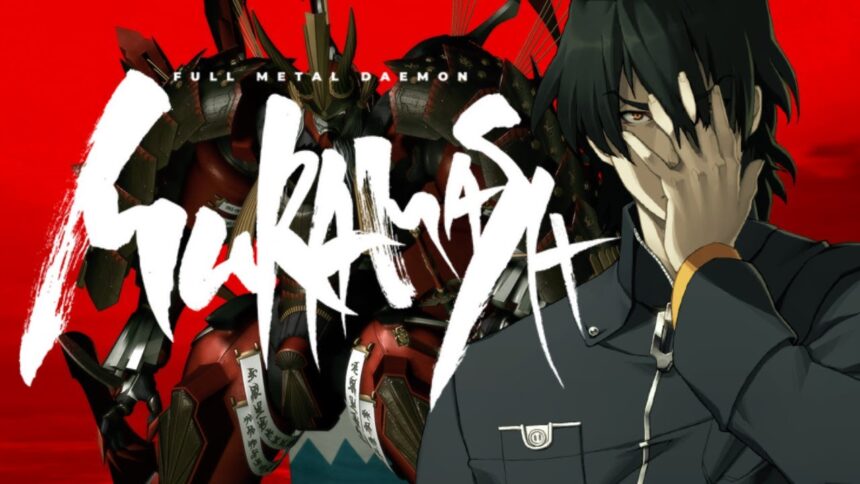
The setup of this awesome visual novel takes place in an alternate feudal Japan where mechanized armors called tsurugi have become the ultimate weapons of war. They are wielded by pilots known as musha under a pact with the machines themselves. The character you play as is Minato Kageaki, the pilot of the tsurugi Muramasa, bound by a mechanic called the Law of Balance that forces him to sacrifice an innocent life for every villain he kills. That single cruel rule became the philosophical engine for the entire story, and I found myself forced to confront, right alongside every major character, what their ideals actually cost once violence enters the equation.
Three routes, Hero, Nemesis, and Conqueror, approach the same central conflict from different angles, and the way each one recontextualized earlier events for me elevated the structure well beyond a typical branching visual novel. Hero and Nemesis can be read in either order and held up remarkably well against each other in my experience, each offering a genuinely different lens on the same war and the same cast of ideologically opposed characters clashing over justice, revenge, and love.
The story’s greatest strength doubled as its clearest liability for me: its sheer length. Detailed political maneuvering, dense explanations of swordplay technique, and lengthy internal monologues pack the script from beginning to end, and while much of that density paid off during the story’s most thought-provoking stretches, I also hit a considerable amount that felt like a tighter edit could have trimmed without losing anything essential. The final Conqueror route compounded this issue for me by reducing major characters from the first two routes to thinner versions of themselves, and the story’s conclusion felt like a step down from the heights the first two-thirds reached.
Minato Kageaki carried the entire cast on his back for me, and he earned it. A protagonist built around genuine ethical anguish rather than easy heroism, his struggle against the Law of Balance gave the story its emotional and philosophical center, and I don’t think many visual novel leads manage to feel this human while also functioning as a walking argument about the cost of violence. Ayane Ichijo and Kanae Otori rounded out the primary heroines with sharply drawn, distinct worldviews of their own, each representing a different answer to the questions Kageaki keeps asking himself.
The rest of the cast held up nearly as well for me, and even minor and recurring characters got enough texture to feel like real people rather than plot devices. That density thinned out considerably in the Conqueror route, where characters who felt fully realized in earlier paths got reduced to shadows of themselves, and I felt some of the goodwill I’d built up over the previous two-thirds of the story slipping away because of it.
Dense, verbose, and unapologetically ambitious, the prose tackles war, morality, and duty with a seriousness I don’t see many visual novels attempt at this scale. Political explanations and detailed breakdowns of sword techniques run long, sometimes longer than the scene needed, but the payoff during the story’s sharpest philosophical exchanges more than justified the investment for me as a reader willing to sit with dense material. Humor gets woven in skillfully even during heavy scenes, and I appreciated how that gave the cast room to breathe between the story’s darkest stretches without undercutting the tone.
The translation deserves real credit here. Localizing a script this large, this technical, and this steeped in period-specific language is no small task, and the final English text read smoothly enough that the sheer scale of the undertaking rarely showed to me. One practical complaint worth flagging: the in-game reading log doesn’t display character names or portraits, which made it needlessly difficult for me to track who said what when jumping back to review earlier dialogue.
Full voice acting throughout gave nearly every major scene real weight, and the vocal performances consistently elevated emotionally heavy moments beyond what the text alone could deliver. The soundtrack matched that quality, built around traditional Japanese instrumentation that reinforced the story’s historical drama roots, with several vocal tracks strong enough that I found myself listening to them outside the game.
Combat sequences lean on a mix of video cutscenes and dynamic cut-ins that sold the scale of these battles better than most visual novels manage, though a handful of fights ran long enough to feel more indulgent than necessary. The art and general CG work struck me as solid without being a standout in its own right, doing its job efficiently rather than becoming a highlight the way the music and voice work did for me.
Few visual novels commit this fully to making a single argument land with real weight. The recurring collision between characters’ stated ideals and the human cost those ideals demand builds a kind of moral exhaustion that’s clearly intentional, and by the time the story’s philosophical threads pulled together, the accumulated weight of a hundred hours of investment paid off for me in a way shorter stories simply can’t replicate. The uncomfortable content mentioned earlier is handled with real narrative purpose in most instances, though a few sequences pushed further into shock territory than the story’s themes strictly required, in my view.
Verdict
Full Metal Daemon Muramasa earned its reputation as one of the most ambitious visual novels I’ve encountered, a philosophical epic about the true cost of violence, anchored by one of the medium’s most compelling protagonists and a script willing to sit with genuinely difficult questions for a hundred hours at a time. Its length worked against it as often as it worked for it, the final route undercut characters who deserved better, and its darkest content is going to be a legitimate dealbreaker for plenty of readers. For anyone willing to commit to something this dense and this uncompromising, though, it delivers a payoff that few other visual novels even attempt to reach for.