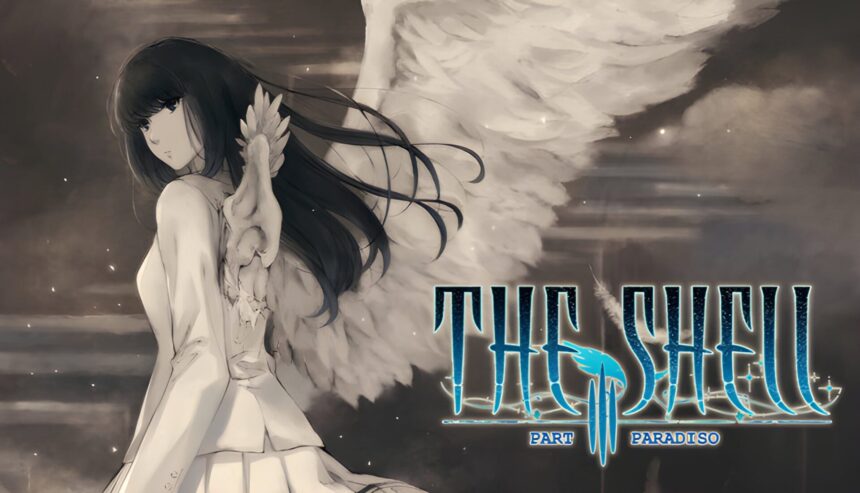
By the time I finally sat down with The Shell Part III: Paradiso, I’d already spent two full games with Reiji Tokisaka, and closing out a trilogy that took over a decade to fully translate into English carries an enormous weight of expectation with it. This is the conclusion to the Kara no Shoujo series, following Reiji as he tries to find closure, both for a missing child and for his own unraveling psyche, after the devastating events of Purgatorio left him searching for Toko’s remains against a killer still very much at large.
Set in the bitter cold of January 1958, Paradiso opens at a funeral, the painter Shinzo Mamiya’s, whose infamous, disturbing artwork has haunted the entire series. When Reiji and his old friend Maris Stella discover an unpublished piece among Mamiya’s belongings, a grotesque work resembling his most notorious painting, a fresh murder turns up mimicking its imagery almost immediately, and I found myself dragged right back into exactly the kind of case that’s already cost Reiji everything he cared about.
The opening hours represent the series at its most assured, and I mean that as real praise. Reiji’s grief and exhaustion get grounded in small, quiet scenes that carried real weight for me without needing to announce it, and the character writing that’s defined this trilogy from the start stayed just as strong through these early stretches, using what’s left unsaid between characters as effectively as anything stated outright. The mystery surrounding Mamiya’s final work and its connection to a new string of killings built with the same patient, meticulous craft the series has built its reputation on, and I settled in expecting more of the same steady, controlled tension.
Structurally, this is where Paradiso ran into its clearest problems for me. Partway through, the story executes an abrupt, multi-year time skip that read as a convenience to move the plot forward rather than an organic choice, jumping Reiji from searching for an infant to searching for a missing child years later. The second half relocates to rural Japan for an unsettling cat-and-mouse pursuit involving an escaped serial killer, a genuinely compelling mystery on its own terms that reveals meaningful new context about earlier events in the trilogy, but the seam between the two halves never stopped feeling disjointed to me rather than earned. Fully understanding the plot also required me to complete all three of the game’s main endings, since crucial context and resolution only emerge once every path has been read, and that demand rewards patient completionists while frustrating anyone hoping for a single, satisfying playthrough.
Reiji anchors the story with real pathos throughout. Watching a man defined almost entirely by the losses accumulating around him try to find some kind of peace gave this entry genuine emotional stakes for me even before the mystery elements kicked in. The returning cast, familiar faces from the first two games now years further into their own lives, including Reiji’s sister Yukari and Maris Stella, benefits from the story’s willingness to check in on how they’ve grown or stagnated since the trilogy began, and several of those smaller character beats rank among the strongest material in the entire series.
The sheer size of the cast becomes a genuine liability, though. Between characters carried over from the first two games, new figures introduced specifically for this entry, and vignettes revisiting material from Purgatorio, I struggled at points to keep track of who was who and what each of them was currently entangled in, and I don’t consider myself an inattentive reader. A few characters also receive development that sits awkwardly against how they were portrayed previously, and at least one relationship shift landed for me as poorly set up given how little those same characters seemed to care about each other in earlier entries.
When the prose is firing on all cylinders, particularly in the quieter, more intimate scenes built around daily life and unspoken grief, this remains some of the strongest character writing I’ve encountered in the medium, finding real meaning in mundane moments without ever feeling heavy-handed about it. Both central mysteries, the art forgery conspiracy and the later serial killer pursuit, are constructed with genuine care, and the second mystery’s resolution meaningfully deepened my understanding of the first, and of the trilogy as a whole. That said, thematic threads about obsession, identity, and inherited trauma, central to the entire series, got explored with noticeably less cohesion here than in the previous two entries, presented in a more fragmented way that occasionally felt suggestive rather than fully realized.
This entry marks a deliberate art style shift away from the realistic character designs of the first two games, moving toward a style closer to Innocent Grey’s other visual novel work. I found that change jarring at first against the trilogy’s established look, though it grew on me by the time it started rendering Reiji himself during the story’s most emotionally raw moments. The soundtrack, by contrast, needed no adjustment period from me at all. It’s the strongest in the entire series and does real work carrying the story’s heaviest scenes. Full voice acting continues to elevate the cast effectively, and the CG count stays generous across a lengthy runtime, giving the story’s most pivotal murder scenes and emotional beats real visual weight. Worth flagging for anyone tracking this franchise’s balance between mystery and adult content specifically: this entry includes strikingly little explicit material relative to its total length, and that choice signals clearly where the developers’ priorities sat for this particular conclusion.
The series’ signature blend of noir detective grit and genuine emotional devastation stayed present for me throughout, and the ending delivers real catharsis, resolving Reiji’s arc with a bittersweet finality that fits everything the trilogy has been building toward. Getting to that payoff meant sitting through a middle stretch that didn’t always earn its emotional beats as consistently as the series’ best moments elsewhere, and the fragmented thematic delivery blunted some of the impact individual scenes were clearly reaching for. Even accounting for those structural stumbles, the accumulated weight of following Reiji across three full games paid off for me by the finale, and the resolution felt like a genuine conclusion rather than a forced wrap-up, an outcome that wasn’t a guarantee given how unwieldy the middle portions of this entry can feel.
Verdict
The Shell Part III: Paradiso closes out one of the visual novel medium’s most acclaimed detective trilogies with a conclusion I found genuinely divisive even in my own reaction to it. Judged purely on its own merits, this is a well-crafted mystery visual novel with gorgeous presentation and some of the series’ strongest quiet character writing. Judged against the extraordinarily high bar set by Purgatorio specifically, it’s a noticeably less consistent entry, hampered by a jarring structural time skip, an oversized cast that’s genuinely difficult to track, and thematic delivery that feels more fragmented than the series’ earlier, tighter installments. What ultimately redeemed it for me was an ending sequence that ties the entire trilogy together with real elegance, delivering the kind of closure that makes the uneven journey there feel worthwhile in retrospect, even if it never quite reaches the heights the series established with its previous chapter.