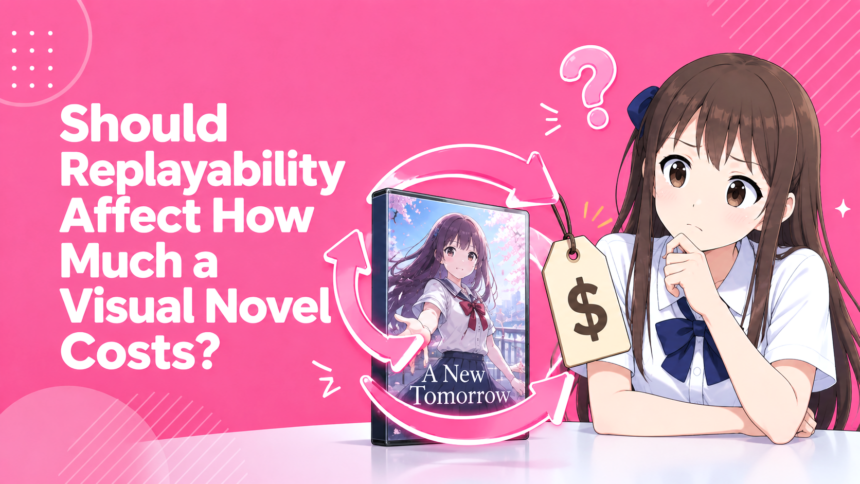
Yes, to a point, but replayability alone doesn’t justify unlimited price scaling, and treating route count as a simple multiplier misunderstands what readers are actually paying for. A visual novel with genuine, well-written multiple routes offers more total content than a linear title of similar length, and that additional content has real production cost behind it worth reflecting in price. But padding a game with technically distinct but shallow branches to inflate a perceived hour count doesn’t deserve the same pricing logic, and readers are right to be skeptical of replayability used purely as a justification for charging more.
Why Replayability Has Real Production Costs Behind It
Writing multiple routes isn’t the same workload as writing one longer linear story of equivalent total length. Each route typically needs its own arc, its own pacing, and its own resolution that feels distinct from every other path through the game, which means a writer is essentially crafting several interconnected stories rather than one continuous narrative. How multiple endings actually work in a well-designed visual novel requires planning branch points, tracking which choices lead where, and making sure each path feels earned rather than arbitrarily bolted onto a shared trunk of content.
Art and voice acting costs scale with routes too, sometimes significantly. A route built around a specific character often needs unique CGs, unique expression sets, and unique voiced lines that don’t get reused anywhere else in the game. Why visual novels carry the pricing they do already reflects how much these production costs add up even before multiplying that investment across several distinct character routes rather than a single unified story.
Given all that, a genuinely well-crafted multi-route visual novel does represent more total production investment than a comparably polished linear title, and reflecting some of that investment in a higher price isn’t unreasonable on its face.
Where the Logic Breaks Down
The problem shows up when route count gets used as a marketing figure rather than an honest reflection of content depth. A game advertising “ten different endings” sounds substantial, but if eight of those endings are minor variations reached through a single late-game choice with no meaningful divergence beforehand, the actual additional content behind that headline number is much thinner than it appears. Readers evaluating replay value specifically should look past raw ending counts and check whether routes genuinely diverge in meaningful ways, since a title padded with shallow branch points doesn’t deserve pricing that assumes deep, substantial replayability just because a number on the Steam store page looks impressive.
This distinction matters because pricing based purely on stated route count, without accounting for how substantial each individual route actually is, rewards studios for technically true but misleading marketing over studios that build fewer, deeper, more meaningfully distinct paths through a story.
Total Playtime vs. Route Count
Total hours of unique content is arguably a more honest pricing signal than route count on its own. A visual novel with three deeply developed routes, each running fifteen hours with genuinely distinct character arcs, offers more real content than one boasting eight routes that mostly share the same first ten hours before diverging into a final short branch. How long a visual novel actually takes to fully experience, counting only genuinely unique content rather than repeated shared material across routes, is a more accurate measure of what a reader is actually paying for than a simple ending or route tally.
Storefronts and reviewers increasingly emphasize this distinction, often separating “total playtime” from “unique content hours,” a split visible directly in how VNDB tracks length data alongside route counts, specifically because route-padding has become common enough that readers have learned to be skeptical of raw numbers without more context behind them.
Kinetic Novels Complicate the Comparison
Not every visual novel is built around replayability at all, and that’s a completely legitimate design choice rather than a shortfall. Kinetic novels remove branching choice entirely, delivering one fixed, linear story with no alternate routes or endings to chase. These titles shouldn’t be priced or evaluated against replayability at all, since replay value was never part of the intended experience to begin with. A well-written ten-hour kinetic novel can absolutely justify a comparable price to a branching title of similar length, provided the pricing reflects the quality and depth of that single fixed story rather than being penalized for lacking a feature it was never designed to have.
This is an important caveat to the broader replayability discussion, since applying a “more routes should mean more expensive” framework universally would unfairly disadvantage strong, focused kinetic novels that simply chose a different structural approach rather than a lesser one.
What Readers Should Actually Check Before Buying
Rather than trusting a stated route or ending count at face value, checking reviews or community discussion, including threads on r/visualnovels, for how substantial each route genuinely is tends to reveal whether a title’s replayability claims hold up. Specific details worth looking for include how early routes diverge from each other, whether each route introduces genuinely new content and character development, and whether the game’s structure rewards a full replay or mostly recycles the same scenes with minor dialogue variation.
Deciding where to actually buy a visual novel sometimes surfaces this kind of detail too, since storefront reviews and community discussion threads, whether on Steam or a publisher’s own storefront like JAST USA’s, frequently call out titles where advertised replay value doesn’t match the actual experience once readers have played through multiple routes themselves.
How This Should Shape Pricing Expectations
A reasonable framework treats genuine, well-executed replayability as one legitimate factor supporting a higher price among several, alongside overall length, art quality, and voice acting investment, rather than treating route count as an automatic price multiplier on its own. A visual novel doesn’t deserve to cost twice as much simply because it claims twice as many endings if those endings don’t represent twice the actual content and craft behind them.
Readers are within reason to expect pricing that reflects real production investment and real content depth, not marketing framing built around technically accurate but practically misleading numbers. The most reliable path to figuring out whether a specific title’s replayability actually justifies its price is checking what other readers who’ve finished multiple routes actually experienced, rather than taking a store page’s stated ending count as a complete picture on its own.
The Short Version
Genuine multi-route replayability does carry real production costs worth reflecting in a visual novel’s price, since writing, art, and voice acting all scale with meaningfully distinct branching content. But route count alone is an unreliable signal, since shallow branches padded for a higher advertised number don’t represent the same investment as deep, genuinely divergent paths through a story. Kinetic novels shouldn’t be penalized for lacking replayability they were never designed to have in the first place. The fairest approach checks actual content depth behind a game’s replayability claims rather than trusting a headline ending count to justify pricing on its own.