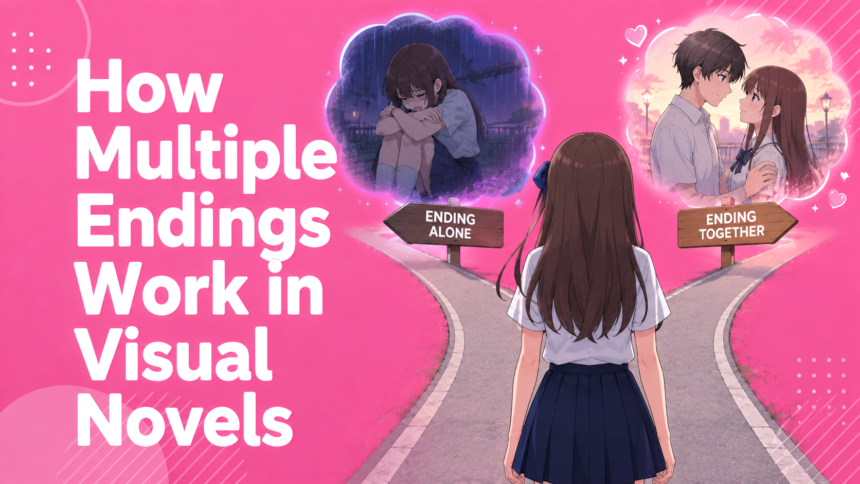
Multiple endings are one of the defining features of the visual novel format. Unlike a novel or a film that delivers the same conclusion to every reader, a visual novel can present dramatically different outcomes depending on the choices made throughout the story. Understanding how multiple endings work in visual novels changes how you read, how you plan your playthroughs, and how you think about the relationship between your choices and the story you experience.
Why Visual Novels Use Multiple Endings
The multiple ending structure exists in visual novels for both creative and commercial reasons, and understanding both helps explain why the format uses it so consistently.
From a creative standpoint, multiple endings allow a story to explore the same characters and world from different angles. A good ending and a bad ending for the same route are not simply the positive and negative versions of one outcome. They often illuminate different aspects of the characters involved, reveal how different choices produce different consequences in ways that feel true rather than arbitrary, and together produce a more complete picture of the story’s themes than either ending alone could provide.
From a practical standpoint, multiple endings extend the content of a visual novel without requiring an entirely new story. A title with five routes and two endings per route contains ten distinct conclusions from a single purchase. This gives readers incentive to replay, gives the developer value from assets shared across multiple endings, and creates community discussion around which endings different readers reached and how.
Do visual novels have replay value covers how multiple endings contribute to the overall replay structure of the format, and how visual novel endings work covers the specific types of endings in detail.
How Your Choices Determine Which Ending You Reach
In most visual novels, the ending you reach is determined by a combination of choices made throughout the common route and the character route you are following. These choices either set flags that the game checks at the ending branch point, accumulate affection scores that determine how the route resolves, or directly select a narrative direction at a specific decision point.
Flag-based systems work by tracking which specific choices you made earlier in the game. When the story reaches its ending branch, it checks the state of these flags and delivers the ending that corresponds to your pattern of choices. The individual choices may seem unrelated at the time you make them, which is why readers sometimes reach unexpected endings despite feeling they made reasonable decisions throughout.
Affection-based systems track how much you have invested in a specific character across the whole playthrough. Choices that align with a character’s values, interests, or emotional needs raise your affection score with them. When the ending branch arrives, a high affection score delivers the good ending and a low one delivers a normal or bad ending. Some titles make the affection tracking visible through on-screen indicators. Others track it invisibly.
Direct choice systems present an obvious decision point near the end of the story where the reader explicitly selects a direction. The ending follows directly from this choice rather than being determined by accumulated decisions. This is less common in longer visual novels but appears in shorter titles and in visual novels that use a different structural philosophy from the typical flag or affection approach.
Understanding which system a specific title uses helps you navigate toward the ending you want. Should I use walkthroughs for visual novels covers when to consult guidance for navigating ending systems and when reading blind produces a better first experience.
Good Endings
A good ending is the positive resolution of a specific character route or story path. The protagonist’s relationship with the central character of that route reaches a satisfying conclusion. The emotional arc of the route resolves in a way the story frames as the intended positive outcome.
Good endings vary considerably in tone and content across different visual novels. A good ending in a romance visual novel typically involves the protagonist and the love interest committing to a relationship. A good ending in a mystery route might involve successfully uncovering the truth and protecting someone who would otherwise have been harmed. A good ending in a tragedy might involve accepting loss with grace rather than avoiding it entirely.
What makes an ending a good ending is not necessarily that it is happy in a simple sense. It is that it represents the best possible resolution of the tensions the route introduced, earned through the choices that led to it.
Bad Endings
A bad ending is a negative resolution reached by making specific wrong choices. The protagonist fails to achieve what the route was building toward, a relationship collapses, someone is harmed who the story established as someone the protagonist was trying to protect, or the story reaches a conclusion framed as an avoidable tragedy.
Bad endings in visual novels range dramatically in how they are presented and how much content they contain. Some are brief: a single scene showing the failure, a few lines acknowledging the outcome, and a return to the main menu. These function essentially as penalty states, signalling that you made a wrong choice and inviting you to try again.
Others are fully developed narrative branches as long and as carefully written as good endings. These bad endings explore what the story looks like when things go wrong in specific ways, illuminate character motivations from angles the good ending cannot, and contribute meaningfully to the complete picture of the route. Some of the most discussed and emotionally resonant content in the visual novel catalogue exists in bad endings.
The choice of whether to seek out bad endings or avoid them is a personal reading preference. How visual novel endings work addresses this question directly, and the walkthroughs in the visual novel walkthroughs section note which bad endings are worth reading and which are purely mechanical failure states.
Normal Endings
Some visual novels include normal endings alongside good and bad endings. A normal ending is a middling resolution: the protagonist avoids the worst outcomes but does not achieve the full positive resolution of the good ending. They made choices that were not actively wrong but that lacked the specific commitments that the good ending required.
Normal endings often feel slightly unsatisfying by design. They are meant to signal that something more was possible, that the protagonist and the relationship could have gone further with different choices. They serve as an incentive to replay for the good ending without being as dramatically negative as a bad ending.
Not all visual novels include normal endings. Many use only good and bad as the available outcomes, with the differences in route navigation determining which of those two the reader reaches.
True Endings
The true ending is the most significant type of ending in the multi-route visual novel structure. It is the definitive conclusion to the entire work, revealing information that recontextualises everything in the preceding routes, delivering the emotional payoff that the full runtime was building toward, and representing the author’s complete intended statement.
True endings are almost always locked behind conditions that require completing other routes first. The most common condition is completing all other routes before the true route and its ending become available. Some true endings require specific choices across multiple playthroughs. Others require reading all routes in a specific order.
This lock serves a creative purpose. The true ending is written to resonate with readers who have already spent many hours with the cast in different contexts. The emotional weight of the true ending depends on the reader bringing knowledge and investment accumulated across earlier routes. A true ending read without that foundation is a weaker experience, which is why the lock exists rather than making the true ending available from the start.
Clannad’s After Story, the Heaven’s Feel route in Fate/stay night, and the answer arc conclusions in Umineko When They Cry are all examples of true ending content that only fully lands because of what came before. Each represents the reason to complete all routes rather than settling for one.
After Stories and Epilogues
Some visual novel routes include an after story or epilogue following the main ending. This is additional content showing what happened to the characters further down the line, sometimes years after the events of the route, providing a more complete emotional resolution than the ending itself delivers.
Clannad’s After Story is the most celebrated example and functions as a full second act to the main visual novel rather than a brief epilogue. Many otome games include shorter after stories as bonus content accessible after completing a route’s main ending. These after stories add to the total reading time and to the sense that the world of the visual novel extends beyond the boundaries of the story being told.
Are otome games visual novels covers how otome games use after stories and epilogues as a structural convention, and what is a route in a visual novel covers how after stories relate to the route structure as a whole.
Hidden and Secret Endings
Some visual novels include hidden endings accessed through conditions so specific that most readers miss them without guidance. A hidden ending might require making a specific sequence of choices across multiple playthroughs, or completing a set of in-game achievements, or reading every route in a precise order before accessing a final branch.
Hidden endings are sometimes purely bonus content that does not affect the main narrative. In other titles they are essential to understanding the complete story, with information or perspectives unavailable anywhere else. The community’s assessment of whether a specific hidden ending is essential content or optional extra is usually accessible through discussions on VNDB or r/visualnovels without requiring the specific ending content to be spoiled.
How Multiple Endings Affect How You Should Read
Knowing that a visual novel has multiple endings changes the approach that gets the most out of the reading experience.
On a first playthrough, making choices based on your own judgment and accepting whatever ending you reach is the approach that produces the most genuine experience. The uncertainty is part of what makes the first playthrough valuable. An ending reached through your own choices lands differently from one reached by following a guide.
On subsequent playthroughs, using the skip function to advance through already-read content efficiently and consulting a walkthrough to navigate toward specific endings you have not yet seen is entirely reasonable. The discovery phase is complete. Subsequent playthroughs are about accessing content rather than exploring blind.
For titles where the true ending is locked behind conditions that are genuinely obscure, checking those conditions specifically without reading any description of the true ending content is the most spoiler-minimal approach. You need to know what conditions unlock the true ending. You do not need to know what it contains before you get there.
How to play visual novels covers the practical skills of save management, skip function use, and route navigation that make reading multiple endings efficient. The visual novel glossary covers every ending type term including true route, bad end, normal end, after story, epilogue, and route lock that appears in community discussion and walkthrough guides.