One of the first questions anyone new to the medium tends to ask is how long visual novels actually are. The honest answer is that the range is enormous — wider than almost any other storytelling format. A visual novel can be a thirty-minute short story or a hundred-hour epic. It can fit in an afternoon or take several months to complete. That range is not a flaw in the medium; it is one of its genuine strengths.
But that answer is not very useful on its own if you are trying to decide what to read next, or if you are wondering whether you have the time to commit to a particular title. That is why this guide breaks down the full length spectrum of visual novels — from bite-sized experiences to the genre’s most colossal works — with real examples at each tier, and explains what determines how long a visual novel ends up being.
Also, if you are new to the medium and want to understand the basics before diving into length, our guide to what a visual novel is is a good starting point.
The Short Answer: Visual Novel Length by Category
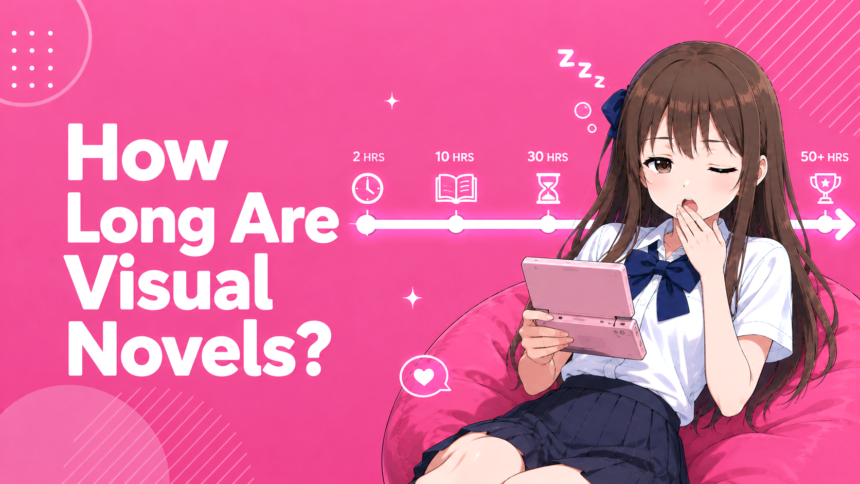
VNDB — the community-maintained Visual Novel Database and the most comprehensive resource for the medium — uses five official length categories that cover the full range. These are the most widely accepted benchmarks in the community and serve as a reliable framework for understanding where any given visual novel sits.
Very short visual novels run under two hours. Short visual novels run between two and ten hours. Medium visual novels run between ten and thirty hours. Long visual novels run between thirty and fifty hours. Very long visual novels run over fifty hours.
These categories are averages based on a single playthrough at an average reading pace, not completionist runs covering every route and ending. A visual novel listed as “medium” at fifteen hours might take thirty or more hours to fully complete if it has multiple routes and many possible endings. That distinction matters when you are planning how much time to invest.
Very Short: Under Two Hours
Very short visual novels are often underestimated by newcomers who assume that brief means slight. Some of the most memorable visual novel experiences available run under two hours precisely because they are built around a single, concentrated emotional or narrative idea that would be diluted by padding it out.
Game jam culture has produced a thriving ecosystem of very short visual novels, particularly on itch.io, where annual events like NaNoRenO and O2A2 — a jam focused on keeping visual novels under 1,000 words — have produced hundreds of free releases in this category. These are often experimental, emotionally direct, and willing to try things that a longer commercial production would not risk.
For readers who are new to visual novels and uncertain whether the format suits them, a very short title is the most sensible starting point. The time investment is minimal, and if a short title does not click with you, you have lost very little. If it does click, you have a clear sense of what longer titles in the same vein will offer.
Short: Two to Ten Hours
The short category is arguably the most diverse and accessible range in the medium. It covers everything from polished indie releases to the lighter end of commercial Japanese visual novels, and it maps comfortably onto the kind of time commitment a reader might give to a novel they pick up for a weekend.
Doki Doki Literature Club! — the most widely played visual novel in the Western market — sits in this category, running around six to ten hours for a first playthrough. That length turns out to be precisely right for what the story does: it needs long enough to build genuine attachment to its characters and world before it does what it does, and it does not need a moment more. Its success has demonstrated to many newcomers that you do not need a fifty-hour commitment to have a profound visual novel experience.
Many otome visual novels and Western indie releases fall in the two-to-ten-hour range, as do kinetic novels — linear visual novels with no choices — that prioritise a single, carefully shaped narrative over branching structure. Saya no Uta runs roughly two to three hours and is considered one of the most effectively crafted short-form visual novels ever made.
Medium: Ten to Thirty Hours
The medium category covers a large portion of the commercial visual novel market, particularly among Japanese releases that have been localised into English. This length gives a story room to develop meaningful characters, build a world, and explore multiple routes without demanding the kind of extreme time investment the longest titles require.
The House in Fata Morgana runs approximately fifteen to twenty hours and is frequently cited as one of the best visual novels available in English. Ace Attorney games typically run ten to twenty hours per title. VA-11 Hall-A sits around ten hours. These are titles that feel substantial without being daunting, and the medium range is often where readers new to longer-form visual novels begin their first major investment in the format.
For readers coming from other narrative media, ten to thirty hours maps onto the feeling of reading through a multi-volume novel series — more than a single book, but a defined and completable commitment.
Long: Thirty to Fifty Hours
The long category is where visual novels begin to diverge most sharply from other narrative forms. Thirty to fifty hours is substantially more time than almost any film, television series season, or standalone novel. It is an investment that most visual novel readers describe not as an obligation but as something that creates a different kind of relationship with a story — one where the characters become genuinely familiar over time rather than simply encountered.
Steins;Gate, one of the most acclaimed visual novels in the medium, sits in the thirty-to-fifty-hour range. That length is part of what makes its emotional payoff so powerful: by the time its most significant moments arrive, the reader has spent dozens of hours genuinely caring about the characters involved. The investment earned the payoff. Fate/stay night at around eighty hours and Umineko When They Cry‘s question arcs at roughly sixty hours total are at the upper boundary of this range and beyond.
Very Long: Over Fifty Hours
The very long category is where visual novels become genuinely without parallel in any other storytelling medium. A visual novel that runs fifty hours, eighty hours, or over a hundred hours is not simply a long book — it is a sustained relationship with a narrative world that few other formats can sustain at all.
Clannad runs approximately fifty hours for a full playthrough, with its script running to around 1.3 million words — longer than the entire Harry Potter series. Higurashi When They Cry, across all of its chapters, runs close to fifty hours and contains roughly 1.5 million English words. Fate/stay night with all routes and the Realta Nua additions has been cited at over 150 hours for a completionist run.
These numbers sound extreme to readers unfamiliar with the medium, and they are — but they are extreme in a way that serves specific storytelling purposes. As we explore in our piece on whether visual novels are games or books, the length of the medium’s longest works is not self-indulgence. It is the mechanism by which those works build the emotional depth and character intimacy that makes their most powerful moments land with the force they do. You cannot shortcut the hundred hours of Clannad. The weight of the ending comes from having lived inside that story.
What Determines How Long a Visual Novel Is
Length in a visual novel is shaped by a small number of structural decisions made during development, and understanding them helps you read any title’s listed length more accurately.
Linear Versus Branching Structure
A linear or kinetic visual novel — one with no choices and a single path through the story — is as long as its script is, and no longer. You read it once and it is done. A branching visual novel with multiple routes is a fundamentally different proposition: each route is its own story with its own scenes, its own emotional arc, and its own CG artwork. A visual novel with five routes where each takes eight hours to read is not an eight-hour visual novel — it is a forty-hour visual novel, minimum, if you want to experience all of it.
This is why the question of whether you intend to complete one route or all routes matters when evaluating a visual novel’s length. VNDB’s listed lengths generally reflect the time to complete one playthrough rather than full completion, so treating that number as a floor rather than a ceiling is wise for any branching title.
Word Count and Reading Speed
Visual novels vary in their reading pace for reasons beyond word count. A title with frequent choices, dramatic pauses, animated CG sequences, and non-skippable sound effects will take longer to move through than a title of identical word count that runs as continuous prose. Voice acting — where a reader waits for lines to finish rather than clicking through at their own pace — also adds substantially to reading time.
Most community estimates use roughly 100 to 125 words per minute as the average visual novel reading pace, accounting for clicks, choices, and the slightly slower engagement that comes from absorbing both text and visuals simultaneously. At that pace, 50,000 words produces around three to four hours of reading time, 200,000 words produces around fifteen to twenty hours, and 500,000 words produces roughly forty hours or more. These are rough conversions — individual reading speeds vary significantly — but they give a useful framework for translating word counts into time.
Single Route Versus Full Completion
The distinction between a single route and full completion is one of the most important things to understand about visual novel length, because it changes the time commitment dramatically.
Clannad is listed at fifty-plus hours, but that figure covers the common route shared by all players and a full run through all the major character routes. If you read only the main route — Nagisa’s story, the one adapted into the anime — you might spend fifteen to twenty hours. If you want to see all the content the game contains, including routes for characters who never appear in the anime adaptation, you are looking at fifty hours or more.
Many readers choose to read only the routes they care most about, treating the other content as optional. Others are completionists who will not feel finished until the CG gallery is fully unlocked and every ending has been seen. Our visual novel walkthroughs are designed for both approaches — whether you want to navigate a specific route efficiently or find everything a visual novel contains.
How Long Are Visual Novels Compared to Other Media?
Putting visual novel lengths in context helps readers from other media calibrate expectations before starting.
A typical novel runs 70,000 to 100,000 words and takes most readers around five to ten hours to finish. A short visual novel falls in roughly the same range. A medium visual novel at fifteen to twenty hours has more content than most novel series, presented with more sensory layering than text alone provides.
A film runs roughly two hours. A television season runs around ten hours. Neither maps onto even the short end of longer visual novel categories. The closest parallel in other media is an extended novel series — the Harry Potter series, the Lord of the Rings, a long fantasy epic — and even those tend to fall below the word counts of the medium’s longer works.
This is not a reason to be intimidated. It is a reason to choose your entry point deliberately. Starting with something in the short or medium range before committing to a very long title is the approach most experienced readers recommend, and it is the approach most likely to result in the medium clicking into place rather than feeling overwhelming.
Tips for Choosing a Visual Novel Based on Length
Knowing how long visual novels are in general only gets you so far. Choosing the right length for your current situation requires a few additional considerations.
If you have limited reading sessions and need something you can finish in a reasonable number of sittings, a short to medium visual novel is the most practical choice. Most visual novels have robust save systems that let you stop mid-scene, but the emotional rhythm of a longer work is better maintained across fewer, longer sessions than many short ones.
If you are new to the medium entirely, starting in the short-to-medium range before committing to something very long is strongly advisable. Even readers who go on to love the medium’s longest works often find that starting with a fifty-hour commitment before understanding what the format does feels like a risk. A ten-to-fifteen-hour title that lands well is a much more reliable introduction.
If you want to use length as a filter when browsing, VNDB’s search system lets you filter titles by length category alongside genre, language, and content rating. It is the most efficient way to find visual novels that fit your available time rather than browsing storefronts hoping to find length information buried in descriptions.
You can also check HowLongToBeat for community-reported completion times on many visual novels, which gives a more granular breakdown of main story versus completionist playtimes than VNDB’s categories alone.
A Note on Length and Quality
It is worth saying directly: there is no correlation between how long a visual novel is and how good it is. Some of the medium’s most celebrated works are under ten hours. Some of its longest are its most powerful. Some very long visual novels are indulgently padded; others earn every hour of their runtime.
The question that matters when evaluating length is whether the story needs the time it takes. A well-paced short visual novel that tells its story in three hours and stops is better than the same story stretched to fifteen. A long visual novel that uses its hundred hours to build emotional depth and character intimacy that pays off in the final hours is not wasting your time — it is doing the thing that only this medium can do.
Our guides to how to create a visual novel and what CG stands for in visual novels explore the craft and structure of the medium in more depth. When you are ready to start reading, our guide to where to download visual novels covers every major platform, and our visual novels glossary is available if you encounter terms you are not familiar with along the way.