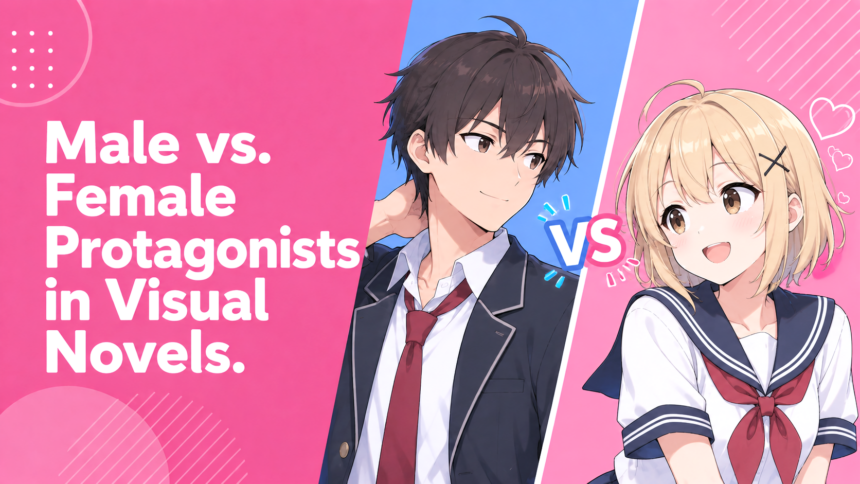
Protagonist gender matters more for marketing and initial audience signaling than it does for the actual quality of a visual novel’s writing, but it’s far from a meaningless detail either. It shapes genre conventions, voicing patterns, and who a specific title feels like it was built for, even when the underlying story could theoretically work with either gender at the helm. Understanding where gender genuinely changes the experience, and where it mostly just changes perception, helps explain why this remains such a persistent point of discussion in visual novel communities, coming up regularly in polls and threads on r/visualnovels asking readers directly which they prefer.
Why Protagonist Gender Became a Genre Signal
Visual novels grew up commercially alongside bishoujo games aimed primarily at a male audience and otome games aimed primarily at a female audience, and that split baked protagonist gender directly into how the genre gets marketed even decades later. A male protagonist surrounded by a cast of female love interests signals a bishoujo or galge structure almost immediately, while a female protagonist navigating a cast of male love interests signals an otome game just as clearly, often before a reader has learned anything else about the actual story.
This signaling function means protagonist gender frequently tells potential readers more about a title’s intended structure and audience than it tells them about the actual narrative quality waiting inside. A reader specifically browsing for otome-style visual novels or checking are otome games actually visual novels uses protagonist gender as one of the fastest available filters, and that filtering function is real and useful, even if it says little about writing craft on its own.
Does Protagonist Gender Affect Relatability?
For readers who prefer self-inserting into a protagonist rather than experiencing the story as an outside observer, playing as a character of their own gender often does genuinely ease that process, since it removes one layer of imaginative distance between the reader and the character they’re stepping into. This isn’t universal. Plenty of readers self-insert comfortably regardless of a protagonist’s gender, and plenty of others don’t particularly self-insert into any protagonist at all, preferring to experience a story as a distinct character’s journey rather than as an extension of themselves.
For visual novels using a more developed, clearly characterized protagonist rather than a deliberate self-insert blank slate, gender matters less for relatability specifically, since the reader isn’t being asked to imagine themselves as the character in the first place. A well-written protagonist with a strong, specific voice can be compelling to readers regardless of whether that protagonist shares the reader’s own gender, in much the same way a well-written character in a novel or film doesn’t require matching the reader’s demographic to land emotionally.
Voicing Patterns Differ Noticeably by Protagonist Gender
One of the more concrete, measurable differences shows up in voice acting conventions rather than in writing quality itself. Male protagonists in bishoujo and galge visual novels are voiced far less consistently than their female love interests, with many titles leaving the male lead entirely unvoiced while every other character speaks. This pattern is tied partly to budget allocation, since studios frequently prioritize voicing the cast members players are meant to romance over the player-adjacent protagonist, and partly to self-insert design, where leaving a male protagonist silent supports the sense that the reader is stepping directly into his position rather than watching him as a separate character.
Female protagonists in otome games follow a somewhat different pattern, though similar unvoiced-protagonist conventions show up there too for largely the same self-insert reasons. The specific voicing pattern a title follows often reveals as much about its underlying design philosophy, self-insert versus fully developed character, as it does about protagonist gender on its own, and the two factors frequently overlap rather than operating independently.
Genre and Story Type Correlate With Protagonist Gender More Than People Expect
Certain genres and tones show up disproportionately more often with one protagonist gender than the other, reflecting historical market conventions more than any inherent requirement of the genre itself. Otome games skew heavily toward romance as a structural focus, since the genre was built specifically around that appeal from the outset. Bishoujo and galge titles similarly center on romance mechanics by design, though a wider range of tone shows up within that category, from light comedy to much darker psychological content.
Visual novels with female protagonists that step outside typical otome or yuri conventions do exist, focusing on plot-driven stories with minimal or no romance at all, but they represent a smaller slice of the market specifically because a female protagonist has become so strongly associated with a genre expectation that a story deliberately breaking from that expectation sometimes struggles for visibility purely due to how readers assume the genre works before actually checking. The same pattern shows up somewhat less severely for male-protagonist titles outside typical bishoujo conventions, since the format’s broader default has historically assumed a male protagonist for non-romance genres by default, making a departure from romance conventions feel less unusual for that gender specifically.
Does Gender Change What Kind of Story Gets Told?
Not inherently, and this is where the meaningful distinction between genre convention and actual storytelling requirement becomes clearest. Nothing about a mystery, horror, or slice-of-life narrative structurally requires a protagonist of one gender over the other, and titles that break from typical gender-genre pairings prove this regularly, whether that’s a female-protagonist story built around dark psychological themes with minimal romance, or a male-protagonist otome-adjacent structure exploring similar relationship dynamics from the other direction. The range of genres visual novels actually cover doesn’t inherently depend on protagonist gender at all, even though the format’s market convention has historically paired certain genres with certain protagonist genders far more often than pure storytelling logic would actually require.
The gap between what’s structurally necessary and what’s simply become conventional through decades of market pattern is worth keeping distinct, since readers sometimes assume a genre requirement exists where really only a marketing habit does.
Should Protagonist Gender Influence What You Choose to Read?
For readers who know they self-insert more comfortably into a protagonist sharing their own gender, factoring that preference into what to read next is entirely reasonable and not something to second-guess. For readers who don’t particularly self-insert, or who enjoy experiencing stories through protagonists different from themselves just as readily, protagonist gender matters far less than genre, tone, and writing quality, and filtering too heavily by gender alone risks skipping over genuinely well-written titles purely because of a marketing convention rather than any real mismatch with personal taste.
The more useful filter in most cases is checking what a specific title is actually trying to do narratively, romance-focused or plot-focused, self-insert or developed protagonist, light or heavy in tone, rather than treating protagonist gender as a reliable proxy for any of those deeper qualities on its own, a lookup easy enough to do directly on VNDB.
The Short Version
Protagonist gender in visual novels functions largely as a genre and marketing signal, correlating strongly with historical conventions around bishoujo, galge, and otome structures, and it does have real, measurable effects on voicing patterns and self-insert design specifically. But it doesn’t structurally determine what kind of story a visual novel can tell, and readers who don’t particularly need to self-insert into a protagonist sharing their own gender will generally find that writing quality, genre, and tone matter far more to their actual enjoyment than which gender the protagonist happens to be.