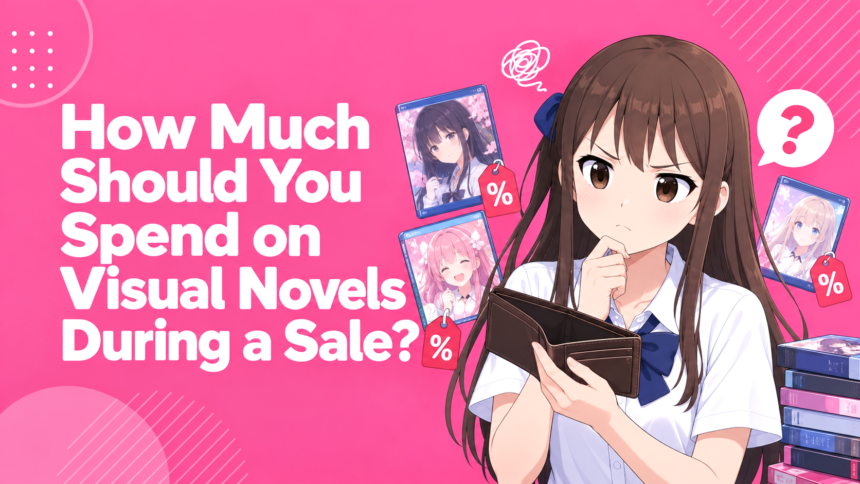
There’s no universal dollar figure that works for everyone, but a useful starting principle is spending based on how much you can realistically read in the coming months, not on how much the discount makes available. Sales are specifically designed to make spending feel low-risk in the moment, a pattern that shows up across digital storefronts generally, and that framing tends to disconnect purchase decisions from actual reading capacity, which is exactly how a reasonable one-title shopping trip turns into a dozen unread purchases sitting untouched for years afterward. Deciding in advance where to actually buy visual novels and at what price helps put this in perspective before a sale even starts.
Why Sales Make Overspending Feel Reasonable
A deep discount changes the psychology of a purchase in a way that’s worth recognizing before it happens rather than after. Paying seventy percent off a visual novel’s normal price feels like a smart, responsible purchase even when it’s the fifth title added to a cart in the same sitting, because each individual purchase is being evaluated against its discounted price rather than against your actual remaining reading time or already-existing backlog. Why visual novels carry the pricing they do partly explains why this feels so tempting: full retail prices for visual novels are often high enough that a steep discount creates a genuinely large perceived gap between what you’d normally pay and what a sale is asking for right now.
This dynamic isn’t unique to visual novels, but the genre’s typically long playtime makes the consequences of overspending during a sale more pronounced than in genres with shorter average completion times. A dozen twenty-dollar action games bought on sale might all get played within a reasonable window. A dozen forty-hour visual novels bought in the same spirit represent an amount of reading time that could easily take years to actually work through.
Set a Number Before You Start Browsing
Deciding on a specific spending limit before opening a storefront during a sale, rather than deciding purchase by purchase as titles catch your eye, removes a lot of the in-the-moment rationalization that makes overspending easy. A number decided in advance, based on your actual budget and how much reading time you genuinely expect to have, holds up better against the pressure of watching a wishlist item’s price drop than a vague intention to “not go overboard” decided on the fly.
This number doesn’t need to be the same every sale, and it’s reasonable to budget differently depending on your current backlog size and financial situation at any given time. The point isn’t landing on one fixed figure forever, it’s committing to a specific number before browsing starts, rather than letting the total accumulate passively across an entire sale window without ever consciously tallying it.
Tie Spending to Reading Capacity, Not Just Budget
Financial budget is the obvious constraint, but reading capacity deserves just as much weight, since a purchase you can afford financially still represents wasted money if it sits unread indefinitely. Estimating how many visual novels you realistically expect to finish in the next six months to a year depends partly on how long visual novels typically run, and limiting sale purchases to roughly that number keeps spending tied to something more meaningful than just what you can technically afford to charge to a card in the moment.
This approach naturally self-corrects for people with existing backlogs. A reader already sitting on fifteen unread titles has a much stronger case for spending very little, or nothing at all, during a given sale, regardless of how tempting the discounts look, simply because reading capacity is already fully spoken for by existing purchases. A reader who just cleared their backlog entirely has more legitimate room to buy several new titles without immediately creating the same unread pile problem.
Prioritize Wishlist Items Over Impulse Discoveries
Sales tend to surface two very different kinds of purchases: titles you’d already specifically wanted and were waiting for a discount on, and titles you’re discovering for the first time purely because a storefront’s sale page, whether on Steam or a publisher’s own store like MangaGamer, put them in front of you. The first category represents genuinely planned spending. The second category is where impulse purchases tend to accumulate fastest, since a deep discount on something you’d never previously considered feels like an opportunity too good to pass up, even when it wasn’t something you were actually looking for.
Giving wishlist items priority within your budget, and treating newly discovered titles as a much smaller, more deliberately limited category, keeps a sale’s overall spending closer to what you’d actually planned rather than what a storefront’s recommendation algorithm, the kind Steam relies on heavily, happened to surface in front of you during a moment of lowered purchasing resistance.
Consider Whether You’d Buy It at Full Price
A useful gut check for any specific purchase during a sale asks whether you’d still want the title enough to buy it at full price, just at a different time. If the honest answer is no, and the only appeal is the discount itself rather than genuine interest in the title, that’s a strong signal the purchase is being driven by the sale’s psychology rather than actual desire to read the game. This test filters out a lot of the weakest impulse purchases without requiring a hard spending cap to catch them.
This doesn’t mean every sale purchase needs to pass this test with total certainty. Genuine discovery during a sale, finding something you didn’t know you wanted until you saw it discounted, is a real and legitimate way titles end up getting read. But leaning on this question as a rough filter, rather than buying reflexively based on discount percentage alone, tends to produce a more satisfying set of purchases overall.
Does Buying More Now Actually Save Money Long Term?
Sometimes, but this reasoning gets used to justify overspending more often than it genuinely applies. It’s true that prices tend to rise or stay flat between sales rather than falling further, a pattern easy enough to confirm by checking a title’s price history directly on Steam, so buying a genuinely wanted title now during a deep discount can represent real savings compared to waiting and eventually paying full price later. But this logic only holds for titles you’re actually confident you’ll read eventually. Applying it to titles you’re on the fence about, purely because “it’ll probably cost more later,” is really just a more sophisticated-sounding justification for the same impulse spending the rest of this advice is trying to guard against.
Whether a specific visual novel is worth buying is a question worth answering honestly for each title individually, rather than assuming a low sale price answers it automatically on its own.
Free Titles Are a Legitimate Way to Manage Spending Pressure
For readers feeling the pull to buy something during every major sale purely out of habit or fear of missing a good discount, deliberately substituting a free title instead of a paid purchase satisfies some of that same “trying something new” impulse without adding to either your budget or your backlog in the same way. Free visual novels cover a genuinely wide range of quality and genre, and platforms like itch.io host a large share of them, giving you somewhere to direct that impulse without any financial consequence at all.
The Short Version
There’s no fixed dollar amount that works for every reader, but tying your sale spending to a number decided in advance, based on realistic reading capacity rather than just available budget, keeps a sale from turning into more unread purchases than you’ll ever actually get to. Prioritizing existing wishlist items over impulse discoveries, checking whether you’d want a title at full price, and considering free titles as a genuine alternative when the urge to buy something is really just about the excitement of a sale itself, all help keep spending aligned with what you’ll actually read rather than just what a discount makes tempting in the moment.