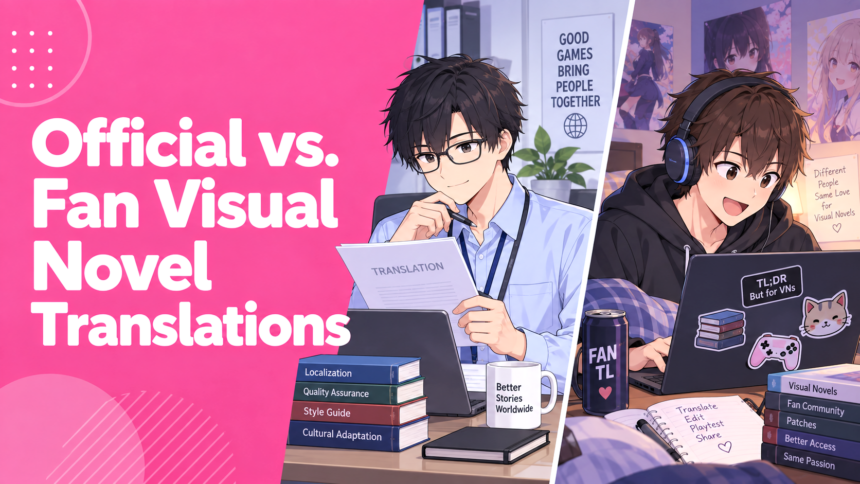
Neither wins outright, and the honest comparison depends heavily on which specific title, which specific fan team, and which specific official localization you’re actually looking at. Official translations bring accountability, legal access, and usually stronger quality control. Fan translations bring speed, access to titles publishers will never touch, and sometimes a level of dedication that rivals or beats professional work. Treating one as automatically superior to the other ignores just how much variation exists within both categories of the visual novel space.
What Official Translations Actually Offer
A licensed, official translation comes from a publisher that’s paid for the rights to localize a specific title, which means the release is legal, supported, and generally held to some baseline of editorial quality control. Professional localization teams typically include dedicated translators, editors, and quality assurance testers whose entire job is catching inconsistencies, awkward phrasing, or outright translation errors before the game ever reaches a storefront.
This structure doesn’t guarantee a perfect translation, but it does mean there’s usually a team, a budget, and accountability behind the final product. If an official translation ships with serious errors, publishers occasionally patch fixes after release in response to reader feedback, something that’s much harder to expect from an unpaid volunteer project that might lose its active contributors at any point.
Official releases also come with legal certainty that fan translations simply can’t offer. Purchasing a licensed release means supporting the original developers and the localization team directly, which factors into whether more titles from that studio or publisher end up getting official treatment in the future. Whether a visual novel is worth buying partly depends on this larger picture, not just the quality of a single release in isolation.
What Fan Translations Actually Offer
Fan translation projects, often called fan patches or fan-tl projects, are unpaid, volunteer-driven efforts to translate a Japanese-only visual novel into English or another language without any official license behind the work. These projects exist specifically because Japan continues to produce the overwhelming majority of visual novels worldwide, and only a small fraction of that catalog ever receives an official Western release. For a huge number of titles, a fan translation is the only way an English-speaking reader will ever experience the story at all.
Quality varies enormously across fan projects, which is really the defining trait of the category as a whole. Some fan translations are produced by skilled, deeply dedicated teams who spend years polishing a script, consulting with native speakers, and iterating on early drafts based on community feedback. Others are rushed, produced quickly by a small team or even a single translator working alone, and the resulting text can carry awkward phrasing, missed cultural context, or outright mistranslations that a professional editorial pass would normally catch.
Speed is where fan translations most consistently outperform official releases. A dedicated fan team can sometimes produce a playable patch within months of a Japanese release, while an official localization, dependent on licensing negotiations and a publisher’s release schedule, can take years to materialize if it happens at all.
Quality Isn’t as Simple as “Official Wins”
It’s tempting to assume paid professional work automatically beats unpaid volunteer work, but the reality in visual novel translation is messier than that. Some of the most beloved fan translations in the genre’s history are held up as gold standards specifically because the teams behind them had more time, more passion, and fewer commercial constraints than a typical publisher-funded project working against a release deadline. A fan team translating a title purely out of love for the story sometimes produces more careful, more thoughtfully localized prose than a rushed commercial release working under tight budget and schedule pressure.
At the same time, plenty of official releases genuinely do outperform earlier fan translations of the same title, benefiting from proper editorial review, consistent terminology across a long script, and access to the original developers for clarification on ambiguous lines. The pattern isn’t consistent enough in either direction to generalize confidently, which is exactly why checking reviews on VNDB or community discussion on r/visualnovels for a specific translation, official or fan-made, matters more than assuming a category label guarantees quality.
Legal and Ethical Considerations
Fan translations occupy murky legal territory, and how that’s handled varies by project and by publisher. Some fan translation patches are built to apply on top of a legally purchased copy of the original Japanese release, requiring the reader to own the source material before the patch does anything at all. Others distribute translated text alongside pirated game files, which raises separate concerns entirely from the translation itself. Whether to pirate a visual novel is a distinct question from whether to use a fan translation patch, and conflating the two skips over a meaningful distinction between supporting unauthorized distribution and supporting unpaid fan labor applied to a legitimately purchased game.
Some Japanese publishers have taken a hard line against fan translation projects for specific titles, issuing takedown requests once an official English license gets picked up, or occasionally even before one exists. Others have been notably permissive, sometimes even quietly supportive, recognizing that fan translations often build exactly the kind of dedicated overseas audience that eventually justifies an official localization deal in the first place.
Learning Japanese as a Third Option
For readers serious enough about the format, learning to read Japanese visual novels directly sidesteps the entire official-versus-fan question by removing the need for either. This is obviously a much larger undertaking than simply choosing between two existing translation options, and it’s not realistic for most readers looking for a quick answer. But for readers who find themselves consistently frustrated with both official and fan translation quality across multiple titles, it’s worth acknowledging as the option that ultimately removes the translation variable from the equation entirely.
How to Actually Decide for a Specific Title
The most practical approach checks what’s actually available before worrying about the abstract comparison at all. If a title has a strong official release, available through storefronts like JAST or MangaGamer, that’s almost always the better starting point given the legal certainty and typically stronger quality control, and it directs money toward the people who made the game in the first place. If a title has no official release and never will, a well-regarded fan translation is often the only realistic way to experience the story, and checking community reception of a specific fan patch before starting helps separate the genuinely well-crafted projects from rougher, less polished efforts.
Reading community discussion around how translation actually gets approached for a specific visual novel, whether that’s an official studio process or a fan team’s methodology, tends to surface real quality signals faster than assuming either category guarantees a particular outcome on its own.
The Short Version
Official translations offer legal certainty, editorial accountability, and financial support for the original creators, but they’re slower to arrive and don’t exist at all for the majority of Japanese visual novels. Fan translations offer speed and access to titles that will likely never get official treatment, with quality that swings widely between genuinely excellent and rough depending entirely on the specific team behind a given project. Neither category deserves blanket trust or blanket dismissal. The better question is always about the specific translation in front of you, not which broad category it happens to fall into.