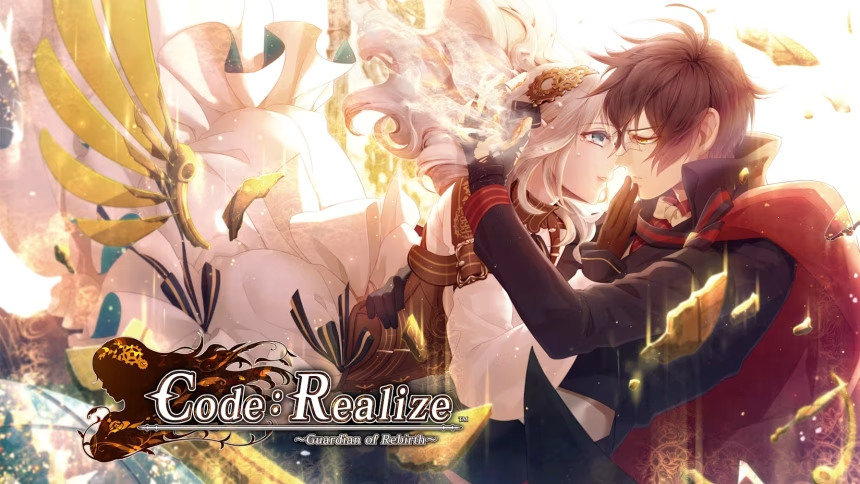
A woman whose touch dissolves flesh and metal alike makes for an unusually literal metaphor in a genre built around romantic contact, and Code: Realize ~Guardian of Rebirth~ gets real narrative mileage out of that tension throughout its lengthy runtime. Developed by Otomate and localized by Aksys Games, releasing in English on PS Vita in October 2015 three years after the original Japanese debut, this steampunk otome sets its story in an alternate Victorian London populated by thinly veiled versions of famous literary and historical figures, Arsène Lupin, Victor Frankenstein, Abraham Van Helsing, Impey Barbicane, and Count Saint-Germain among them, and builds its central romance around a heroine who’s been told her entire life that falling in love isn’t something she’s allowed to have.
Cardia has spent years locked away in an abandoned mansion at her absent father’s instruction, isolated because her skin carries a corrosive poison that destroys anything it touches. Royal Guards storm her hideout hunting the “monster” locals whisper about, and the gentleman thief Lupin breaks her out, setting the two of them off to find her father and uncover the truth behind her condition while gradually gathering a found-family crew of similarly literary-inspired companions along the way.
The sheer size of the common route is the most immediately distinctive thing about this game, and it’s what generated the most personal back-and-forth reading through it. Roughly eight full chapters play out before the story splits into individual character paths, an unusually long shared foundation even by otome standards, and how that lands depends heavily on what a reader wants from the format. Worldbuilding and found-family dynamics earn the extended common route real credit, giving the ensemble genuine group chemistry and letting every major plot thread breathe before romance takes center stage. Getting to know a specific love interest more intimately sooner is a fair thing to want too, and that same length reads as a genuine barrier on that front, a recurring frustration since the plot consistently takes priority over romantic development even once individual routes finally begin.
Cardia herself is where this game earns its most unqualified praise. Rather than the more familiar passive, blank-slate otome heroine, she actively participates in her own story, learning to fight, pick locks, drive steam-powered vehicles, and understand chemistry alongside her companions, developing real competence and agency across the runtime rather than existing purely to be rescued. That characterization choice elevates the whole experience, giving even a reader who finds the romance itself somewhat thin real reason to stay invested in her personal arc specifically. The wider cast holds up well too, each companion carrying a distinct personality shaped by their literary namesake, though individual route quality varies noticeably; at least one specific character’s storyline lands as considerably weaker and less engaging than the others, a common enough pattern for a five-plus-true-route otome but still worth knowing going in.
Reaching the true final route, Lupin’s story, requires completing at least one ending for each of the other four companions first, a genre convention that’s fairly standard but one the game doesn’t always communicate clearly to newcomers who might expect to simply choose their favorite from the start. That true route does earn real credit for tying together loose plot threads left dangling across the other paths, delivering a genuinely satisfying sense of narrative closure even if its own individual backstory material reads as comparatively thin next to the emotional weight it’s tasked with resolving.
Momentum in the writing leans on real, recurring plot conveniences, characters escaping seemingly hopeless situations through fortunate timing more often than feels entirely earned, a fair criticism to raise even while otherwise enjoying the overall story. Presentation fares better across the board. The steampunk Victorian art direction from illustrator Miko is widely and consistently impressive, with detailed period costuming and genuinely striking CGs standing among the visual highlights of the era’s otome catalog. The soundtrack does solid, if unremarkable, work throughout, and Japanese-only voice acting, no English dub is included, comes across as well-performed for anyone comfortable reading subtitled dialogue.
Verdict
Code: Realize ~Guardian of Rebirth~ distinguishes itself through a genuinely strong, proactive heroine and a richly detailed steampunk setting, delivering real narrative ambition even when its unusually long common route and plot-forward structure mean romance sometimes takes a back seat to worldbuilding and mystery. Individual route quality varies, a handful of plot conveniences strain credibility, and reaching the true ending requires real time investment across every other path first. For readers drawn to Cardia’s journey specifically and willing to embrace an otome experience that prioritizes story over swooning, though, this remains one of the more consistently well-regarded entries the genre has produced in English.