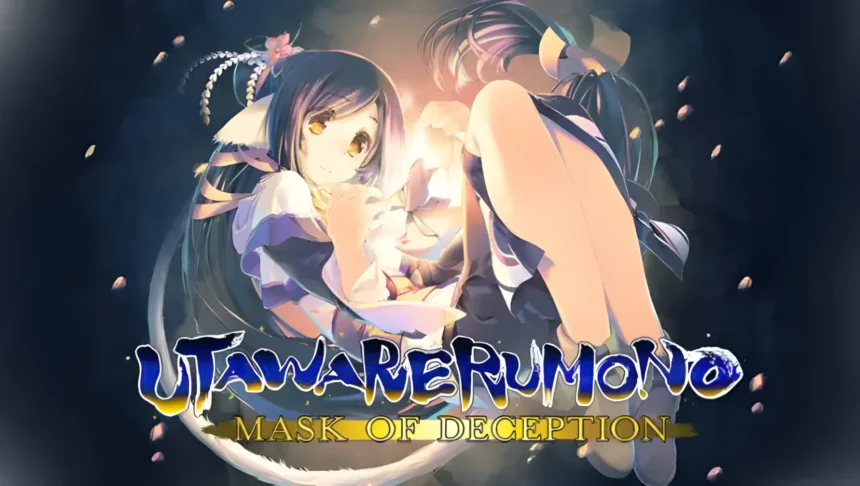
Waking up with no memory in a snowy forest, moments from being eaten by a giant insect, is a fairly standard visual novel opening, but Utawarerumono: Mask of Deception took an unusually long time turning that setup into anything I’d call a compelling story. Developed by Aquaplus and localized by Atlus, this is the western release of the franchise’s second installment, a prequel in story terms to the original 2002 debut despite arriving thirteen years later, blending traditional visual novel storytelling with tactical RPG combat in a world where nearly everyone has animal ears and a tail.
Rescued from certain death by a young woman named Kuon, the amnesiac protagonist she names Haku slowly recovers his strength while trying to piece together who he is and how he ended up alone in the wilderness. As Kuon travels with him in search of somewhere he might settle down, the two get pulled deeper into the political machinations of the powerful nation of Yamato, and what begins as a gentle, low-stakes travelogue gradually reveals itself to be the setup for a much larger conflict.
The overarching plot, once it finally gets moving, delivers engaging political intrigue, layering court machinations, hidden identities, and Haku’s own mysterious origins into a story that earned my real investment by its back half. The problem is just how long “once it finally gets moving” actually takes. I’d put the slow build at somewhere around fifteen to twenty hours before the plot developed any real momentum for me, and getting there meant sitting through an extended stretch of low-stakes slice-of-life material, extended scenes of daily routine and gentle banter that tested my patience considerably before the political stakes kicked in.
This is also, by design, only half a story. Mask of Deception ends on a significant cliffhanger explicitly setting up its direct sequel, Mask of Truth, and anyone going in expecting a self-contained narrative arc should adjust expectations accordingly. The back half’s reveals recontextualize the earlier, slower stretches in ways that rewarded the patience it took me to get there, and the eventual resolution of Haku’s mystery lands with real weight, but the sheer amount of table-setting required before any of that pays off remains my single biggest complaint about the whole experience.
Haku and Kuon anchor the story with a genuinely charming dynamic, an amnesiac who initially reads as fairly weak and helpless paired against a companion who’s confident, capable, and refreshingly willing to take the lead, a small but welcome subversion of typical genre dynamics. As the story widens its cast, the ensemble develops real personality, and the political intrigue surrounding Yamato gives several supporting characters motivations beyond simply orbiting the central pairing.
The persistent sexual humor woven throughout the cast is a real point of friction I want to be direct about. A recurring joke involving characters volunteering to be Haku’s “sex slaves” runs through much of the game as ongoing comic relief, and I found myself genuinely uncomfortable with how frequently characters, including Haku himself, comment on the female cast in sexualized terms, in ways that read as considerably more uncomfortable given how young several characters appear. It’s a real weakness in an otherwise likable ensemble, and it sits tonally at odds with the more serious political drama the story is simultaneously trying to build.
When the script commits to its central political intrigue, it’s well constructed, and this localization handles a script this dense with real care, particularly in how smoothly the finale’s revelations land after a long, deliberate buildup. The slow-burn structure clearly wants to give its cast room to breathe before the stakes escalate, and for me, the character work built during the quieter stretches did eventually pay real dividends once the plot kicked into gear. The tonal whiplash between that serious political drama and the persistent fanservice-driven comedy is where the writing struggles most, though. It read to me like two different stories awkwardly stitched together, one earnest and dramatic, one leaning hard into harem-anime sexual humor, and the friction between those two registers kept the writing from ever feeling fully consistent in tone. Extended scenes built around mundane daily activities, stretched considerably longer than their content justifies, compound the pacing problem further, turning what should be efficient character-building into padding.
Visually, this is a gorgeous game, with detailed character art and backgrounds that hold up well regardless of how I felt about the story surrounding them at any given moment. The orchestral soundtrack, recorded with the China National Symphony Orchestra and string sections captured at Abbey Road Studios, earned every bit of the praise its reputation suggests, and the Japanese voice acting, presented without an English dub, is strong enough that the absence of localized voice work never became a real detriment for me.
The tactical RPG combat is where the package falls short of its ambitions. Battles use a straightforward grid-based system with a timing-based critical hit mechanic that’s simple to learn and reasonably satisfying moment to moment, but the overall difficulty rarely rose above undemanding for me, and the game does a poor job explaining its own systems, leaving me to figure out deeper mechanics largely on my own. Combat sequences are also relatively infrequent relative to the sheer volume of visual novel content surrounding them, functioning more as an occasional break from reading than a substantial gameplay pillar in its own right, and an eight-character limit per battle created a few frustrating situations where underleveled party members got forced into fights they weren’t prepared for.
The eventual payoff for sitting through the slow build is real, and the finale’s political revelations land with genuine weight, enough that I wanted to jump straight into the sequel immediately after finishing. Watching Haku and Kuon’s relationship develop from a practical arrangement into something considerably deeper gave the back half real emotional stakes for me, and the wider cast’s fates became genuinely important once the story fully committed to its central conflict. That emotional investment stayed directly proportional to how much patience I brought to the opening stretch, and the persistent tonal clash between serious drama and sexualized comedy undercut some of the emotional weight the story was otherwise building, making it harder for me to take certain scenes as seriously as the writing clearly wanted them taken.
Verdict
Utawarerumono: Mask of Deception delivers a genuinely engaging political fantasy once it finally gets going, anchored by a likable central pairing in Haku and Kuon and backed by gorgeous art, a strong orchestral score, and solid Japanese voice work. Getting to that payoff requires pushing through fifteen to twenty hours of slow, low-stakes setup, and the persistent, often uncomfortable sexual humor woven throughout sits awkwardly against the more serious political drama the story is trying to tell. As only half a larger story, this also isn’t a self-contained experience, and anyone picking it up should go in prepared to continue into Mask of Truth to get any real resolution. For patient readers willing to look past its rougher tonal edges and thin combat, there’s a worthwhile fantasy epic here, just one that takes considerably longer than it should to reveal itself.