What would you do with a button that might slow down the machine currently killing your best friend? There’s a very specific moment partway through Your Turn To Die where the game hands you exactly that, a literal button, and lets you press it. It won’t save him. Nothing you do will. But I pressed it anyway, once, then a dozen more times, and that single interactive choice did more to implicate me in a tragedy than most visual novels manage across their entire runtime. Developed solo by Nankidai using RPG Maker, this horror mystery, free to play in its original form with a paid Steam Early Access release available too, draws obvious comparisons to Danganronpa, and I think it’s earned the right to stand next to it rather than in its shadow.
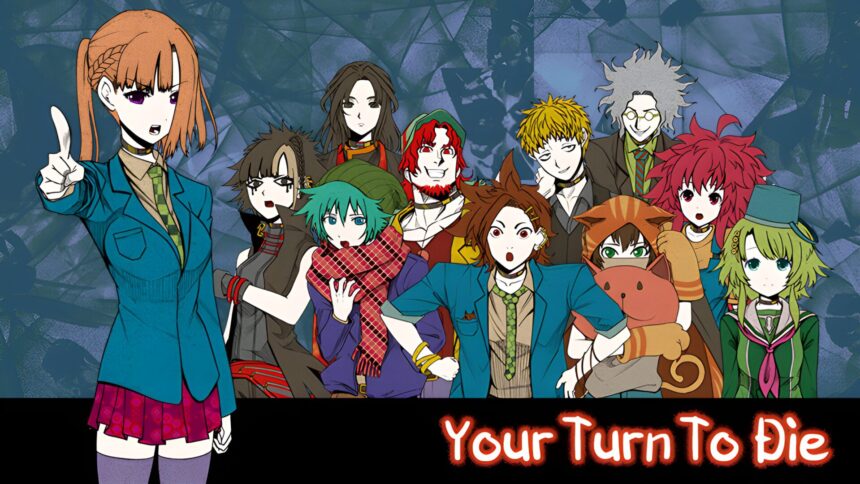
The story is simple, Sara Chidouin comes home from school one night to find something has gone badly wrong, and wakes up trapped alongside her best friend Joe and nine other captives in a facility built around a cruel, escalating series of death games, each one forcing the group to vote by majority on who lives and who doesn’t. What separates this from a dozen other “trapped strangers forced to kill each other” premises, for me, is how patiently it builds its cast before asking me to care about losing any of them, and how relentlessly it refuses to let a character’s death actually mean their story is over. Even participants who die relatively early continued to matter to the plot in ways that unfolded gradually, their absence still shaping decisions and revelations chapters later rather than simply clearing space for the next twist.
Sara herself makes for a compelling anchor, someone who takes on a protective, almost maternal role toward the group while quietly buckling under the weight of believing she’s responsible for the people dying around her. Sou, the group’s most openly distrustful member, gives the cast a genuinely difficult figure to read, someone whose self-isolating behavior invites suspicion that the story uses deliberately, letting the group’s collective paranoia become as dangerous as anything the masked game master throws at them. It’s rare for an ensemble this large to avoid a single grating personality, and the character writing here manages it, giving even the most minor players in the vote enough specific motivation and interiority that losing them to the majority actually felt like something to me.
Structurally, this is closer to a genre-blending adventure game than a straightforward visual novel, mixing dialogue-heavy investigation with an evolving grab-bag of minigames, dance-based memory challenges, russian roulette sequences, arcade-style reaction tests, and later, a more considered tactical sequence where directing characters’ actions in the right order becomes a matter of life and death. That variety kept individual chapters from ever feeling like a repeat of the last one for me, and the puzzle-solving generally struck a fair balance, difficult enough to feel earned without crossing into obtuse frustration. Where the minigames stumble is in how inconsistently they carry emotional weight. A reaction-based challenge used early on to save someone’s life gets reused later purely as an arcade diversion for in-game currency, and that shift undercut the tension those same mechanics had built up originally. Failing any of them also just means reloading a save with no real consequence, which kept the stakes from ever landing quite as hard as the story around them clearly wants them to.
The game’s episodic, ongoing development brings its own real complications, and I want to be upfront about them. Being built and written by a single person means each meaningful branch in the story requires an enormous amount of individual effort to pull off well, and the game’s attempts at genuine narrative branching show real strain as a result. Choices made earlier in the story sometimes left certain characters with noticeably less to do later, depending on which path I took, and at least one significant plot reveal in a specific branch read to me as underexplained relative to how much weight the story puts on it. It’s a rare case where a story might have been served better by committing to a single, tightly controlled path rather than attempting branches a lone developer can’t fully support with equal care across every version. I should also flag directly that the story is not yet finished. I played through the current Steam Early Access build, which covers up through Chapter 3, Part One, Section B; the final chapter has been delayed indefinitely as of this writing, and anyone picking this up should know they’re committing to a story without a confirmed ending date.
None of that undercuts what the game gets right at its core, though. The music consistently earns its own dedicated following, shifting fluidly between dread, quiet sorrow, and rare moments of genuine warmth in ways that elevate scenes well beyond what the RPG Maker engine’s visuals alone could manage. Those visuals themselves start noticeably sparse, with some characters getting by on only a couple of expressions in the earliest chapters, before expanding dramatically as the story progresses, eventually giving major cast members dozens of distinct sprites that let even small emotional beats land with real specificity.
Verdict
Your Turn To Die -Death Game By Majority- earns comparisons to the genre’s biggest names by taking the “trapped strangers, deadly votes” premise and treating every single member of its cast, living or dead, as essential to the story rather than disposable shock value. Its ambitious branching narrative shows real strain given its solo development, and some of its minigames lose emotional impact through inconsistent stakes and easy retries, but the strength of its writing, cast, and atmosphere make it one of the more genuinely gripping entries the death-game genre has produced, even while still awaiting its final chapter.