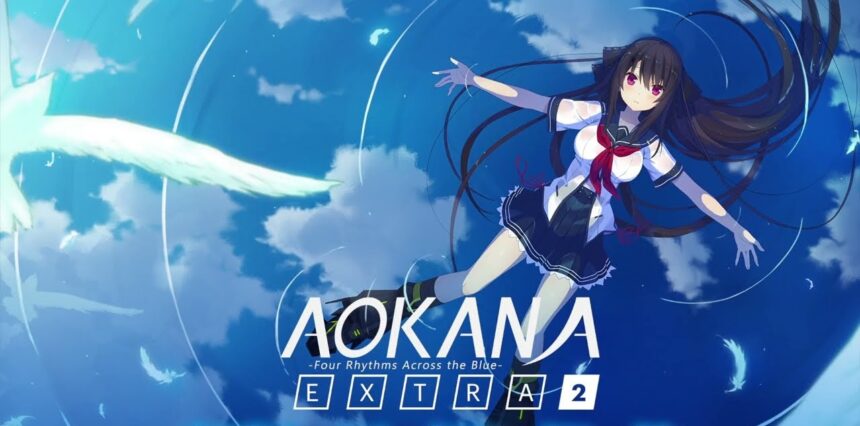
Winning isn’t always the end of the story, and that idea sits at the center of everything Aokana – EXTRA2 is trying to do. This fandisc picks up months after Misaki Tobisawa claims the fall Flying Circus tournament, and the setup here isn’t a victory lap the way you might expect. Instead, the story digs into how reaching a goal doesn’t automatically fix whatever was driving someone to chase it in the first place, and that angle caught me off guard in a good way.
Misaki spends this whole story as the target instead of the underdog. Every rival in the sport is studying her technique now, looking for cracks to exploit, and that pressure builds steadily across the runtime in a way that felt genuinely tense to watch play out. Masaya, meanwhile, is still carrying the psychological weight of his own past failures in FC, trying to support her from the sidelines while quietly wrestling with whether he’s even ready to compete again himself. Two threads running in parallel like that gave the story more shape than a typical fandisc usually bothers with.
Following up a victory with a story about the anxiety success itself can create is a smart, well chosen direction, especially for a character whose original route was already built around the fear of losing. Misaki’s arc doesn’t just repeat that fear, it reframes it. Suddenly everyone’s expectations are pointed at her instead of the other way around, and that shift made for compelling reading. Sure, it leans on a fairly familiar power of friendship resolution by the end. The emotional groundwork holding that resolution up still felt earned rather than hollow, largely because it mirrors Masaya’s own unresolved trauma so closely.
Being a kinetic novel with a single heroine route and no branching choices, the pacing stays tight from start to finish across a runtime that landed around five hours. None of the padding that tends to weigh down longer visual novels trying to stretch a similar premise across multiple paths shows up here, and the efficiency of it stood out immediately.
Both Misaki and Masaya get real development. Their parallel struggles with the psychological cost of competing at the top level give the story a throughline that holds together emotionally from start to finish. The best part of the whole thing is watching Masaya support Misaki through exactly the kind of pressure that once broke him, and that gives their relationship a depth beyond typical fandisc romance material. The wider cast gets comparatively little room, which makes sense for a five hour story built around a single pairing, though a few supporting characters still manage brief, welcome moments in the spotlight.
The dialogue balances competitive sports drama with real emotional introspection well, and the writing never leans too hard into melodrama even while tackling genuine anxiety and self doubt. Some of the Flying Circus mechanics get re-explained here, overlapping a lot with material from the original game. As a refresher, that works fine, though it probably won’t add much for anyone already deeply familiar with the sport’s rules from a recent playthrough of the first game.
Visually, this might be one of the best looking visual novels in the genre right now. It carries over the original Aokana’s reputation for striking production values, with dozens of new CGs and full voice acting for the cast. The Flying Circus matches in particular render beautifully. Colorful streaking lines sell the speed and technicality of the sport’s aerial competition in a way that’s just fun to sit back and watch unfold. The soundtrack matches that same level of polish throughout, and a handful of new vocal tracks stand out as easy favorites by the end.
By the finish, the core idea about rediscovering passion after achieving a goal that turns out to be more complicated than expected lands with real sincerity. The parallel emotional arcs between Misaki and Masaya give the resolution actual weight instead of feeling like a happy ending tacked on for its own sake. It’s a smaller, more contained emotional story than a full length visual novel would attempt, and it clearly knows that about itself. Within its runtime, it accomplishes exactly what it sets out to do.
Verdict
Aokana – EXTRA2 is a well crafted, tightly focused continuation of Misaki’s story, thoughtful in a way that elevates it well past a simple victory lap sequel. Its short runtime and single route structure keep it from feeling essential the way the original Aokana did, and playing that game first is basically a requirement going in. For anyone already invested in Misaki and Masaya specifically, though, this delivers a satisfying, visually excellent coda that closes out their story exactly the way it deserved.