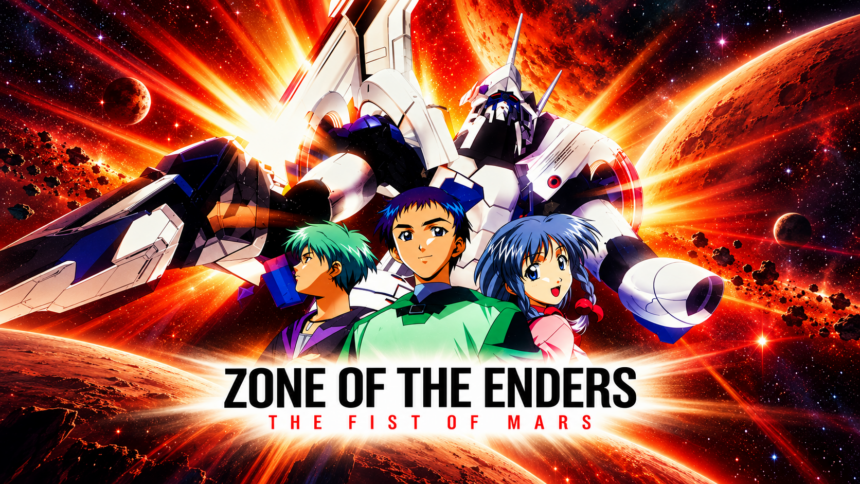
Cage Midwell is seventeen and working aboard the interplanetary ship Bonaparte III when he discovers Myona Alderan hiding in the cargo hold with no memory of how she got there. An attack on the ship leaves both of them escaping inside a prototype machine called Testament before crashing on Mars. Their arrival immediately pulls Cage into a conflict he understands badly and has even less preparation to survive.
On the other hand, Mars in 2173 is already carrying generations of resentment toward Earth. Martian colonists are derisively called Enders, and Earth exercises political and military control over a population increasingly unwilling to accept its position. Cage and Myona barely have time to understand where they have landed before they are detained and blamed for the destruction surrounding their arrival.
Their escape brings them into contact with BIS, short for Born In Space, a resistance organization led by former UNSF officer Deckson Geyse. That shift gives the story its real direction. Cage stops being someone trying to survive an accident and becomes part of a movement fighting against Earth’s treatment of Mars, whether he is ready for that responsibility or not.
Bolozof Velasgo makes the political divide difficult to ignore. He represents the contempt directed at Martians with enough hostility that I never had to wonder where the story wanted its moral line drawn. The conflict is not presented as two equally reasonable governments misunderstanding one another. Earth possesses power, Martians live under it, and characters on both sides make choices within that imbalance.
The game breaks the campaign into 26 episodes, and that structure did more for my sense of progression than a conventional sequence of RPG chapters would have. Most episodes surround a tactical battle with substantial story scenes before and after it, while the final episode closes through narrative rather than another combat map. I started treating them more like installments of a television series than individual levels.
That rhythm works particularly well because The Fist of Mars has far more dialogue than its Game Boy Advance presentation initially suggests. Entire stretches can pass through portraits, text boxes, and changing expressions before a tactical map appears. The writing makes room for political arguments, relationships, humor, and personal insecurities rather than using every conversation only to explain the next objective.
Ares Enduwa matters early because Cage does not begin as an independent hero. Ares is his co-worker, closest friend, and the person Cage looks up to aboard the Bonaparte. That dependence gave the opening story more weight for me than simply watching Cage receive Testament and become useful. The machine does not immediately solve the more personal problem that Cage is accustomed to measuring himself against someone he considers more capable.
Myona approaches the story from another direction. Her missing memory gives Cage someone else to protect while allowing the politics and terminology surrounding Mars to reach the player through a character who does not already understand everything herself. I liked that because the world has enough organizations, machines, military terminology, and historical resentment to become cumbersome if everyone spoke as though the audience already knew it.
The game also includes reference material for characters, terminology, and combat units, which fits how much information the script expects me to keep straight. It rarely replaces the story’s explanations, but it gives the campaign somewhere to store details that would otherwise need to be repeated in dialogue.
Once combat begins, the experience becomes much simpler. Units move across square grids, weapons have different ranges, terrain influences positioning, and mission objectives vary between eliminating enemies, protecting targets, and defeating particular units. LEVs and Orbital Frames have different strengths, but the tactical layer rarely overwhelmed me. Most battles were straightforward enough that the story remained the harder part of the game to keep track of.
The Interactive Attack System gives those fights their unusual hook. Instead of allowing every attack and dodge to resolve entirely through statistics, IAS lets me manually influence the result through a first-person targeting sequence. On offense, that means lining up a shot. On defense, it means trying to keep the enemy’s targeting cursor away from my machine.
It is a strange addition to a turn-based strategy game, but I appreciated having something physical to do once two units actually engaged. The grid determines whether I have created a favorable situation, while IAS gives me a chance to influence what happens inside that encounter. It never turns The Fist of Mars into an action game, but it keeps combat from feeling completely detached from the mecha fantasy the story is selling.
The tactical difficulty remains forgiving for much of the campaign. I rarely felt seriously outmatched by the missions themselves, and that makes the strategic side easier to approach than something built around punishing optimization. The tradeoff is that positioning and upgrading can sometimes feel more procedural than tense.
Certain combat decisions can also change how later portions of the story unfold, including which ending path becomes available. I liked that the game can attach consequences to battlefield performance without turning every conversation into a visible morality choice. Knowing afterward that an apparently ordinary mission could influence the direction of the story made the campaign feel less rigid than its episode structure initially suggested.
Between missions, money can be used to improve machines, while Local Servers found during battles provide additional equipment and upgrades. The customization is fairly restrained. I never spent long building radically different versions of the same unit, which keeps preparation moving quickly but also limits how much strategic identity I could impose on the roster.
Visually, the game is at its best whenever it gets close to the machines. Katsuzo Hirata, Koji Kurosumi, and Takeshi Shimoyama are credited with character design, while Kurosumi handled mechanical design under supervisors Toshio Noguchi and Yoji Shinkawa. The LEVs and Orbital Frames carry much more visual presence than I expected from a Game Boy Advance screen.
Attack sequences help sell that scale. The battlefield itself is necessarily compact, but combat cuts away to larger illustrations and effects that make weapons feel more substantial than tiny grid sprites could. The mecha designs manage to remain readable even with the hardware’s limitations, and I found myself paying more attention to individual machines than I normally would in a handheld strategy RPG.
Character portraits do similar work during the long story sequences. Different expressions prevent conversations from becoming completely static, and occasional event illustrations give important scenes more visual emphasis. There is no voiced dialogue, so those portraits, sound effects, and music have to carry much of the dramatic presentation beside the text.
Tatsuya Fujiwara and Susumu Nakamura are credited for sound, and the score knows exactly when the script is trying to generate urgency. Sometimes it knows a little too well. There were scenes where the dialogue had already established the tension and the music pushed in the same direction so aggressively that the moment felt as though it were reaching twice for an effect it had already earned.
At other times, that directness fits the television-like structure. Each episode needs to establish its mood quickly before the next tactical mission interrupts it, and the music rarely wastes time being ambiguous about whether a scene is threatening, reflective, or urgent. On a handheld game built around long passages of text, that immediate tonal reinforcement helps keep conversations from flattening together.
Kazuyoshi Horikawa wrote the scenario, with Atsushi Kamata directing and Naoya Inui credited with story creation. WinkySoft developed the game, while Konami published it. Japan received it as Z.O.E: 2173 Testament on September 27, 2001, followed by the North American release of The Fist of Mars on February 26, 2002 and a European release that June.
Despite following the original Zone of the Enders chronologically, it largely builds its own cast and conflict. That independence worked in its favor for me. Cage does not spend the campaign standing in the shadow of the previous game’s protagonist, and the story can concentrate on Mars, BIS, Earth, Myona, and the relationships around Testament without constantly stopping to remind me that another Zone of the Enders game exists.
The part that stayed with me most was still Cage’s relationship with Ares. The larger political story gives both of them somewhere to stand, but their friendship makes those positions matter before the war expands around them. Cage begins by looking toward Ares whenever he needs certainty. Handing him an extraordinary machine does not automatically erase that dependence.
That is where The Fist of Mars earns its teenage mecha pilot for me. Testament gives Cage power immediately. The story takes much longer to give him the confidence to decide what that power should be for. The tactical battles may rarely demand everything the machines are capable of, but the character writing understands that becoming useful in a war and becoming capable of choosing for yourself are not the same thing.
Verdict
Zone of the Enders: The Fist of Mars works better as a story-driven mecha campaign than as a demanding strategy RPG. Its 26-episode structure gives the adventure a convincing anime rhythm, Cage and Ares give the opening an emotional foundation, and the Earth-Mars conflict makes the political stakes clear without relying entirely on the machines to create drama. The grid battles are approachable enough that I rarely felt seriously threatened, though the Interactive Attack System gives individual exchanges more personality than the tactical layer would have on its own. The character and mechanical artwork also pushes well beyond what I expected from the Game Boy Advance. What stayed with me was Cage gradually becoming more than the boy who happened to be sitting inside Testament, which is exactly the growth a story like this needed to earn.