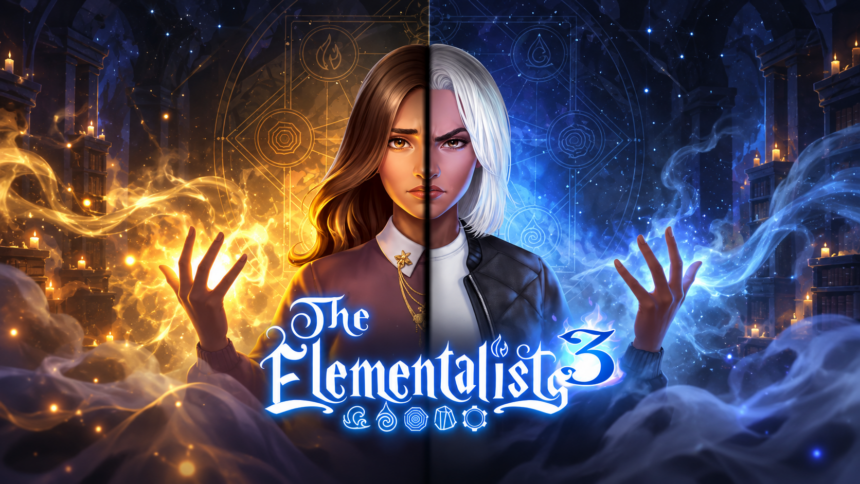
The cruelest thing Book 3 does is turn Atlas into the person standing between Eli and her future. For two books, their relationship survived separation, hidden identities, dangerous magick, and the awkward work of becoming siblings after growing up apart. Now Penderghast tells them only one of them may become the next High Attuned, a position powerful enough to shape the entire Attuned world. I expected the competition to test their abilities. I was less prepared for how quickly it starts testing whether everything they built as siblings can survive being told to treat each other as obstacles.
That change gives The Elementalists, Book 3 a completely different source of tension from Raife or Kane. There is no distant villain I can comfortably unite everyone against. Atlas wants the same title Eli can pursue, has understandable reasons for believing they deserve it, and becomes increasingly consumed by proving that point. Every challenge therefore carries baggage before it even begins. Winning feels good until I remember who has to lose. The High Attuned trials dominate the ten chapters. They test spellwork, judgment, endurance, and the twins’ willingness to push beyond what would have counted as acceptable behavior during their first two years. Previous spells can return if Eli learned them earlier, so carrying progress forward occasionally gives the competition the satisfying feeling of using an education accumulated across the whole series rather than starting from a fresh spell list.
The more important progression happens through Power and Peace choices. I leaned toward one philosophy through decisions that often looked small in isolation, but the pattern eventually determined what Eli was willing to do when the competition stopped feeling sporting. Power treats victory as something worth taking. Peace keeps looking for an answer that refuses the premise that one twin must destroy the other to succeed. Neither is merely a dialogue flavor by the finale. That made the last challenges genuinely uncomfortable for me. Atlas is frustrating here, sometimes deliberately so, and the competition brings out selfishness and resentment that had been easier to contain when the twins were fighting on the same side. I was angry with Atlas more than once. I also never forgot that this is the sibling Eli spent two books trying to find and understand, which made retaliation much harder to treat as a satisfying route reward.
The possible outcomes are consequently harsher than a simple win-or-lose screen. Eli can emerge as High Attuned, Atlas can claim the position, and a Peace-oriented path can create a shared solution rather than accepting the competition exactly as it was designed. Power can lead somewhere much more severe. I liked that the morality system finally reaches beyond personality and changes what victory itself means.
The cost of concentrating so heavily on the twins is that Penderghast feels smaller around them. Beckett, Shreya, Griffin, Aster, Zeph, and the rest of the Pend Pals return, and an existing romance still receives affectionate scenes, but they are supporting players in a story that rarely has spare room for individual subplots. I enjoyed seeing them again, especially when they stopped being spectators and challenged Eli or Atlas directly, but I could feel how much less space ten chapters provide compared with the first two books.
That compression is the book’s clearest weakness. The competition moves from challenge to challenge with very little room for the wider magical world to breathe. Some consequences deserve longer conversations than they receive, and certain relationships have to reach closure quickly because there simply is not another semester’s worth of chapters waiting behind them. Book 3 gives its central conflict enough attention to work, but it cannot give every part of The Elementalists an equally substantial goodbye.
The shorter length does help the competition maintain momentum. There is always another trial, another shift in the twins’ relationship, or another choice pushing Eli toward Power or Peace. I never experienced the mid-book drift that slowed Book 2 for me. The trade-off is almost the reverse: this time I occasionally wanted the story to stop moving and let the characters sit with what had just happened.
The familiar mechanics still carry history forward nicely. My Attunement remains relevant, previously acquired spells can matter, and the familiar continues to feel like part of Eli’s life instead of an accessory forgotten between books. Tim remains Tim, which is perhaps the most important continuity decision in the entire trilogy. The returning romance also benefits from that accumulated history. Beckett, Shreya, Griffin, or Aster does not need another courtship arc to justify caring about Eli. Their quieter scenes work because two previous books have already established the relationship. Book 3 mostly lets the romance function as emotional support while the sibling conflict takes priority, which is exactly where it belongs.
Visually, the new competition spaces, outfits, spell effects, and magical creatures give the finale enough fresh material that returning to Penderghast never feels like recycling Book 2 wholesale. The Choices presentation remains static by nature, but large magical confrontations are staged clearly enough to sell the scale of what Eli and Atlas are doing. The soundtrack continues giving the series a recognizable magical-school atmosphere without competing with the dialogue.
Premium choices remain the familiar irritation. Diamond scenes can add spells, conversations, romantic moments, or extra context, and some are tempting precisely because this is the last book. I never felt unable to understand the central competition without buying everything, but a finale naturally makes optional goodbyes harder to ignore than they would be halfway through a series. What surprised me most was that I did not finish Book 3 thinking about who deserved to be High Attuned. The title matters because the competition convinces both twins that it must matter more than almost anything else. My choices gradually became less about winning and more about deciding whether Eli was willing to let an institution define success in a way that required her relationship with Atlas to become collateral damage.
That is a strong idea for the series to end on, even if the book reaches it faster than I wanted. Eli entered Penderghast by discovering a world she never knew belonged to her. By third year, she is powerful enough to help decide what that world should look like. The final test is not whether she has learned enough magick. It is whether power gets to decide what she is willing to sacrifice.
Verdict
The Elementalists, Book 3 makes Eli and Atlas’s bond the conflict instead of giving them another villain to defeat together. The Power and Peace system gives that competition meaningful consequences, but ten chapters leave the wider cast and final goodbyes noticeably compressed. As a finale, it works best when winning stops being the most important outcome.