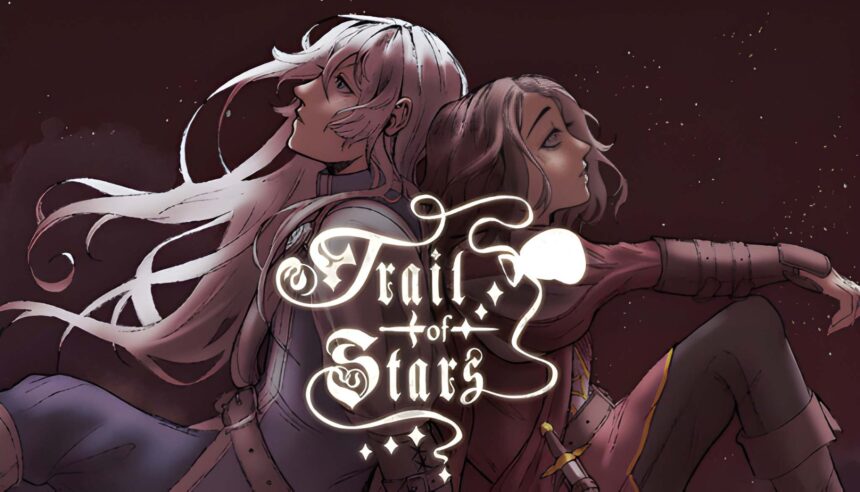
Trail of Stars is most affecting in the things its two leads never have to explain to each other. He is gentle in a world that treats gentleness like a defect. She carries enough anger to imagine putting a dagger through the man they both serve. Neither needs a long confession about why they behave that way. The story lets hesitation, protectiveness, and the way they watch each other do the work instead. The setup is deliberately simple. A noble lord takes two squires on a hunt. One is a boy whose very existence seems to violate whatever order surrounds them. The other is a girl who has good reason to hate their master. What begins like the first page of a familiar fairy tale quickly becomes something much more intimate, because the danger is not a witch, a curse, or some creature waiting in the woods. It is the power already hanging over both of them.
That makes their different responses to harm especially important. He has survived by remaining soft, which almost feels rebellious in a setting that keeps giving him reasons not to be. She has taken the opposite route. Her anger points outward, and the fantasy of violence gives shape to feelings she cannot safely express any other way.
Neither response is treated as more legitimate than the other. I liked that. He is not written as morally superior because he is gentle, and she is not punished for being furious. They simply recognize something wounded in each other before either has the language to name it.
The story is under 3,000 words, so there is no room for elaborate courtship. That limitation actually suits them. Their affection feels old before it feels romantic, built from familiarity and the instinct to protect each other long before either says anything that could be mistaken for a confession. The childhood-friends element gives even the smallest gesture history.
The heavier material is handled with similar restraint. Both characters carry trauma connected to abuse, and the girl’s past includes implied grooming from someone older and more powerful. Nothing is lingered over for shock. The story cares much more about what those experiences have done to their sense of safety than about depicting the experiences themselves.
That choice keeps the fairy-tale tone intact without making the darkness feel sanitized. Trail of Stars still contains blood, death, unwanted advances, and an obvious imbalance of power. It simply refuses to turn suffering into spectacle. The result feels sadder because so much of the damage is visible only in the way these two young people have learned to move around it.
The two endings use the short runtime well. I went back through both in the same evening, and the second changed the emotional temperature of the first more than I expected. Neither route needs a large plot divergence to justify existing. The difference comes from what each ending allows the relationship to become.
Pauline Reinacher’s character art gives the whole thing the softness of an illustrated storybook, while Sparrowling’s backgrounds keep the world sparse enough that the two squires remain the focus. Akua’s three fully rendered CGs arrive exactly where a short story like this needs them. There are so few major visual interruptions that each one feels deliberate.
The music is even more important. ENDYSIS, Calamanser, and ArcanaXIX built a small original score around the story, with ArcanaXIX performing live cello parts. That instrument gives the quiet scenes a physical warmth I did not expect from something this brief. The cello never feels like it is trying to force sadness into a scene. It simply gives the silences somewhere to settle.
Trail of Stars was made in Ren’Py by ENDYSIS, who handled the writing, programming, GUI, logo, and direction. Its storybook interface fits the material instead of merely decorating it, and the whole presentation feels unusually cohesive for such a small project.
What stayed with me was how little the game needs to say outright. It never turns either lead into a speech about trauma, and it never confuses tenderness with healing everything instantly. These are two damaged young people who cannot fix each other’s pasts. What they can do is make the future feel slightly less hostile.
Verdict
Trail of Stars makes less than 3,000 words feel complete by trusting implication over explanation. Its two leads respond to trauma in completely different ways, and their quiet affection gives the fairy-tale framing real emotional weight. The live cello and restrained art deepen that intimacy without ever overwhelming it.