The part of World End Syndrome I remember most clearly is not a corpse, a supernatural revelation, or even one of its larger romantic scenes. It is the town map. Mihate sits there divided into ordinary places that eventually become familiar enough to carry their own expectations, and every morning, afternoon, and evening asks where I want to spend the next piece of summer. Somewhere around my third in-game morning, I caught myself lingering over that screen much longer than the decision deserved, debating whether to look for Miu near the café or head toward the club room and see what Kensuke was doing. On paper, I was selecting a location. In practice, every selection felt like choosing which relationship, rumor, or half-understood mystery I was willing to neglect for a few more hours.
That freedom arrives surprisingly late. World End Syndrome begins with a lengthy prologue that can run for a couple of hours while barely asking the player to make meaningful decisions. The unnamed protagonist has left his old life behind after a personal tragedy and moved to Mihate, a secluded seaside town where an uncle he barely knows owns the mansion he will now call home. Waiting there is Maimi Kusunose, the cousin he had all but forgotten, and it does not take long for history teacher Kaori Yamashiro to drag him into the school’s Mystery Research Club. What initially looks like a convenient excuse to surround him with girls soon gains a much darker purpose. Mihate still tells stories about the Yomibito, dead people said to return once every hundred years, and the current summer happens to fall exactly a century after the last supposed incident.
The prologue deliberately denies the player most of the freedom the later game is built around, and then ends by forcing a bad outcome on the first run. I genuinely thought I had made some obscure mistake when the credits arrived. I had not. World End Syndrome expects that failure, sends the player back through the opening, and only afterward exposes the calendar-driven structure that occupies the bulk of the game. I still think the transition is unnecessarily hostile. A mystery can surprise me without making me wonder whether I misunderstood the basic rules of progression. Yet once Mihate opens up and I can start choosing where to spend each time slot, the forced ending becomes easier to understand as a structural reset between the game’s controlled introduction and the summer I am actually allowed to shape.
That second phase changes almost everything. Different characters appear around Mihate depending on the date and time, route events can require visiting specific locations, and the map gradually records people I have encountered there. Progress carries enough information between playthroughs that returning to an earlier save or starting again does not leave the town feeling completely unreadable. Previously seen text can be skipped quickly, which becomes essential because World End Syndrome is constructed around finishing routes in sequence rather than seeing everything from one flexible save. There is no flowchart letting me jump backward through a completed branch, so repetition is unavoidable, but the combination of fast skipping and persistent location information kept later runs from feeling like complete restarts.
The route progression is more controlled than that open calendar initially suggests. Saya and the girl introduced as Hanako are available early, with additional heroine stories unlocking as earlier material is completed, eventually opening Maimi, Yukino, Miu, and the concluding route that brings the larger mystery together. That gradual unlocking makes sense once the secrets start overlapping because later routes would reveal too much if they were available immediately. The drawback is that the town map sometimes promises more freedom than the story actually allows. I could spend days visiting someone whose route was not yet available and still fail to reach the outcome I expected. Once I understood that World End Syndrome was using a calendar interface to hide a fairly deliberate route order, my decisions became much easier to read.
Maimi is the easiest character to underestimate because she initially fits so comfortably into the energetic cousin role. She lives under the same roof, knows the household better than the protagonist does, performs well at school and in tennis, and can turn something as ordinary as curry into a personal argument. Her objection to potatoes sharing space with rice is exactly the kind of trivial recurring detail that makes Mihate’s everyday material work. World End Syndrome spends enough time on meals, errands, club chatter, and summer routines that its heroines are allowed to become people before the mystery asks them to become clues.
Miu Amana works in almost the opposite register. She is quiet enough to seem detached when first encountered and spends part of her time helping at the café run by her older brother Yamato, but the reserve gradually reads less like simple aloofness once her history begins surfacing. Shiori Izawa leans into that restraint in the Japanese performance, holding Miu at an emotional distance so consistently that the moments where something breaks through become much more noticeable. Her route also sits relatively late in the progression, which gives the game permission to connect her more directly to information earlier stories have been circling.
Saya Kamishiro carries herself with the confidence expected from someone born into Mihate’s most prominent family, but her route gets more interesting as that social position stops functioning like a complete personality. Yukino Otonashi, the young writer the protagonist meets before properly settling into town, brings a different kind of adulthood into a cast dominated by high-school relationships. Then there is “Hanako Yamada,” whose awkward presence around the film production becomes suspicious almost immediately once the game starts emphasizing her resemblance to actress Rei Nikaido. World End Syndrome rarely hides the fact that something is wrong with a character as aggressively as it hides why that wrongness matters. I usually knew where I was supposed to be suspicious long before I understood what the suspicion was actually pointing toward.
The supporting cast makes those routes feel less compartmentalized. Kensuke Asagi gives the Mystery Research Club someone capable of turning a serious investigation into an excuse for chaos, while Kaori’s enthusiasm for Mihate’s local legends keeps pulling the group back toward the Yomibito even when everyone would rather enjoy the summer. Because the same characters continue appearing across different routes, relationships established in one playthrough can make small exchanges in another read differently. World End Syndrome is good at planting details that initially feel incidental, then waiting several routes before giving them enough context to hurt.
That delayed payoff is where Tomio Kanazawa’s scenario does its best work. Kanazawa, who had previously produced Deadly Premonition, writes Mihate less like a town permanently trapped inside a horror game and more like somewhere horror has learned to coexist with ordinary life. Long stretches pass with club meetings, cafés, beach trips, errands, jokes, and arguments before the Yomibito mythology pushes back into view. The structure can make the horror feel intermittent, but I think that is more effective than maintaining constant dread. A town has to feel worth living in before the possibility of something terrible happening to it carries any weight.
The quieter foreshadowing affected me more than the obvious scares. World End Syndrome repeatedly plants a detail in one route and leaves it sitting there until another character’s story gives it a second meaning. One mid-game moment that initially looked almost disposable stayed in my head until a later route suddenly made me understand why it had been there. I will not identify it because the effect depends completely on experiencing the first version without realizing it is setup. The game earns much of its emotional weight through exactly that kind of delay.
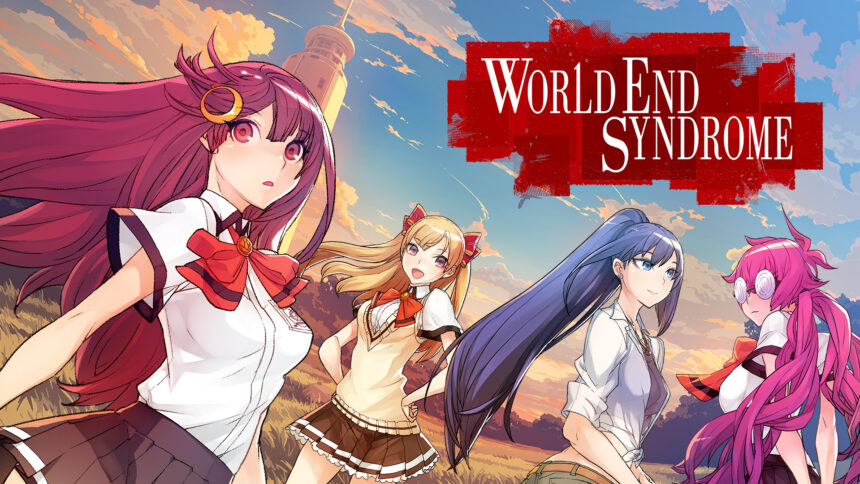
Yuki Kato’s character art makes spending that much time with the cast easy. Kato, known for work on BlazBlue, gives the heroines unusually extensive presentation for a visual novel of this structure, including multiple outfits, expressive portrait work, and different poses that stop conversations from looking like two unmoving cutouts trading lines. The background and movie work, led by Koya Takahashi, gives Mihate similar attention. Beaches, streets, school spaces, cafés, woodland, and the Kamishiro estate build a town that feels geographically coherent by the time the player has spent several calendar weeks moving through it.
The game can occasionally sabotage that atmosphere through its own reward systems. Some character images unlock around moments whose emotional tone does not sit comfortably beside the fan-service presentation attached to them, and the resulting tonal shift can be jarring. A scene can spend several minutes trying to make me uneasy, then the gallery effectively congratulates me with an image designed around a completely different kind of attention. Nothing about the artwork itself is poor. The problem is when the game chooses to celebrate it.
Takashi Nitta’s score handles those tonal transitions more gracefully. Everyday scenes are often carried by lighter melodies that allow Mihate to remain inviting, while the mystery material can move toward more electronic or unsettling textures without making the change feel as though another game has suddenly taken over. The soundtrack is not constantly demanding recognition, which works for a story that spends so much time building atmosphere through repetition. Returning to the same part of town with a familiar piece of music becomes part of the summer routine before the story starts changing what those places mean.
The Japanese voice cast is equally important to distinguishing characters across so many repeated scenes. Hisako Tojo gives Maimi the volume and energy her early characterization demands but finds considerably more restraint when the route asks her to carry heavier material. Shiori Izawa’s Miu benefits from the opposite approach, keeping so much emotion compressed that small deviations register immediately. Shizuka Ito voices Yukino, Mitsuki Nakae voices Saya, Ibuki Kido handles both Rei and Hanako, Manami Numakura voices Kaori, and the wider cast is voiced as well. The protagonist has a credited voice actor in the Japanese release, though the presentation still keeps his role comparatively subdued. There is no English dub.
The Western localization does not always match the visual polish surrounding it. Typos and awkward phrasing appear often enough to notice, and even the title itself is presented inconsistently in places as World End Syndrome and Worldend Syndrome. Neither problem ever made the story incomprehensible, but they stand out because so much care clearly went into the illustration, music, interface, and voice work. This is exactly the kind of game where one more thorough editing pass could have removed distractions that have nothing to do with the writing itself.
Arc System Works and Toybox released World End Syndrome in Japan on August 30, 2018 for PlayStation 4, PlayStation Vita, and Nintendo Switch. Arc System Works America brought the PlayStation 4 and Switch versions to North America on May 2, 2019, while PQube handled the European release on June 14. The Western Vita version never joined them, leaving PS4 and Switch as the primary English console releases. That timeline matters mostly because World End Syndrome still feels closely tied to the Switch era of visual novels, where a portable screen suits the rhythm of knocking out one or two in-game days at a time.
By the later routes, the town itself had become as important to me as whichever heroine I was following. I knew where Miu was likely to be, where Maimi tended to appear, what part of Mihate felt wrong after dark, and which apparently ordinary location might suddenly produce an event I had never seen. The calendar system creates that familiarity almost accidentally. Repetition could have turned the town into a checklist, but instead I became attached to its routines.
That attachment is what makes the final route work. Once enough heroine stories have been completed, the Yomibito mystery stops existing as a distant thread running underneath unrelated romances and becomes the reason so many earlier details were arranged the way they were. I understood why the game had controlled its route order so carefully even when that control had frustrated me. By the time Mihate finally explained itself, I had already lived through enough versions of the same summer for the answer to feel attached to a place rather than delivered by a final exposition scene.
Tomio Kanazawa later announced a sequel titled World End Phenomenon in December 2019. Years passed without the project resurfacing, and no released follow-up has appeared as of 2026. I would still like to see one, largely because Mihate feels built to survive beyond the specific mystery resolved here. That may be the strongest compliment I can give the setting. Long after I stopped needing to choose where to spend the next morning, I could still picture the map.
Verdict
World End Syndrome asks for patience in ways that are not always elegant. The unavoidable first-run bad ending is initially confusing, the route progression is more restrictive than its open calendar suggests, the localization needed another editing pass, and a few fan-service rewards arrive at exactly the wrong emotional moment. Yet the same structure responsible for some of those frustrations is also what makes Mihate memorable. Revisiting the town across different routes allows small details to gather meaning, while Yuki Kato’s expressive character work, Koya Takahashi’s atmospheric environments, Takashi Nitta’s score, and a strong Japanese voice cast make everyday summer scenes worth returning to even before the larger mystery pays them off. The heroines begin close to recognizable archetypes and gradually outgrow them, but what ultimately stayed with me was the town itself. By the time the final route explained why this particular summer mattered, Mihate already felt like somewhere I had actually spent one.