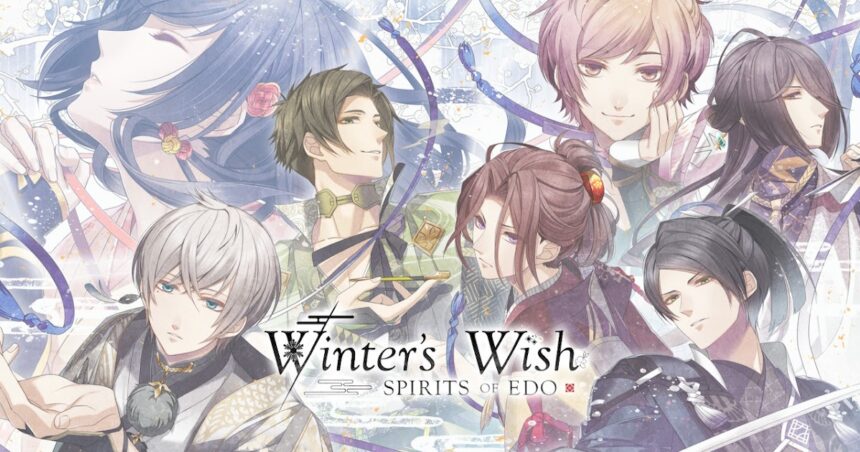
Winter’s Wish: Spirits of Edo begins with Suzuno living apart from the village that fears her. She can see emotional “Threads” around people, and black Threads warn of approaching calamity. When men from the shogunate’s secret Oniwaban arrive, that unwanted ability suddenly has a purpose. Edo is suffering repeated attacks from creatures called blightfall, born from accumulated negative emotions, and Suzuno can detect the warning signs that others cannot. Instead of asking me to forget how she was treated before reaching the city, the story lets that history follow her into a place where people finally need what she can do.
That made Suzuno more interesting to me than the basic setup suggested. She is kind and accommodating, but her eagerness to help rarely felt like simple heroine niceness. After being taught that other people’s fear could determine whether she deserved a place among them, of course she pays close attention to what everyone else is feeling. Her power turns that habit into something literal. The irony is that the six men she can romance are Vessels, non-human beings whose hearts and memories have been sealed, so she cannot read them the way she reads ordinary people. I liked what that does to her. She has to build trust without relying on the ability that has defined so much of her life.
The route structure reinforces that adjustment by sending Suzuno into one of three areas of Edo: Castle Town, Samurai Town, or the Entertainment District. Each area pairs her with two potential partners and carries its own local conflict before the individual romances take over. That gave my playthroughs more environmental and social variety than I expected from a six-route otome game. It also meant the men had time to exist beside each other before becoming the sole focus of a route, which helped their personalities feel connected to the Oniwaban as a group rather than arranged around Suzuno one at a time.
I did feel the cost of that structure after several routes. The shared rules surrounding Vessels, blightfall, sealed emotions, and the Oniwaban have to remain important no matter which pair I followed, and repetition eventually crept in. Some discoveries have much more force the first time the setting explains them. Later routes work best when they turn familiar rules toward a character-specific problem instead of pausing to remind me how the supernatural system functions.
The romances themselves benefit from the fact that the love interests are not simply supernatural men with different personalities. Their condition as Vessels affects what intimacy can mean. A relationship that would normally be framed as emotional progress can carry danger here because recovering a heart or buried memories changes what a Vessel is allowed to be. That gave affection an edge I appreciated. Getting closer to someone is not automatically safe just because the game is moving toward romance.
Suzuno also gets enough to do that I rarely felt as though I was only accompanying more capable characters. In some routes she actively trains to defend herself, while elsewhere her value comes through observation, decision-making, or her ability to recognize danger before the fighters around her can. I preferred that variation to making her suddenly competent at everything. Her usefulness grows, but it grows differently depending on the story being told.
The violence surprised me more than the action did. Winter’s Wish carries a Teen rating, yet its confrontations are willing to make injury and death feel unpleasant. Sword clashes are accompanied by cries of pain, blood can mark clothing or briefly hit the screen, and some deaths are communicated through text and sound rather than softened into vague offscreen consequences. I never thought the game was chasing shock value. What mattered was that the danger surrounding the Oniwaban did not evaporate whenever the story wanted to return to romance.
Visually, the game is much softer than that description might suggest. Team. Nagaoka’s character designs are detailed without becoming overly busy, and Suzuno’s changing clothes and appearance help her feel more present in her own story than a heroine represented by one fixed portrait would. I especially liked the way lighting and interface effects support her perception of Threads. When the supernatural intrudes, the presentation can shift the atmosphere quickly without needing a large animated sequence.
The CG illustrations do more of the dramatic heavy lifting. They reward particular story progress and give important scenes a sense of scale the standard portraits cannot provide. Across six romances, that matters because repeated dialogue framing could otherwise make separate routes blur together visually. The backgrounds and costume work also make the three districts easier to distinguish, so moving between Castle Town, Samurai Town, and the Entertainment District feels like more than selecting a different pair of names from a menu.
Voice acting contributes even more to that separation. Suzuno herself is unvoiced, but the main and supporting cast receive Japanese voices, including Yusuke Kobayashi as Tomonari Takamura, Tomoaki Maeno as Kunitaka Tojo, Seiichiro Yamashita as Yoichi, Takuya Sato as Genjuro Kuga, Daisuke Namikawa as Kinji, and Soma Saito as Ohtaro. Leaving Suzuno silent while everyone around her speaks creates the familiar otome balance between a defined protagonist and a role I can still partly inhabit. More importantly, the six performances keep characters with deliberately restricted emotions from sounding interchangeable.
The music is less assertive, but I liked that restraint. The opening theme, “Yure Yurare,” and ending theme, “Futaba,” are performed by manami*, with lyrics and composition by aya of LOVERIN TAMBURIN. The broader background score supports the historical fantasy mood without constantly pushing scenes toward grandeur. Since so much of the story already depends on hidden feelings, sealed hearts, and ominous Threads, I was glad the music usually gave those ideas room rather than insisting on the emotion for me.
One of my larger frustrations came from how long the game sometimes takes to reach a choice or a new piece of information. Winter’s Wish has plenty of worthwhile character material, but not every conversation needs the same amount of space. Route locking also means the larger mystery cannot be approached in any order I want. Certain paths only become available after completing earlier material, which makes sense for protecting later revelations but can make the overall structure feel more prescribed than the three-division setup initially suggests.
Even with that patience tax, I kept returning to Suzuno rather than the mystery as the reason to continue. Her ability begins as something other people use to define her. In Edo, it becomes valuable, but the better routes do not treat employment by the shogunate as an instant cure for years of rejection. She still has to learn that understanding everyone’s feelings does not mean carrying responsibility for all of them. Watching that change happen alongside the romances gave the game an emotional center stronger than its monsters.
That is where Winter’s Wish separated itself from the historical-fantasy otome games it initially reminded me of. The supernatural premise is busy, with blightfall, Formfolk, Vessels, divine powers, sealed memories, and gods all occupying the same setting. I did not find every piece equally memorable. What held it together was the recurring question of whether a person should be valued for what they can provide, for what they were made to be, or simply because they are a person. Suzuno and the Vessels approach that question from opposite directions, and the romances are strongest when they allow those directions to meet.
Verdict
Winter’s Wish: Spirits of Edo gave me more to care about than its familiar six-suitor structure initially promised. The three Oniwaban divisions create useful variety, the Vessel premise gives romance genuine stakes, and Suzuno’s movement from feared outsider to capable participant gives the larger story a strong emotional line. I was less enthusiastic about repeated worldbuilding and stretches of dialogue that delay the next meaningful development, especially across multiple routes. Still, the detailed art, strong Japanese cast, restrained music, and willingness to let danger remain dangerous made Edo worth returning to. I would recommend it most to otome players who enjoy route-heavy historical fantasy and are willing to accept a slower structure in exchange for a heroine whose growth matters as much as the men she can choose.