Route structure shapes a visual novel‘s pacing, replayability, and how satisfying its ending ultimately feels, and different studios have settled on genuinely different approaches to solving the same basic problem: how do you let a reader experience multiple character paths without the whole thing collapsing into narrative chaos. Understanding the major structural patterns helps explain why some visual novels feel tightly plotted while others feel more like a loose anthology of character-focused stories sharing a setting.
Parallel Independent Routes
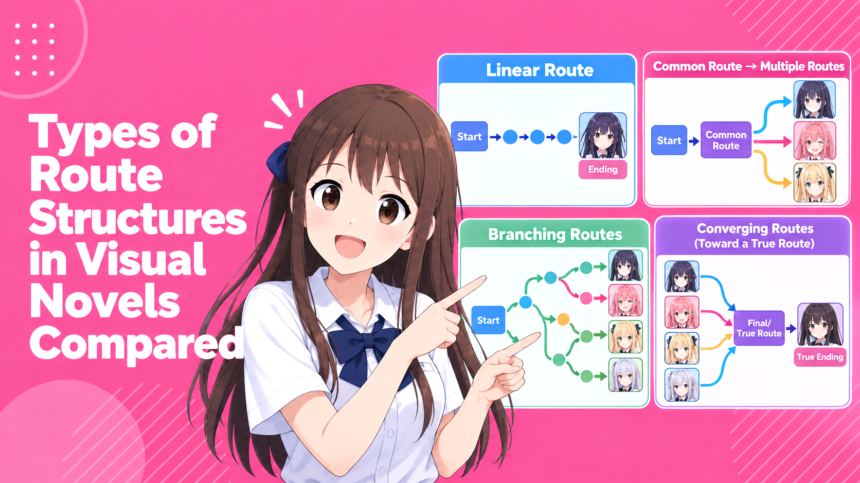
The most straightforward structure gives each heroine or major character their own fully independent route, branching off from a shared common route early in the story and rarely referencing events from other paths afterward. Each route functions close to a self-contained story, with its own arc, its own resolution, and minimal narrative dependency on which other routes a reader has or hasn’t completed.
This structure works particularly well for romance-focused visual novels where the appeal centers on spending dedicated time with a specific character rather than untangling an overarching plot. Reading order barely matters under this structure, since routes don’t build on each other in any meaningful way, and a reader can genuinely start with whichever character interests them most without missing context or spoiling later content.
The trade-off is that parallel routes can feel repetitive across a full playthrough, since the shared common route gets revisited multiple times and character interactions occasionally feel disconnected from a larger narrative purpose beyond the specific romance being told in that route.
True Route With Subroutes
A more structured approach uses individual character routes as building blocks toward a final true route that resolves the story’s central mystery or overarching conflict, typically requiring most or all character routes to be completed before the true route becomes accessible. Under this system, character routes aren’t fully self-contained. Each one plants clues, deepens world-building, or develops side characters in ways the true route later draws together and resolves.
This structure rewards patience and full completion far more than parallel independent routes do, since skipping ahead to the true route without reading the supporting character routes first usually means missing context the writers assumed a reader would already have. Route locks frequently enforce this requirement directly, preventing access to the true route until the game detects that other routes have been completed. The payoff for readers willing to commit to the full structure tends to be a much more satisfying, well-integrated ending than parallel route structures typically deliver, since every earlier route was written specifically to set up that final resolution.
Fake Routes
Some visual novels include what the community generally calls a fake route: a route that appears to be a genuine, fully resolved ending but is later revealed, either within the same playthrough or through a subsequent route, to be incomplete, misleading, or superseded by a deeper true ending. This exact terminology, and how strongly readers feel about it, comes up constantly in “what route structure do you prefer” threads on r/visualnovels. A fake route sometimes ends on an emotionally satisfying but ultimately hollow note specifically to set up a later revelation that recontextualizes everything the reader thought they understood about that earlier resolution.
This structure works as a deliberate narrative trick, using the reader’s assumption that they’ve reached a genuine ending against them to create a stronger impact once the true resolution eventually arrives. It requires careful pacing to avoid feeling like a cheap bait-and-switch, and visual novels that use fake routes well typically plant enough subtle hints during the fake ending that a rereading afterward reveals it was never meant to be fully trusted as final in the first place.
Sandbox and Map-Based Route Selection
Rather than a shared common route branching at a fixed point, some visual novels use a sandbox or map-based structure where readers freely choose which character to spend time with across a series of discrete time periods or story beats, building affection or story progress with multiple characters simultaneously rather than committing to one route at a time. Affection systems typically govern this structure directly, tracking accumulated points with each character across many small interactions rather than relying on a single major branching choice.
This approach gives readers a strong sense of control over pacing and can feel closer to an actual simulation of building relationships over time, but it comes with real risk of feeling like a chore if the underlying systems aren’t well tuned. Readers unsure which specific interactions raise affection with which character, without any way to check progress directly, sometimes end up relying heavily on external walkthroughs or checking a title’s own tags on VNDB just to reach a specific desired route, which undercuts the sense of organic choice the structure is meant to create in the first place. Flowcharts exposed directly within the game interface help mitigate this by showing a reader exactly where key decisions and progress points sit.
Sequential Unlock Systems
Some visual novels deliberately lock routes behind completing others in a specific required order, rather than leaving route order fully open to reader choice. This sacrifices some reader freedom in exchange for tighter authorial control over pacing, letting writers guarantee that a reader has absorbed specific context or emotional buildup before encountering a route that depends on it.
This structure works best in visual novels with strong narrative intent behind route ordering, where a specific sequence genuinely produces a better experience than any other order would. It works less well when the sequential requirement feels arbitrary rather than narratively justified, since forcing a specific order without a clear payoff for that structure mostly just reads as a restriction rather than a deliberate storytelling choice.
Kinetic Structure: No Routes at All
Not every visual novel uses branching routes in the first place. Kinetic novels remove choice entirely, delivering one single, fixed narrative path with no alternate routes, endings, or character-specific branches to navigate. This represents the opposite end of the spectrum from every structure discussed above, prioritizing a tightly controlled, singular authorial vision over reader-driven branching entirely.
This structure suits plot-driven, tightly plotted stories especially well, since a writer working without branching constraints can control pacing and reveal information with total precision, unconstrained by the need to accommodate multiple possible reader paths through the same narrative space. The trade-off is an obvious lack of replayability tied to alternate outcomes, though a well-written kinetic novel can still reward rereading purely for its prose and pacing rather than for discovering different content.
Common Route Plus Equal-Weight Character Routes
A structural variant that avoids designating any single true route treats every character path as carrying roughly equal narrative importance, with the shared common route serving mainly as setup rather than building toward one specific definitive ending. Under this approach, there’s no single “correct” final route a reader is meant to save for last, since each character path resolves its own arc completely without deferring the story’s real payoff to one specific path above the others.
This works well for ensemble-focused visual novels where the appeal lies in exploring a well-developed cast broadly rather than converging on one singular resolution. It asks less narrative patience from readers than a true-route structure does, since satisfaction doesn’t depend on completing every other route first, though it also sacrifices some of the layered payoff a well-executed true-route system can deliver to readers willing to see the full structure through.
How to Tell Which Structure a Specific Title Uses
Checking how endings actually work for a specific visual novel before starting, through community discussion on r/visualnovels or the game’s own marketing material, usually reveals which of these structures a given title is built around well before you’ve invested significant time into it. This matters because the right approach to route order, spoiler avoidance, and overall pacing expectations changes considerably depending on which structural category a specific game falls into, and going in with the wrong assumption about structure can lead to a genuinely worse experience than adjusting expectations upfront would have produced.
The Short Version
Visual novels handle route structure through several genuinely distinct approaches: parallel independent routes prioritizing reader freedom, true-route systems building toward one integrated final payoff, fake routes designed to subvert reader expectations, sandbox systems built around ongoing affection tracking, sequential unlocks enforcing deliberate pacing, kinetic structures removing branching entirely, and equal-weight ensemble routes avoiding any single definitive path. No single structure is inherently superior, and each serves different kinds of stories better than the others, which is exactly why the format has continued using such a wide range of approaches rather than settling on one dominant standard.