Welt is not the first thing the boy owns after waking. It is the first thing someone gives him. Before that, he is Ω1, a designation attached to the amnesiac survivor recovered after the 1952 Berlin Honkai Eruption. Einstein decides a number is not enough for a human being and calls him Welt, “world.” Tesla later supplies Joyce. Anti-Entropy keeps returning to that act of naming because Welt spends the rest of the story deciding whether an identity assembled by other people can still become genuinely his.
Research Lab 42 could easily have felt like another sinister laboratory waiting to reveal why its scientists cannot be trusted. Instead, Einstein’s first priority is convincing Welt that nobody there intends to treat him as a test subject. Her protectiveness is quiet and practical rather than sentimental, which made their early scenes much more effective for me. Welt wakes with extraordinary circumstances surrounding him but almost no understanding of himself, and Einstein gives him room to exist before demanding answers.
Tesla destroys any possibility of the lab becoming too serene. The morning after Welt arrives, she confronts him over food he ate without realizing it belonged to her, and their argument immediately gives Lab 42 the personality it needs. She is abrasive, impatient, brilliant, and much less interested than Einstein in making Welt comfortable before saying whatever is on her mind. The contrast between the two scientists becomes one of the visual novel’s strongest recurring pleasures. They care about many of the same things while behaving as though agreeing politely would constitute some kind of personal defeat.
That chemistry keeps the heavier science-fiction material readable once the story begins widening beyond Welt’s recovery. Honkai radiation, experimental countermeasures, Divine Keys, Schicksal, and increasingly dangerous encounters arrive quickly, but I rarely felt as though the cast disappeared behind the terminology. Tesla can turn a technical problem into an argument. Einstein can make the same problem feel like something to be patiently dismantled. Welt is usually caught between them, learning about the world at the same time he is learning what kind of person he wants to be inside it.
Reanna makes the danger surrounding that research tangible. When the group encounters a centipede-like Honkai beast near a radiation source, Tesla’s team uses anti-Honkai chemicals to create an opening and Reanna finishes the creature with Abyss Flower. The scene matters less to me as an action sequence than as proof of how casually these people operate around forces Welt barely understands. He is entering a world where scientific curiosity, military necessity, and supernatural destruction are already tangled together.
The Ninth Divine Key deepens that feeling. It is not introduced as a convenient weapon waiting for Welt to inherit it. Understanding what it is, what it can do, and why different factions care about it becomes part of the larger investigation. That keeps the artifact from feeling detached from the scientists studying it. In Anti-Entropy, weapons are usually also research problems, historical evidence, and political leverage.
The trip toward Manhattan is where the story began feeling much larger than Lab 42. Elaine Glaston appears injured on the road, bringing her own independent Honkai research into the group’s orbit. Her connection to Dr. Mikhail Morgan opens another branch of the scientific community, while Hellawes and Percival make that circle feel populated rather than conveniently empty until the main cast arrives. I liked how quickly these people developed their own rhythms with Einstein, Tesla, Reanna, and Welt. The expanding cast rarely feels like a queue of lore dispensers.
That matters because Anti-Entropy is ultimately about the people who will become associated with an organization, not merely the organization as an abstract faction. The title gains meaning gradually. I am watching relationships, disagreements, scientific convictions, and opposition to Schicksal accumulate before they harden into something recognizable as a movement.
Welt sits at the center without dominating every conversation. His amnesia gives him a reason to ask questions, but the story does not reduce him to a blank camera for franchise exposition. He is observant, emotionally restrained, and increasingly conscious that the scientists around him have given him more than medical safety. They have given him a context in which he can decide what his existence means.
The name becomes inseparable from that. “Welt” begins as Einstein solving the practical problem of Ω1 not being much of a human name. “Joyce” follows from Tesla. Neither woman can dictate what he eventually makes those names represent. That gradual transfer of ownership is more compelling than the usual amnesia mystery where the entire emotional payoff depends on discovering a forgotten birth identity.
The visual novel runs for twenty-six chapters, which gives that development enough space to feel earned. It moves briskly through scientific discoveries and escalating conflict, but the quieter scenes keep Welt from turning into a bundle of powers waiting for the plot to activate him. Meals, arguments, jokes, and small moments inside the lab do as much for his identity as any confrontation with Honkai.
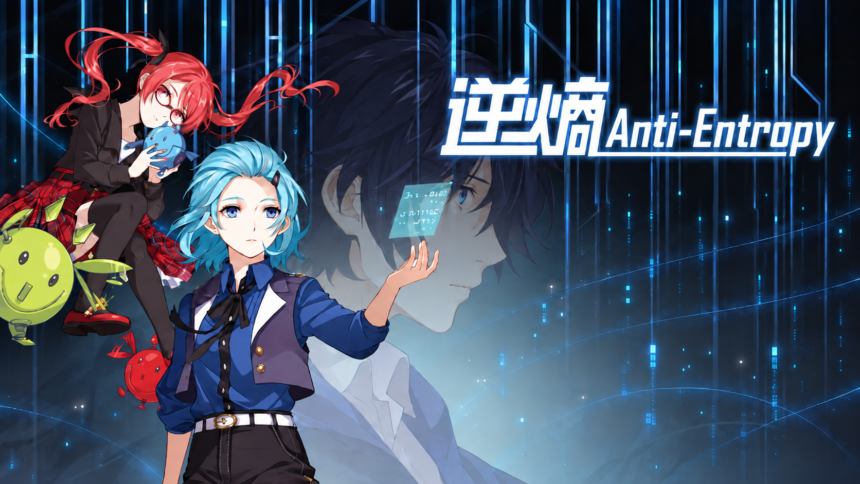
The presentation is comparatively simple, relying on character portraits, backgrounds, text, and occasional larger illustrations rather than elaborate animation. That never bothered me because the writing is strongest when two or three people are talking through a problem anyway. The character art carries enough expression to distinguish Tesla’s irritation from Einstein’s dry patience, and the scientific environments give the story a period-specific identity rather than looking like generic futuristic laboratories.
Anti-Entropy originally appeared in Chinese in 2017, with a Japanese version following in 2018. It belongs directly to the Honkai Impact 3rd continuity, and that connection is both its appeal and its barrier. The story explains its immediate scientific problems clearly enough, but names such as Schicksal, Honkai, Divine Keys, and the larger significance of these characters inevitably carry more weight if the surrounding universe is already familiar.
I still found Welt’s arc easy to hold onto because it is personal before it becomes historical. He begins as someone with no usable past, surrounded by people who know more about his body and circumstances than he does. By the time the story has widened into factions, powerful artifacts, and conflicts with consequences far beyond Lab 42, the question underneath remains surprisingly simple: what does a person owe to the people who helped create the life he now considers his own?
That is what stayed with me. Einstein and Tesla give Welt a name before he has enough history to understand what a name can mean. The rest of Anti-Entropy is him growing into it.
Verdict
Anti-Entropy works best as Welt Joyce’s slow ownership of an identity other people initially construct for him. Einstein and Tesla give the story its personality, while the expanding scientific conflict gives that personal arc real historical weight. The Honkai terminology can become dense, but the relationships keep the twenty-six chapters grounded.