A ruined city is easy shorthand for hopelessness. Empty streets, collapsed institutions, and people killing for whatever power remains can establish the mood before anyone says a word. I expected that machinery to do most of the work here. Instead, the longer I spent in Toshima, the more interested I became in the people trying to decide what was still worth holding onto inside it.
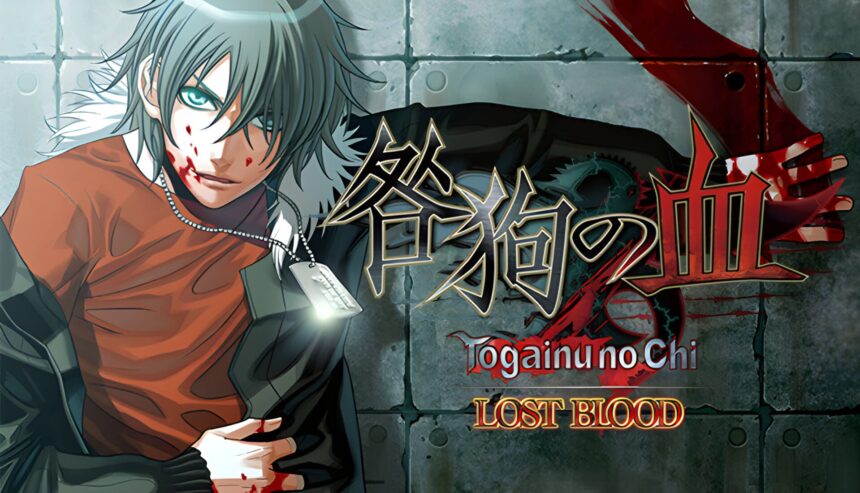
Togainu no Chi first appeared in Japan in 2005, while the official English release, Togainu no Chi ~Lost Blood~, arrived through JAST in 2020. Fifteen years is a substantial gap, but the age of the underlying game became less important to me once its central mystery started opening up. Nitro+CHiRAL built something that initially resembles straightforward dystopian action, then gradually uses its different routes to expose how much is hiding underneath that setup.
Akira enters the story already accustomed to violence. An undefeated champion in the street-fighting competition Bl@ster, he is arrested for a crime he did not commit and sentenced to life imprisonment. An unexpected offer gives him another option. If he enters Igra, a deadly competition operating in Toshima, and brings down the syndicate Vischio from within, he can regain his freedom. The premise gets him into the ruined district quickly, but I was more interested in how little his previous success prepared him for the people and forces controlling it.
Toshima itself helped enormously with that. Japan has been devastated by a third world war and divided between opposing powers, while the former Tokyo district has deteriorated into territory controlled by Vischio. Igra gives that instability a brutal structure, with competitors fighting for tags while Vischio’s drug trade hangs over much of what happens there. None of those ideas felt especially new to me individually. Their effectiveness came from how steadily the story connected them, revealing enough about the larger situation to keep me questioning what Akira had actually been sent into.
That becomes more rewarding once the routes begin separating. Keisuke, Rin, Motomi, Shiki, and Nano each pull Akira toward different parts of the story, and reading across them gave me context that one path alone could not. I liked having an actual reason to continue beyond seeing another relationship. Information that seemed incidental in one playthrough could matter considerably more once another character moved closer to the center.
Keisuke’s path hit especially hard because his long history with Akira gives their relationship emotional baggage before Toshima has a chance to change either of them. Rin brings a different energy to Akira’s time in the city, while Motomi’s older, more experienced presence offers another perspective on what Toshima has become. Shiki immediately introduces a far more hostile dynamic. I did not respond equally well to every direction those relationships took, but the differences between them kept the routes from feeling like the same romance rewritten around another character.
Nano is handled differently enough that I would rather leave his role there. By the time I reached that material, questions scattered across the rest of the story finally had enough context to make earlier scenes look different in retrospect. That was where the route structure paid off most for me. Togainu no Chi ~Lost Blood~ does not simply divide one narrative into several romantic options, it uses repeated playthroughs to gradually change how much I understand about the larger conflict.
Akira is an unusual center for all of this because he begins emotionally withdrawn rather than immediately charismatic. His skill in Bl@ster establishes that he can handle himself, yet his detachment makes the quieter relationship scenes as important as the confrontations surrounding them. I occasionally wanted more from him in conversations where another character seemed to be supplying most of the emotional momentum. Over time, though, that reserve became part of why small changes in his behavior registered so clearly.
The artwork carries some unmistakable signs of its original era, and I noticed variation between CGs and other pieces of 2D art more than I would in a visually uniform modern release. Tatana Kana contributed character artwork, while the broader credits include several additional 2D artists and graphics staff. Some images worked much better for me than others, but the overall design of Toshima and its cast has enough personality that the inconsistencies never became a serious obstacle.
Sound held together more consistently. Elephant Music and ZIZZ handled music production for the original PC release, with a soundtrack that moves between instrumental background pieces and vocal themes. The original soundtrack includes songs performed by HIDEKI and Kanako Ito alongside its BGM. I especially liked how much harder the more aggressive music could push Toshima’s atmosphere without requiring the prose to keep reminding me how dangerous the setting was.
The English release retains the original Japanese voice performances, and having the game fully voiced made a substantial difference across a story with this many routes. Kousuke Toriumi voices Akira, while the cast includes Hikaru Midorikawa as Shiki, Tomokazu Sugita as Keisuke, Jun Fukuyama as Rin, and Kazuya Ichijo as Motomi. The performances gave me another way to read characters whose dialogue could shift quickly between guarded conversation and much harsher exchanges, particularly when Akira himself remained deliberately restrained.
There is no getting around the tone, either. Togainu no Chi ~Lost Blood~ carries extensive warnings for disturbing subject matter, including severe violence, abuse, drug-related themes, and sexual material. I would not recommend going into it expecting its relationships to function like a conventional light romance. The darkness is deeply tied to Toshima and the people surviving there, and several stretches were deliberately uncomfortable rather than entertaining in the usual sense.
Even with that warning, the emotional material mattered more to me than the shock value. Keisuke’s connection to Akira, Motomi’s perspective on the city, and the questions surrounding Nano gave the bleak setting people and relationships worth caring about. I did not need every route to leave me satisfied in the same way. Having each one alter my understanding of Akira’s situation was enough to keep pulling me back through choices I had already seen from another direction.
Verdict
Togainu no Chi ~Lost Blood~ shows its age in places, and its ruined-city setup initially feels more familiar than distinctive, but its route structure gives that premise considerably more depth than I expected. Following Keisuke, Rin, Motomi, Shiki, and Nano exposes different pieces of Akira’s situation, while the Japanese performances and forceful soundtrack give Toshima an identity that survives the unevenness of some of its artwork. I had reservations about where certain relationships went, but uncovering the larger story across multiple paths kept me invested. Fifteen years after its original Japanese release, the official English version gave me a clear sense of why Nitro+CHiRAL kept returning to stories where relationships and darker psychological material are difficult to separate.