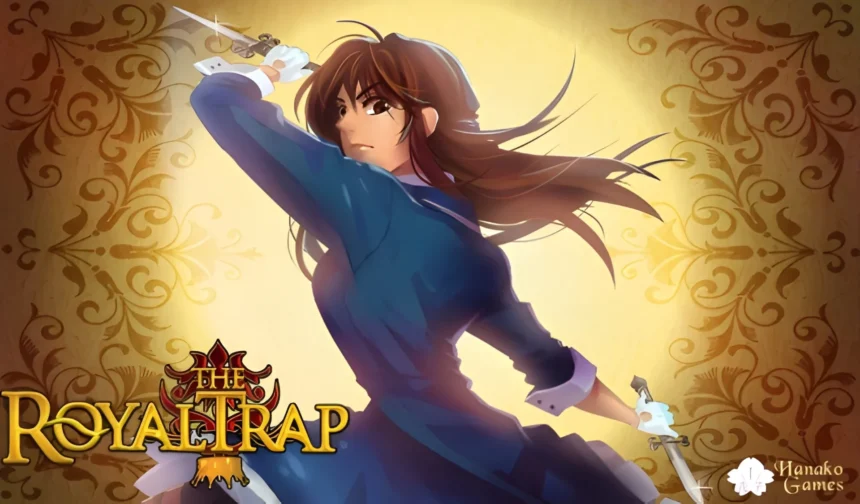
Madeleine Valois is a second daughter in a society that hands inheritance to firstborn women, which means she’ll never see a cent of her own family’s fortune no matter how well she does her job. That job happens to be keeping Prince Oscar of Ocendawyr out of trouble long enough to land him a royal bride, since a mere prince’s only real shot at ruling anything is marrying into a crown himself.
The Royal Trap, later reissued under the name The Confines of the Crown, sets up exactly that arrangement and then complicates it the moment the party celebrating Princess Cassidy of Gwellinor’s future coronation goes sideways. Cassidy disappears, her suitors start accusing each other of orchestrating the kidnapping, and Oscar ends up named the prime suspect almost immediately.
Hanako Games built this on the Ren’Py engine, the same studio behind Cute Knight and Long Live the Queen, releasing it worldwide on February 23, 2013 for Windows, Mac OS, and Linux. A DVD version followed that June with an HD upgrade and exclusive concept sketches. A 2015 Steam re-release added new background art, a higher resolution, and expanded content under the Confines of the Crown subtitle, a name Hanako eventually switched to using on its own by 2017.
The story runs across seven chapters that play out roughly the same regardless of choices for the first four, before splitting into four completely different plots starting at chapter five, one apiece for Oscar, Nazagi, Callum, and Gaston. Each of those branches contains its own set of endings depending on how Madeleine handles herself along the way, and progressing through the story steadily unlocks artwork viewable in a separate gallery.
Madeleine reads as far more than a standard advisor role thanks to the world she operates in, one where men rule but women inherit. Whoever the missing princess eventually chooses to marry will become the next king, and that stake gave Madeleine’s daggers and lock-picking skills a real political weight beyond just personal bodyguard duty.
Nazagi earned a reputation among the palace staff as someone to avoid, partly for being intimidating and asocial, partly for his work as a farmakeist. Some of the staff actually believed him to be a vampire and kept garlic on hand as a precaution. That palace wide unease gave every scene he appeared in a little extra tension before he’d even said anything.
The story keeps its title’s double meaning working on two levels at once, the literal trap set by royal politics and the more personal trap of being born into royalty in the first place. That second meaning takes on real weight once Cassidy’s own history, having been raised as the opposite gender from a young age, becomes part of the plot. Oscar’s status as the prime suspect kept every one of Madeleine’s choices feeling like they carried real consequences for someone other than just herself. Watching that pressure build across the shared opening chapters made the split into four separate routes at chapter five feel earned rather than arbitrary.
Yui Sumeragi’s character art holds the anime inspired visual identity through every chapter, while AQU’s event CGs mark the story’s bigger turns with detail sharp enough that unlocking new pieces in the gallery felt like an earned reward rather than an afterthought tacked onto the choice structure. Boossara composed the score, built largely around classical guitar work that gives the whole thing a period appropriate texture without leaning on anything more bombastic than the story needs. Matthew Myers wrote the opening theme separately, performed by Natasha Cox of the band Mankind Is Obsolete, and that original vocal track gave the game an identity right from the start that a lot of otome titles at this budget simply don’t bother reaching for.
Watching Madeleine try to hold the line on every rule she’d set for herself, only to watch each one crack a little further as the political stakes escalated, made her eventual choices feel earned rather than inevitable. The Royal Trap builds a distinctive world around its central romance, and that world ended up mattering to me just as much as whichever branch I finally landed on.
Verdict
A second daughter with nothing to inherit ends up holding more real political weight than most of the royals around her, and that inversion is what actually makes The Royal Trap work. Yui Sumeragi’s art and four distinct branching plots from chapter five onward give the story real replay value, and an original vocal theme from Natasha Cox gives it a level of polish a lot of otome titles at this scale skip entirely. The shared opening chapters ask for some patience before the story actually splits, but Madeleine’s own escalating stakes carry that stretch well enough to make the wait worth it.