
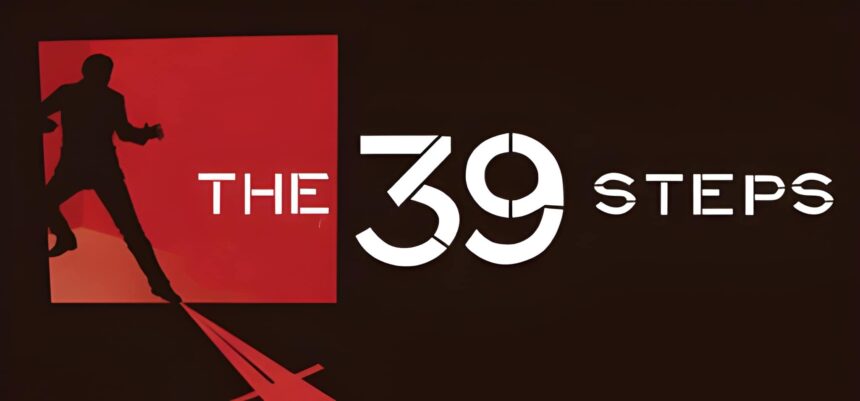
The Story Mechanics built this game around two named mechanics, Encounter and Recall. Encounter treats the core dialogue as theatrical performance delivered by purposely abstracted, almost silhouette-like figures, while Recall switches into a different visual register entirely whenever a character tells a story about their own past, sometimes rendered as period-appropriate silhouette plays true to 1914. The 39 Steps puts Richard Hannay through exactly that kind of framing, an engineer freshly back in London from years in Africa who gets pulled into a conspiracy the moment a stranger named Franklin Scudder dies in his own apartment. Framed for a murder he didn’t commit, Hannay has to escape the city and stay alive long enough to untangle a plot tied to a spy ring called the Black Stone, one with consequences reaching well beyond his own survival.
KISS Ltd published the game across PC, Mac, and iPad, with an Android version following, calling it their first ever digital adaptation, a label meant to separate the format from a standard visual novel or interactive audiobook.
The Story Mechanics built this as a direct adaptation of John Buchan’s 1915 novel, following the book’s own plot closely rather than the looser path Hitchcock’s famous film took with the same material. That fidelity means the story runs entirely linear, with no branching dialogue or alternate outcomes to chase, and I found that lack of choice suited a story this tightly plotted rather than working against it.
1914 Britain gets recreated with enough specificity, from London’s streets to the Scottish highlands Hannay eventually flees into, that the historical backdrop felt like an active participant in the story rather than dressing behind it. The story itself unfolds across a tight window in May and June of that year, right as tensions that would soon tip into world war were already simmering underneath the plot Hannay stumbles into.
Hannay himself holds the weight of an ordinary man forced into extraordinary circumstances. Watching his practical, engineer’s mindset clash against a conspiracy built on secrecy and misdirection gave the chase real texture beyond just running from place to place.
The novel’s own careful plotting survives the jump to an interactive format almost entirely intact, the actual nature of the Thirty-Nine Steps themselves staying exactly as tightly held here as it was on the page. Buchan’s story leans on a few outright far-fetched turns along the way, and the game doesn’t try to smooth those over, trusting the pace of the chase to pull a reader past any moment that asks for a little suspended disbelief.
Small puzzles punctuate the story between its heavier narrative stretches, notebooks to piece together and lines to draw across the screen to open locked doors. I appreciated the attempt to make Hannay’s escape feel more hands-on, though the door-opening sequences in particular added little beyond a brief pause in the pacing.
That abstraction runs through the visual style too. Characters stay deliberately indistinct, more suggestion than fully realized figure, which left real room for imagination the way reading the original novel would, and the minimalist approach kept focus on the story itself rather than trying to compete with the voice performances or the period setting for attention.
Nick Underwood carries the entire production as Richard Hannay, giving the character a specific, weary determination that held up across every chapter. Greg Hemphill, Robin Laing, and Benny Young round out a cast of professional voice actors leaning into a range of regional British accents, giving Hannay’s journey from London down into the Highlands a real sense of place scene to scene.
An original score tracks the story’s shifts in tension throughout, quiet during Hannay’s moments of planning and considerably more urgent whenever the chase catches back up to him.
Reaching the end of a story this openly indebted to spy fiction that came after it, including the James Bond novels it helped inspire, left me thinking hard about its influence. So much of the modern thriller playbook actually traces back to this exact chase. The 39 Steps treats its source material with real respect, adapting Buchan’s novel into an interactive format without losing what made the original worth adapting in the first place.
Verdict
Encounter and Recall give The 39 Steps a distinct shape among digital adaptations, treating Buchan’s novel as theatrical performance one moment and a story-within-a-story the next, faithful enough to the book, rather than the more famous film, that its century-old plotting carries the whole experience on its own. Nick Underwood’s lead performance and a detailed recreation of 1914 Britain sell the journey convincingly, even if a few clunky door-opening puzzles do little more than interrupt the pacing along the way.