
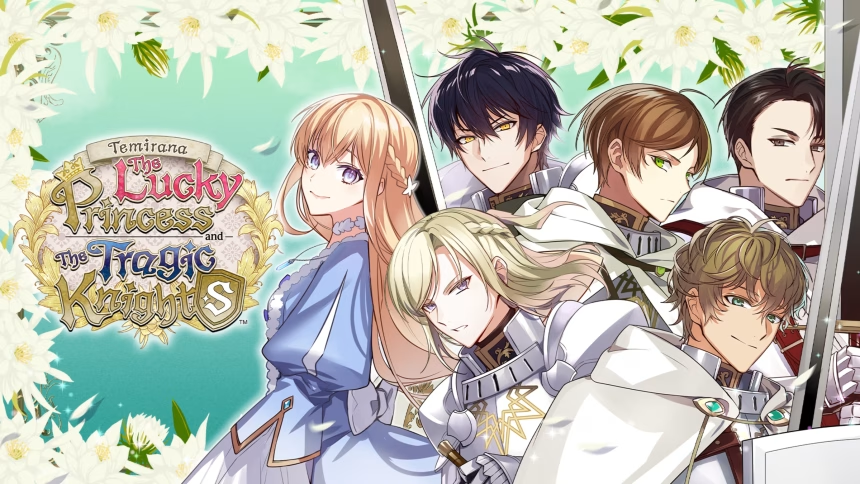
Status in Temirana comes down to one detail nobody chooses for themselves – the month a person happens to be born in. That single rule shapes everything from who gets a title to who gets treated as barely worth acknowledging. Cecilia Farias Temirana grows up on the wrong side of a different kind of arbitrary judgment, marked from birth by a birthmark that got her labeled the Cursed Princess and raised in a house well away from the rest of the royal family. Her two older sisters lead the resentment against her, and that specific, sustained unkindness from her own blood gives Temirana: The Lucky Princess and the Tragic Knights a family wound that runs deeper than the usual otome backstory device.
What actually protects Cecilia through all of this is a power everyone else reads as proof of the curse, a glow that surrounds people and places whenever she’s in real danger. She finally learns to trust that light instead of fearing it around her sixteenth birthday, at the Helis Duelm dueling tournament, where five men shine with a light unlike anything she’s seen warn her before. Against everyone’s advice, she invites all five into her own order of knights, and I liked how the game lets that decision read as reckless rather than automatically wise, since nothing about the setup guarantees she made the right call.
Josephy Cornelhild Zondarig, the ousted prince of a kingdom already fallen, now performs with a traveling troupe called the Marveil Circus, carrying pride and a stubborn will to rebuild a country that no longer technically exists. Tobias Harbeck Frey, a sickly noble who dreams of knighthood despite his health, keeps Kiya Nelty close as his own servant, an orphan whose memory has been gutted by loss he can’t fully account for. Adel Nares works his way up from the lower-class district of Samari Village as the eldest son in a poor family, chasing knighthood because of a book he read once and never forgot, and Milan Herring, a taciturn blacksmith who keeps a real weakness for sweets tucked under all that quiet, is hiding a family secret of his own. None of the five slot neatly into a stock archetype, and putting a prince stripped of his kingdom next to a farmer who’s never had one in the first place does real work showing how thoroughly Temirana’s birth-month caste system flattens everyone underneath it, Josephy included, who gets classified as a Commoner the moment his foreign birth outweighs his old royal blood.
Benetti Astella rounds out Cecilia’s circle as a small divine beast who acts as advisor, companion, and comic relief in roughly equal measure, and its running commentary on the knights gave me some of the lightest moments in a story that otherwise leans hard into grief and political maneuvering.
Ichicolumn developed the game under director Ayumi Takagi, known for Hana Yaka Nari and Waga Ichizoku, with Uta Amemiya writing the main scenario after Charade Maniacs and Nitaka, known for character work on Touken Ranbu, designing the cast. Idea Factory published it in Japan on April 27, 2023 under the Otomate label, and Idea Factory International brought it west to Nintendo Switch on January 13, 2026, digitally and physically in North America the same day, with the European physical release following on January 27.
Cecilia’s own portraits and backgrounds carry real detail, though a handful of the unlockable CG illustrations lean into an older, slightly dated style that reads more like an intentional throwback than a technical shortfall, and I wished a few of the supporting cast members who get real presence in the story got more art to match, since some of them stay voice-only where a portrait would have helped. The opening theme, Flower of Solares by Chisato Akita, sets a tone the rest of the fantasy-leaning score keeps up with, swelling into something grand during the political scenes and pulling back to something quieter whenever a route slows down for its characters to actually talk to each other.
Every knight and most of the supporting cast is fully voiced in Japanese, and the performances carry real range across five very different personalities, Josephy’s wounded pride, Tobias’s gentle stubbornness, Milan’s clipped reserve, all coming through clearly even before the dialogue spells out who’s talking. Cecilia herself stays unvoiced through the whole thing, which stood out to me more than I expected given how much weight the story puts on her as its center. Idea Factory International’s localization stays clean for the vast majority of a long, dense script, with only occasional typos scattered across the runtime, though a few lines here and there read flatter on the page than I suspect they landed in Japanese.
Five full knight routes branch out from a shared common route, each ending in more than one possible outcome depending on the choices made along the way, and a secret route opens up only after clearing the true ending on all five, tying threads from every individual story back together without restating any of them outright. The common route alone runs long enough, and covers enough of Temirana’s politics and family tension, that reaching any of the five branches already feels like an accomplishment rather than a formality to get through.
Cecilia spends the whole story carrying a specific kind of hurt, being hated by the people who were supposed to love her unconditionally, and watching her learn to extend real trust to five strangers before she can extend it back to her own family gave the story its strongest emotional throughline for me. That arc lands hardest in the quieter common-route scenes, long before any individual route locks in, where small, unglamorous moments of being chosen by someone do more work on her than any grand declaration could.
Verdict
Temirana: The Lucky Princess and the Tragic Knights takes a curse-to-blessing premise that could have stayed thin and gives it real weight through a caste system with actual teeth and five knights who each carry a version of the same outsider status Cecilia does. The unvoiced heroine and a handful of dated CGs keep it from being a flawless technical package, but the writing underneath, especially Cecilia’s slow relearning of trust, more than makes up for it. A warm, politically sharper than expected otome with a cast worth spending five routes and a secret sixth getting to know.