A customer can walk into the boutique asking for a particular kind of outfit, and the romance has to wait while the work gets done. Fabric, colour, garment type, and whatever requirements the client has set come first. Completing the commission earns gold, which feeds back into progression and keeps Joselina’s profession from becoming a decorative sentence in her character biography. Even the dialogue choices are less concerned with finding a hidden correct answer than with deciding what kind of woman Joselina is going to be. Fierce responses make her bolder and more openly flirtatious, while Kind responses lean toward restraint and thoughtfulness. Those choices accumulate toward different endings, but neither personality is treated as failure, and there are no bad endings waiting to punish the wrong tone.
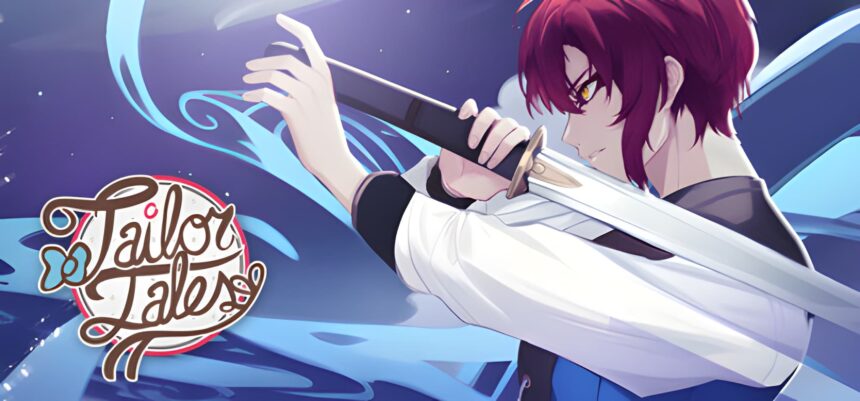
That combination of fashion work and character control is the foundation of Tailor Tales, Celianna’s independently developed otome about an aspiring designer running her own boutique in a fictional European country. Each love interest receives a completely separate story rather than branching away from one shared common route, so starting another romance can mean much more than meeting a different man. The genre, setting, history, and even the version of Joselina’s surrounding circumstances can change with him. That freedom lets the game move from comparatively grounded romance into superhero material, high-school gang history, online relationships, or historical fantasy without pretending all of those ideas belong to one continuous timeline.
Neil Forrester keeps things comparatively intimate. He and Joselina already crossed paths as children, when he ran away from parents whose expectations left little room for him to behave like the child he actually was. The encounter mattered enough to survive in Joselina’s memory, but adulthood does not reunite them on equal terms because Neil does not initially recognize who she is. That imbalance is what got to me. Joselina is trying to build a new relationship with someone who already belongs to an important memory of hers, while Neil gets to approach her without carrying the same history. Nothing dramatic has to happen for that to hurt. Remembering somebody who no longer recognizes the place they occupy in your past is enough.
Neil’s route benefits from being allowed to stay centered on that more personal problem because Tailor Tales does not need every bachelor to fit into the same overarching plot. Caine can pull the game somewhere completely different. He first appears as a college student after being left drunk at a party by his friends, while his larger story eventually brings in the superhero identity Boltage. Aiden’s route moves into another kind of adult relationship and makes extensive use of online communication. Gray reconnects with Joselina through their history as rival gang leaders during high school, while James inhabits a version of the world where superpowers are part of the premise. Eeyok shifts the game into an eighteenth-century fantasy involving nobility, execution, time reversal, and a heroine trying to prevent the future that already killed her once.
Instead of feeling like one enormous story stretching itself around increasingly incompatible love interests, Tailor Tales operates more like a collection of romance novels sharing a protagonist, fashion systems, and certain recurring ideas. That structure gives each bachelor enough room to have his own central conflict without needing to answer to years of accumulated common-route continuity. Seven love interests currently have released material: Neil, Dimitri, Caine, James, Gray, Aiden, and Eeyok. Zex is planned as the eighth route, beginning from a setup where his younger brother Calix breaks into Joselina’s boutique and Zex offers to repair the damage. Even before that route is complete, its premise follows the same pattern as the others by giving the relationship its own problem rather than squeezing Zex into another man’s storyline.
The scale of the completed routes helps explain why additions take so long. Tailor Tales has grown to around 800,000 words across its available material, while individual stories commonly reach well beyond 100,000 words. Eeyok’s route alone runs to roughly 178,000 words. These are not short alternate branches built from mostly shared scenes. Each romance has enough room to establish its own supporting cast, setting, and emotional problem, which is why the game can move so dramatically between genres without making every bachelor feel like a reskinned version of the same story.
Fashion provides the thread that survives those changes. Client commissions require Joselina to assemble clothing that matches requested criteria, and completing work earns gold used to continue progressing. The boutique can also be decorated, while Joselina herself can be dressed and customized. Her general avatar offers a broad selection of colours, including nineteen skin tones and twenty eye and hair colour options, while the version represented in CG artwork uses a smaller predefined set of skin, eye, and hair colours. Clothing selected for the normal avatar does not automatically replace the outfits drawn into CGs, which is understandable given how much route-specific illustrated material the game has accumulated.
That customization matters because Joselina is more defined than a silent blank-slate protagonist. Giving the player control over her tone and appearance supports a heroine who already has ambitions and opinions of her own. Fierce and Kind responses do not erase her core personality, but they let the player decide how openly she expresses it. That is a better fit for the fashion premise than a traditional affection system where every conversation becomes a hunt for the answer one bachelor wants to hear.
Partial voice acting adds another layer without attempting to perform hundreds of thousands of words. The love interests have credited performers, but the game does not accompany every line with speech. Character sprites instead carry much of the presentation, with blinking and mouth animation giving conversations more movement than completely static portraits. The CGs use similar animation touches, and each bachelor has dedicated illustrations tied to his story. Tailor Tales therefore puts most of its production weight where the project needs it repeatedly: characters, clothing, route-specific backgrounds, CGs, and the systems connecting the boutique to narrative progression.
Celianna handles the development and lead writing, with Pixanna publishing the Steam release. The core game remains free to play, while Tailor Tales Plus adds paid material around individual routes. Depending on the bachelor, that additional content can include side stories, epilogues, or material outside the free route. Aiden is the major exception to the usual free-route structure because only his opening chapters are available without Plus. That distinction has become more noticeable as the project has grown, but the amount of story available without payment is still substantial.
Tailor Tales began around a smaller initial roster and expanded as additional bachelors were added over time. The result no longer feels like a modest otome with a fashion minigame attached. It has become a long-running collection of separate romantic stories built on the same framework. The strongest reason for that framework to exist is still Joselina herself. Designing clothing gives her something to pursue that does not depend on romance, Fierce and Kind choices give her room to approach relationships differently without reducing personality to a correct affection answer, and separate routes let those choices play out against dramatically different kinds of men and stories.
Neil’s route makes the value of that structure especially clear because it does not need spectacle to give Joselina something difficult to navigate. His hospital work, their adult reunion, and the childhood encounter sitting unevenly between them are enough to create a relationship where the past matters differently depending on which person is looking at it. The ache comes from Joselina knowing that something important already happened between them while Neil effectively gets to meet her again for the first time. His failure to recognize her does not erase the memory she carried forward. It simply leaves her deciding what that memory should mean now that the person inside it has become somebody else.
That is a much quieter conflict than superheroes, time reversal, criminal suspicions, or fantasy bloodlines, but Tailor Tales has enough structural freedom to let all of those romances belong in the same project. It does not need every route to prove the same point. It only needs each one to give Joselina a relationship substantial enough to stand on its own.
Verdict
Tailor Tales has grown far beyond the simple idea of combining an otome with a clothing designer. The boutique gives Joselina an occupation that remains mechanically present, while Fierce and Kind choices let her personality change without turning every conversation into a hunt for the correct affection answer. More importantly, the lack of a common route lets Neil’s forgotten childhood connection, Caine’s superhero material, Eeyok’s historical fantasy, and the rest of the roster function as genuinely separate romances rather than variations on one storyline. The project is enormous now, and not every route is equally accessible through the free version, but the amount of finished material is difficult to dismiss. Neil’s route stayed with me for the simplest reason of all: Joselina remembers something between them that he does not, and rebuilding a relationship across that uneven memory gives their reunion more emotional weight than an ordinary meet-cute.