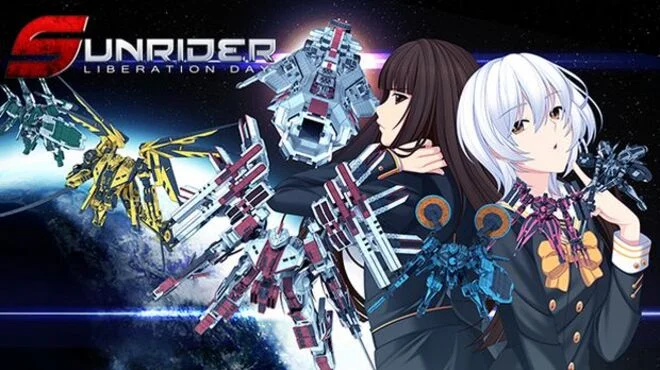
Sunrider: Liberation Day picks up captain Kayto Shields and his crew of Ryder mecha pilots right where Mask of Arcadius left off, pushing further into PACT territory after the faction’s failed bid to crush the Solar Alliance. Kayto steers the starship Sunrider on a one-ship mission of revenge, aiming to liberate his home planet of Cera from the People’s Alliance for Common Treatment. The deeper he pushes into PACT space, the more the mission turns up secrets nobody on his crew saw coming.
Love in Space built the game in Ren’Py as the third overall release in the Sunrider series, following Mask of Arcadius in 2014 and the non canonical high school spinoff Sunrider Academy in 2015. Liberation Day itself stands as the second chapter in the main canonical story. Sam Yang, the studio’s president, directs the series, and the whole franchise traces back to a Kickstarter campaign that raised more than fourteen times its original funding goal. A fourth entry, Sunrider: The Captain’s Return, has been in development since, carrying the story forward past where this chapter leaves off.
Turn-based tactical battles alternate with lengthy story segments here, playing out on a hex grid where energy weapons like lasers and pulse cannons lose accuracy the farther they fire while kinetic weapons scale up more reliably with upgrades, forcing real decisions about which Ryder to bring into which fight. Mercenary ships can be hired to round out a squad, though the core Ryder roster itself carries over unchanged from Mask of Arcadius rather than expanding with new playable mechs. Save data imports directly from that first game too, and for readers who want the story without wrestling the tactical layer, a lower difficulty option labeled waifu mode strips back the challenge without cutting any of the actual narrative. Losing a fight for real means real consequences rather than just sending a reader back to try again with nothing learned.
The version available now goes under the Captain’s Edition name, and that name change traces back to how rocky the original launch actually was. Sam Yang has said directly that the initial release didn’t go as planned. Part of the confusion came down to Love in Space never clarifying on Steam, the way they had on Kickstarter, that Liberation Day was only meant to be roughly the halfway point of a much longer planned story rather than a final ending. Two major patches followed, and after the second one landed, Captain’s Edition became the name the game shipped under everywhere, with a full version 2.0 update adding roughly twenty to thirty minutes of additional story and several new choices onto the ending.
A separate, non-canon scenario called [Re]turn came bundled in later as well, giving the game a second, self-contained story to dig into once the main campaign wraps.
Asaga holds onto a partially awakened set of Ryuvian royal abilities that let her move faster than the situation should physically allow. Ava handles nearly everything by the book, in a way that puts her at odds with Icari, a mercenary who trusts procedure about as far as she can throw it. Chigara sits apart from all three of them, tied by blood to the same clone army responsible for PACT’s advanced Prototype pilots, and watching Asaga and Ava grow suspicious of her for exactly that resemblance gave every scene the three of them shared a real undercurrent of tension. The rest of the bridge crew rounds out around them, Admiral Grey, Claude, Cosette, Fontana, Kryska, and Sola each filling their own place among a cast this large without any of them reading as an afterthought.
One of Kayto’s own crew turns out to be feeding PACT information on the Sunrider’s movements the entire time, and the story lets that suspicion fall on more than one plausible candidate before settling anything. Watching the crew’s trust in each other erode over false suspicion did more damage to the ship’s morale than any single battle in the campaign, and that slow unraveling of trust between people who’d already fought and bled together stuck with me longer than the actual reveal did.
Character art takes a clear step up from Mask of Arcadius, sharper and more detailed across both the story scenes and the tactical battle screens. That improvement shows most in how much easier it became to track individual Ryders mid-fight, once the sprites stopped blending together the way they sometimes did in the first game. Piloted mechs like the Nightmare Ascendant and the gravity gun equipped Bianca carry enough visual and mechanical identity of their own that recognizing a specific Ryder mid-battle never came down to guesswork.
Full Japanese voice acting covers the entire main cast. Sakura Matsuri voices Asaga, Hanamura Ao voices Ava, Haruna Ren voices Icari, and Yomogi Kasumi voices Chigara, with Koshi Yukimitsu, Murasaki Nina, Hayase Yayoi, Oshita Kota, Yumeno Usagi, and Nakase Hina rounding out Admiral Grey, Claude, Cosette, Fontana, Kryska, and Sola respectively. A Japanese theme song plays over the opening too, sold separately as its own item alongside the base game and the bundled copy of Sunrider Academy that comes packaged with it. Hearing Asaga’s more clipped, formal delivery against Icari’s rougher edge sold their opposing personalities faster than the dialogue alone would have managed.
Love in Space first released the game on Steam on March 4, 2016, with a GOG version following on May 22, 2018, requiring a 64-bit operating system on the PC side. Its own storefront listing flags nudity, sexual content, and general mature material, worth a brief mention without dwelling on it further given the site’s focus. Playing Mask of Arcadius first isn’t strictly required but comes recommended directly from the developer, since Liberation Day leans on relationships and stakes that first campaign spent hours building.
By the time the campaign closes in on the Helion front, the mission Kayto started as a straightforward push for revenge had turned into something he clearly wasn’t fully prepared to handle. Reaching the expanded ending built from the Captain’s Edition update’s added story gave the whole campaign a real sense of closure. Love in Space has said that ending was always meant to function as roughly the midpoint of a much larger planned story, not a final stopping point, and the studio’s continued work on a fourth entry backs that framing up.
Verdict
Kayto’s crew starts Liberation Day chasing a straightforward revenge mission and ends up hunting a spy in their own ranks instead, the two threads tangled together tightly enough that neither one ever fully overshadows the other. Asaga, Ava, Icari, and Chigara carry that unraveling trust with real weight, backed by a clear step up in art quality from the first game, hex based tactics with real teeth, and a full Japanese cast that sells the tension in scenes dialogue alone wouldn’t quite manage. The Captain’s Edition update turned a rocky launch into an ending that actually earns its closure, which matters more here than it would in a story with less riding on how it wraps up.